Review
. 2017 May 31;5(2):6.
doi: 10.3390/jdb5020006.

Sonic Hedgehog Signaling and Development of the Dentition

Affiliations
Review

Sonic Hedgehog Signaling and Development of the Dentition

Maisa Seppala et al. J Dev Biol. .

Abstract

Sonic hedgehog (Shh) is an essential signaling peptide required for normal embryonic development. It represents a highly-conserved marker of odontogenesis amongst the toothed vertebrates. Signal transduction is involved in early specification of the tooth-forming epithelium in the oral cavity, and, ultimately, in defining tooth number within the established dentition. Shh also promotes the morphogenetic movement of epithelial cells in the early tooth bud, and influences cell cycle regulation, morphogenesis, and differentiation in the tooth germ. More recently, Shh has been identified as a stem cell regulator in the continuously erupting incisors of mice. Here, we review contemporary data relating to the role of Shh in odontogenesis, focusing on tooth development in mammals and cartilaginous fishes. We also describe the multiple actions of this signaling protein at the cellular level.

Keywords: dental mesenchymal stem cells; initiation; odontogenesis; patterning; tooth number.


Conflict of interest statement

The authors declare no conflict of interest.

Figures
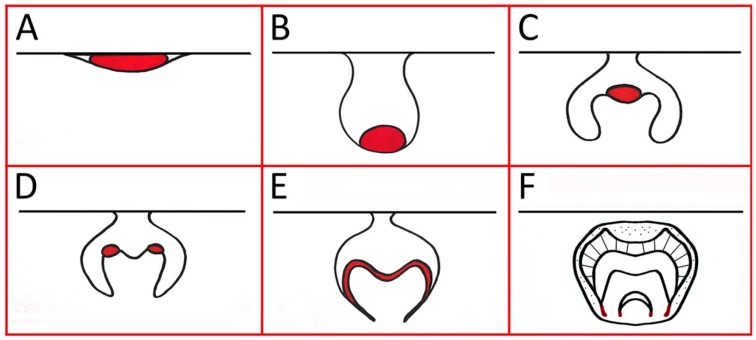
Figure 1
Figure 1
Schematic representation of Shh transcription in the developing tooth (red). (A) Initiation; (B) Early bud stage (at the tip of the bud in enamel knot precursor cells); (C) Early cap stage (in the primary enamel knot); (D) Late cap stage (in the secondary enamel knots); (E) Bell stage (in the internal enamel epithelium, pre-ameloblasts and stratum intermedium); (F) During root development (in Hertwig’s epithelial root sheath).
Figure 2
Figure 2
A simple diagrammatic representation of the (known) key events in Shh signaling at the primary cilium. In the absence of signal (OFF), Ptch1 accumulates at the ciliary membrane and represses Smo. GLI proteins are sequestered by Kif7 and Suppressor-of-fused (SuFu), and phosphorylated through the activity of Gpr161, PKA, CK1 and GSK3B. The phosphorylated GLI proteins are proteolytically processed into truncated repressor forms, which act to inhibit transcriptional activation of the pathway. The signaling pathway is activated (ON) through the binding of Shh to Ptch1, which is facilitated by Cdo, Boc and Gas1 co-receptors. The receptor complex is internalized and degraded, which leads to the accumulation of Smo in the ciliary membrane, where it is phosphorylated and interacts with Ellis-van Creveld (EvC) proteins in the basal component of the cilium. The Kif7, SuFu, and GLI complex moves to the tip of the cilium where GLI is concentrated and then transported back to the cytosol where it enters the nucleus as a full length activator of transcriptional targets.
Figure 3
Figure 3
Disrupted Shh signaling and early tooth development. (AC) Para-sagittal sections of the developing maxillary and mandibular molar dentition in (A) E16.5 Wild type; (B) E16.5 CreER™; Shh mutant; (C) E15.5 Gas1 mutant embryos. In the wild type embryo, the first molars (m1) are at the late cap/early bell stage of development and the second molars (m2) are at the early cap stage. In CreER™; Shh mutant embryos, Shh signaling has been abrogated from E10.5 following the administration of Tamoxifen, with fusion between the first and second mandibular molars (m1/m2). In the Gas 1 mutant, m1 are at the late cap stage and the m2 tooth germs are just beginning to form an early cap. However, a supernumerary premolar tooth (sn) is present in mesial to m1 in both quadrants.
Figure 4
Figure 4
Conserved shh expression in shark tooth initiation and successional morphogenesis. Expression of shh in the odontogenic band marks the onset of dental competence in the shark (Scyliorhinus stellaris) lower jaw (A) and upper jaw (B). Development of the first tooth and subsequent morphogenesis in Scyliorhinus canicula is superficial with shh expression restricted to the dental epithelium at the apical cusp, lower jaw (C) and upper jaw (D). Dental lamina epithelium continues to invaginate lingual to the first tooth, from which new successional teeth will develop in the lower jaw (E) and upper jaw (F). New successional teeth in the shark continue to express shh during morphogenesis (E,F). Note shh is not expressed in the epithelial dental lamina away from developing teeth, and its expression is restricted to the enamel knot-like cells at the apex of each new tooth throughout morphogenesis. False colour, (magenta) gene expression; nuclear counterstain DAPI (white).

References

    1. Briscoe J., Therond P.P. The mechanisms of hedgehog signalling and its roles in development and disease. Nat. Rev. Mol. Cell Biol. 2013;14:418–431. doi: 10.1038/nrm3598. - DOI - PubMed
    1. Ingham P.W., McMahon A.P. Hedgehog signaling in animal development: Paradigms and principles. Genes Dev. 2001;15:3059–3087. doi: 10.1101/gad.938601. - DOI - PubMed
    1. Xavier G.M., Seppala M., Barrell W., Birjandi A.A., Geoghegan F., Cobourne M.T. Hedgehog receptor function during craniofacial development. Dev. Biol. 2016;415:198–215. doi: 10.1016/j.ydbio.2016.02.009. - DOI - PubMed
    1. Buchtova M., Handrigan G.R., Tucker A.S., Lozanoff S., Town L., Fu K., Diewert V.M., Wicking C., Richman J.M. Initiation and patterning of the snake dentition are dependent on sonic hedgehog signaling. Dev. Biol. 2008;319:132–145. doi: 10.1016/j.ydbio.2008.03.004. - DOI - PubMed
    1. Handrigan G.R., Richman J.M. Autocrine and paracrine shh signaling are necessary for tooth morphogenesis, but not tooth replacement in snakes and lizards (squamata) Dev. Biol. 2010;337:171–186. doi: 10.1016/j.ydbio.2009.10.020. - DOI - PubMed

LinkOut - more resources
