. 2018 Apr 3;8(1):5467.
doi: 10.1038/s41598-018-23766-9.

Centrifugation-free extraction of circulating nucleic acids using immiscible liquid under vacuum pressure

Affiliations

Centrifugation-free extraction of circulating nucleic acids using immiscible liquid under vacuum pressure

Hoyoon Lee et al. Sci Rep. .

Abstract

Extraction of cell-free DNA (cfDNA), which exists at an extremely low concentration in plasma, is a critical process for either targeted-sensing or massive sequencing of DNAs. However, such small amount of DNA cannot be fully obtained without high-speed centrifugation (<20,000 g). Here, we developed a centrifugation-free cfDNA extraction method and system that utilizes an immiscible solvent under single low vacuum pressure throughout the entire process. It has been named Pressure and Immiscibility-Based EXtraction (PIBEX). The amounts of extracted cfDNA by PIBEX were compared with those extracted by the conventional gold standards such as QIAGEN using quantitative PCR (qPCR). The PIBEX system showed equal performance regarding extraction amount and efficiency compared to the existing method. Because the PIBEX eliminates the troublous and repetitive centrifugation processes in DNA extraction, it can be further utilized in microfluidic-sample preparation systems for circulating nucleic acids, which would lead to an integrated sample-to-answer system in liquid biopsies.


Conflict of interest statement

The authors declare no competing interests.

Figures
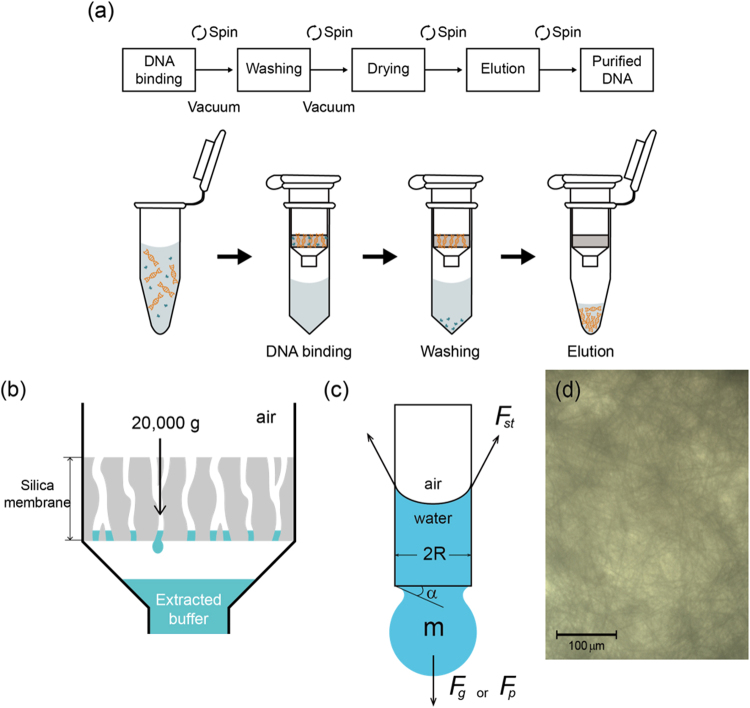
Figure 1
Figure 1
Conventional cfDNA extraction method using centrifugation. (a) Workflow of conventional cfDNA extraction using centrifugation. (b) Schematic to spin out last residual elution buffer in silica membrane with extremely high g force (20,000 g). (c) Force balance in a capillary of silica membrane between surface tension force of elution buffer (Fst) and gravity force (Fg) or pressure force (Fp), with capillary radius R, angle of droplet neck α, and droplet mass m. (d) Microscopic picture of silica membrane. The scale bar indicates 100 μm.
Figure 2
Figure 2
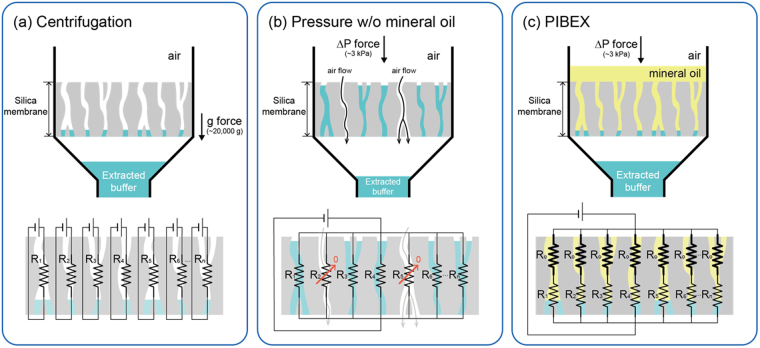
Comparison of extraction mechanisms (a) centrifugation, (b) pressure without immiscible solvent, and (c) pressure with immiscible solvent: PIBEX. The corresponding electrical circuits of each mechanism are depicted. Rn and Ro are the hydrodynamic resistances of elution buffer and mineral oil through each channel in the silica membrane, respectively (Ro ≫ Rn). R2 and R5 in (b) become negligible owing to air flow. Electrical power corresponds to each driving force.
Figure 3
Figure 3
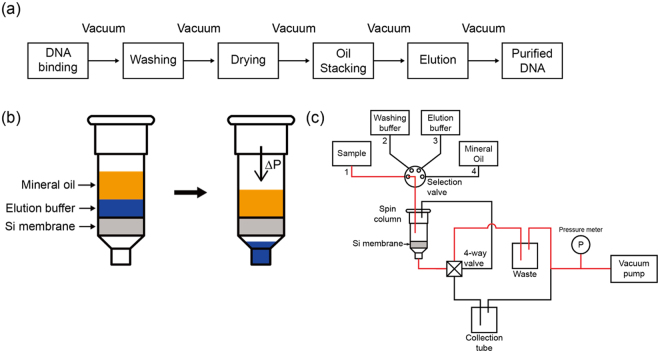
Schematic of PIBEX. (a) Workflow for cfDNA extraction by PIBEX. (b) Extraction of elution buffer, using immiscible solvent (mineral oil) above the elution buffer layer. (c) Schematics of flow channels and valves in PIBEX. The red line represents connected channel.
Figure 4
Figure 4
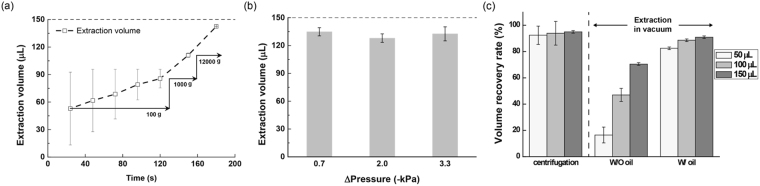
Increase of extraction volume, using vacuum pressure and immiscible solvent. (a) Extraction volume of elution buffer in centrifugation with high g force. The error bar is a standard deviation (n = 5). (b) Extraction volume of PIBEX with low vacuum pressure in the range of 0.7–3.3 kPa. The error bar represents a standard deviation (n = 3). Dotted lines in (a) and (b) represent the input volume of elution buffer: 150 μL. (c) Volume recovery rate in cases of centrifugation, vacuum driven extraction without oil, and vacuum driven extraction with oil: PIBEX with different input elution buffer volumes, 50, 100, and 150 μm. The error bar represents a standard deviation (n = 3).
Figure 5
Figure 5
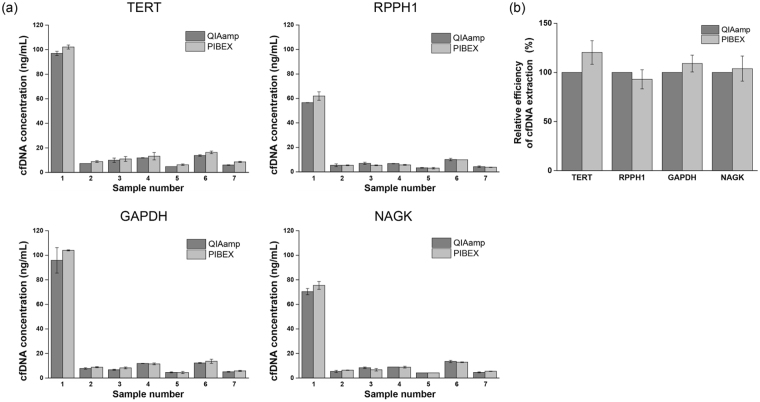
Comparison of extracted cfDNA concentration in qPCR assay. cfDNA concentration in a plasma sample was compared according to extraction methods, QIAamp and PIBEX. cfDNA amount in plasma sample was quantified by qPCR in four reference genes, TERT, RPPH1, GAPDH, and NAGK, in (a). The error bar represents standard deviation of triplex qPCR assay in a sample. The relative efficiency of cfDNA extraction in PIBEX was derived based on QIAamp in (b). The error bar is standard deviation of samples (n = 7).

References

    1. Ziegler A, Koch A, Krockenberger K, Großhennig A. Personalized medicine using DNA biomarkers: a review. Human genetics. 2012;131:1627–1638. doi: 10.1007/s00439-012-1188-9. - DOI - PMC - PubMed
    1. Sidransky D. Nucleic acid-based methods for the detection of cancer. Science. 1997;278:1054–1058. doi: 10.1126/science.278.5340.1054. - DOI - PubMed
    1. Schwarzenbach H, Hoon DS, Pantel K. Cell-free nucleic acids as biomarkers in cancer patients. Nature Reviews. Cancer. 2011;11:426–437. doi: 10.1038/nrc3066. - DOI - PubMed
    1. Lo YD, et al. Digital PCR for the molecular detection of fetal chromosomal aneuploidy. Proceedings of the National Academy of Sciences. 2007;104:13116–13121. doi: 10.1073/pnas.0705765104. - DOI - PMC - PubMed
    1. Allyse M, et al. Non-invasive prenatal testing: a review of international implementation and challenges. International Journal of Women’s Health. 2015;7:113–126. doi: 10.2147/IJWH.S67124. - DOI - PMC - PubMed

Publication types