


Four Weekly Ayahuasca Sessions Lead to Increases in "Acceptance" Capacities: A Comparison Study With a Standard 8-Week Mindfulness Training Program
- PMID: 29615905
- PMCID: PMC5869920
- DOI: 10.3389/fphar.2018.00224
Four Weekly Ayahuasca Sessions Lead to Increases in "Acceptance" Capacities: A Comparison Study With a Standard 8-Week Mindfulness Training Program
Erratum in
-
Corrigendum: Four Weekly Ayahuasca Sessions Lead to Increases in "Acceptance" Capacities: A Comparison Study with a Standard 8-Week Mindfulness Training Program.Front Pharmacol. 2021 Jan 21;11:635111. doi: 10.3389/fphar.2020.635111. eCollection 2020. Front Pharmacol. 2021. PMID: 33551823 Free PMC article.
Abstract
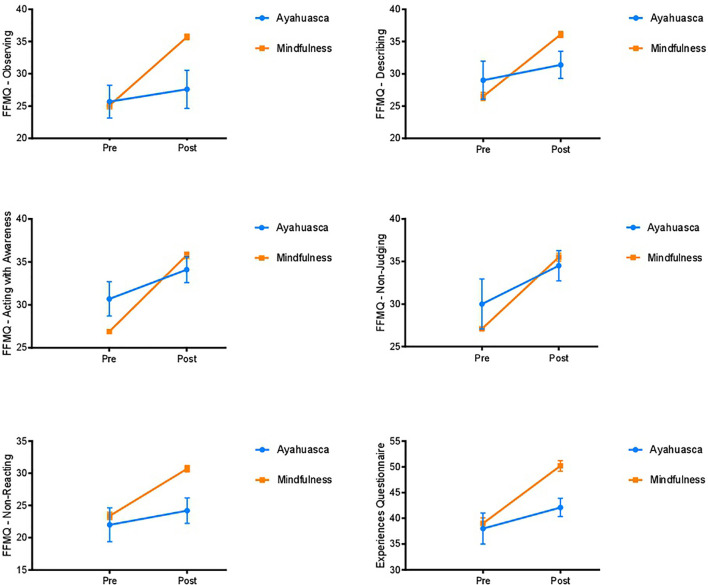
Background: The therapeutic effects of the Amazonian plant tea ayahuasca may relate to its ability to enhance mindfulness capacities. Ayahuasca induces a modified state of awareness through the combined action of its active principles: the psychedelic N,N-dimethyltryptamine (DMT) and a series of centrally acting β-carbolines, mainly harmine and tetrahydroharmine. To better understand the therapeutic potential of ayahuasca, here we compared the impact on mindfulness capacities induced by two independent interventions: (a) participation in four ayahuasca sessions without any specific purpose related to improving mindfulness capacities; and (b) participation in a standard mindfulness training course: 8 weeks mindfulness-based stress reduction (MBSR), with the specific goal of improving these skills. Methods: Participants of two independent groups completed two self-report instruments: The Five Facet Mindfulness Questionnaire (FFMQ) and the Experiences Questionnaire (EQ). The MINDSENS Composite Index was also calculated, including those EQ and FFMQ items that have proven to be the most sensitive to meditation practice. Group A (n = 10) was assessed before and after the last of four closely spaced consecutive ayahuasca sessions. Group B (n = 10) was assessed before and after completion of a standard 8-week MBSR course. Results: MBSR training led to greater increases in overall mindfulness scores after the 8-week period. MBSR but not ayahuasca led to increases in the MINDSENS Composite Index. However, the ayahuasca sessions induced comparable increases in the Non-Judging subscale of the FFMQ, specifically measuring "acceptance." Improving this capacity allows for a more detached and less judgmental stance toward potentially distressing thoughts and emotions. Results: The present findings suggest that a small number of ayahuasca sessions can be as effective at improving acceptance as more lengthy and costly interventions. Future studies should address the benefits of combining ayahuasca administration with mindfulness-based interventions. This will allow us to investigate if ayahuasca will improve the outcome of psychotherapeutic interventions.
Keywords: Non-Judging; acceptance; ayahuasca; human; mindfulness.
Figures
References
-
- Bishop S. R., Lau M., Shapiro S., Carlson L., Anderson N. D., Carmody J., et al. (2004). Mindfulness: a proposed operational definition. Clin. Psychol. Sci. Pract. 11 230–241. 10.1093/clipsy.bph077 - DOI
LinkOut - more resources
Full Text Sources
Other Literature Sources
