. 2018 Mar 19:9:188.
doi: 10.3389/fphys.2018.00188. eCollection 2018.

Skeletal Muscle Pyruvate Dehydrogenase Phosphorylation and Lactate Accumulation During Sprint Exercise in Normoxia and Severe Acute Hypoxia: Effects of Antioxidants

Affiliations

Skeletal Muscle Pyruvate Dehydrogenase Phosphorylation and Lactate Accumulation During Sprint Exercise in Normoxia and Severe Acute Hypoxia: Effects of Antioxidants

David Morales-Alamo et al. Front Physiol. .

Abstract

Compared to normoxia, during sprint exercise in severe acute hypoxia the glycolytic rate is increased leading to greater lactate accumulation, acidification, and oxidative stress. To determine the role played by pyruvate dehydrogenase (PDH) activation and reactive nitrogen and oxygen species (RNOS) in muscle lactate accumulation, nine volunteers performed a single 30-s sprint (Wingate test) on four occasions: two after the ingestion of placebo and another two following the intake of antioxidants, while breathing either hypoxic gas (PIO2 = 75 mmHg) or room air (PIO2 = 143 mmHg). Vastus lateralis muscle biopsies were obtained before, immediately after, 30 and 120 min post-sprint. Antioxidants reduced the glycolytic rate without altering performance or VO2. Immediately after the sprints, Ser293- and Ser300-PDH-E1α phosphorylations were reduced to similar levels in all conditions (~66 and 91%, respectively). However, 30 min into recovery Ser293-PDH-E1α phosphorylation reached pre-exercise values while Ser300-PDH-E1α was still reduced by 44%. Thirty minutes after the sprint Ser293-PDH-E1α phosphorylation was greater with antioxidants, resulting in 74% higher muscle lactate concentration. Changes in Ser293 and Ser300-PDH-E1α phosphorylation from pre to immediately after the sprints were linearly related after placebo (r = 0.74, P < 0.001; n = 18), but not after antioxidants ingestion (r = 0.35, P = 0.15). In summary, lactate accumulation during sprint exercise in severe acute hypoxia is not caused by a reduced activation of the PDH. The ingestion of antioxidants is associated with increased PDH re-phosphorylation and slower elimination of muscle lactate during the recovery period. Ser293 re-phosphorylates at a faster rate than Ser300-PDH-E1α during the recovery period, suggesting slightly different regulatory mechanisms.

Keywords: PDH; human; hypoxia; oxidative stress; pyruvate dehydrogenase; skeletal muscle; sprint exercise.


Figures
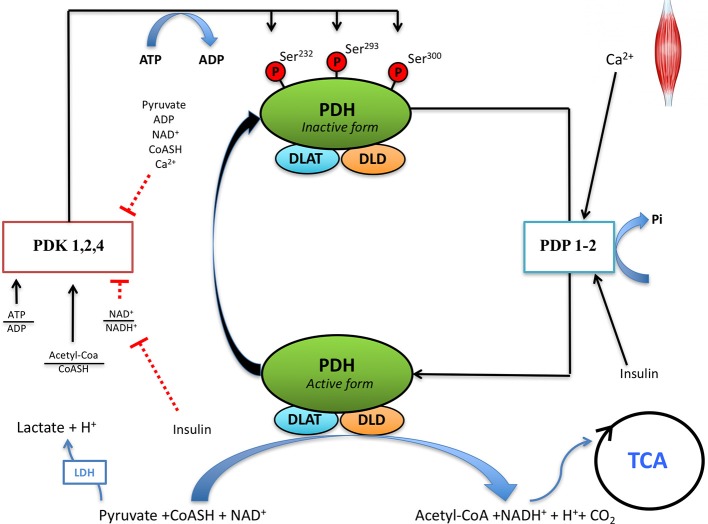
Figure 1
Figure 1
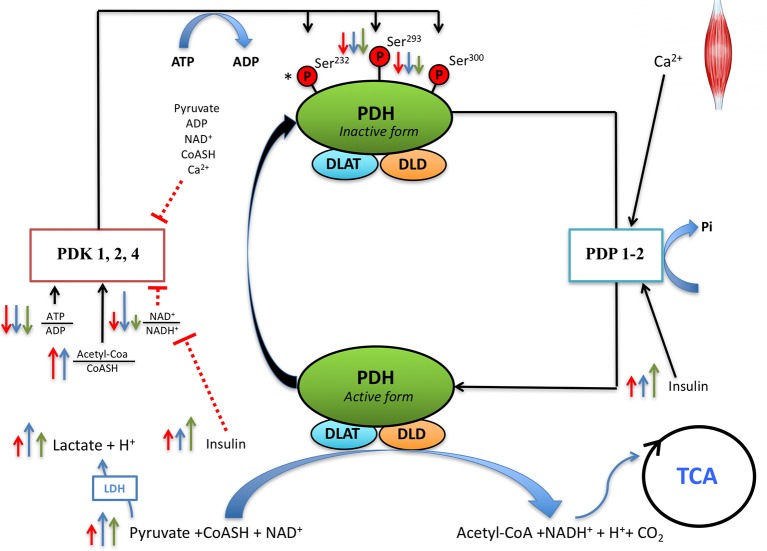
Regulation of pyruvate dehydrogenase (PDH) activity in skeletal muscle. Pyruvate dehydrogenase complex (PDC) is regulated by phosphorylation and dephosphorylation by pyruvate dehydrogenase kinase (PDK) and pyruvate dehydrogenase phosphatase (PDP), respectively. PDC catalyzes the irreversible decarboxylation of pyruvate to Acetyl-CoA, which can be oxidized through the tricarboxylic acid cycle (TCA). DLAT, dihydrolipoamide S-acetyltransferase; DLD, dihydrolipoamide dehydrogenase; ATP, adenosine triphosphate; ADP, adenosine diphosphate; NAD, nicotinamide adenine dinucleotide; NADH, nicotinamide adenine dinucleotide reduced; CoASH, coenzyme A.
Figure 2
Figure 2
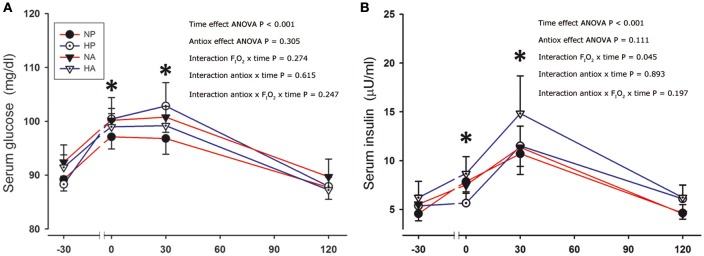
Serum glucose and insulin. Serum glucose (A) and insulin concentration (B) before, immediately after, and 30 and 120 min after the end of a single 30-s all-out sprint (Wingate test) performed in normoxia placebo (black circles), hypoxia placebo (open circles, FIO2:0.105), normoxia antioxidants (black triangles) and hypoxia antioxidants (open triangles; FIO2:0.105). *P < 0.05 in comparison to resting (ANOVA, time main effect, n = 9).
Figure 3
Figure 3
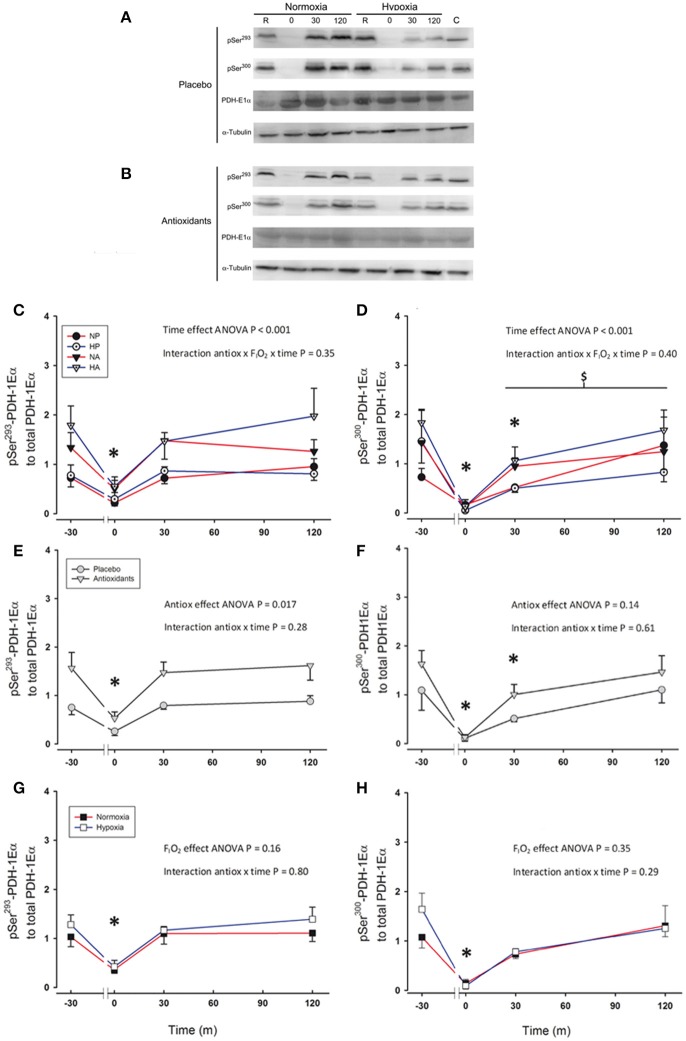
Representative western blots for Ser293-PDH-1Eα and Ser300-PDH-1Eα phosphorylations and PDH-1Eα total protein expression in response to a single 30 s sprint after placebo (A) or antioxidants (B) intake. Levels of Ser293-PDH-1Eα phosphorylation to PDH-1Eα total protein expression (C,E,G), and Ser300-PDH-1Eα phosphorylation to total PDH-1Eα total protein expression (D,F,H) before, immediately after, 30 and 120 min following the end of a single 30 s all-out sprint (Wingate test). (C,D) Responses to sprints performed in normoxia placebo (black circles), hypoxia placebo (open circles, FIO2: 0.105), normoxia antioxidants (black triangles) and hypoxia antioxidants (open triangles; FIO2: 0.105). (E,F) Represent the responses observed for two placebo conditions (gray circles) averaged compared to the average of the two antioxidants conditions (gray triangles). (G,H) Represent the responses for the average of the normoxic conditions (black squares) compared to the average of the hypoxic conditions (open squares; FIO2:0.105). *P < 0.05 in comparison to resting (ANOVA, time main effect). $P < 0.05 compared to Ser293-PDH-1Eα phosphorylation recovery. n = 9 for all variables.
Figure 4
Figure 4
Proposed regulation of PDH activity during sprint exercise and the early post-exercise recovery. During the sprint exercise muscle contractions elicit an immediate increase of sarcoplasmic (Ca2+) which activates pyruvate dehydrogenase phosphatase (PDP, mainly PDP1 which is more expressed in skeletal muscle). PDPs dephosphorylate PDH in the serines 293 and 300, regardless of FIO2. While PDH dephosphorylation during sprint exercise is not modified by antioxidants, antioxidants facilitate Ser293PDH-1Eα re-phosphorylation during the recovery period. This indicates that reactive nitrogen and oxygen species (RNOS) contribute maintaining PDH in its active form, or that RNOS slow-down re-phosphorylation during the recovery period. Several regulatory factors of PDKs activity are modified by sprint exercise. After the sprints, the ATP/ADP ratio is decreased to a similar extent in normoxia and hypoxia, regardless of the ingestion of antioxidants. The NAD+/NADH+ ratio is decreased to a greater extent in hypoxia than normoxia, with this effect being attenuated after the ingestion of antioxidants. Serum insulin increases after the sprint exercise, more when the sprints are performed in hypoxia than normoxia. Normoxia (red arrows), hypoxia (blue arrows), antioxidants (green arrows). The length of the arrow is representative of the magnitude of the change. *Indicates that Ser232PDH-1Eα was not measured in the present investigation and, therefore, its regulation by FIO2 and RNOS during sprint exercise remains unknown.

References

    1. Allen D. G., Westerblad H., Lännergren J. (1995). The role of intracellular acidosis in muscle fatigue. Adv. Exp. Med. Biol. 384, 57–68. 10.1007/978-1-4899-1016-5_5 - DOI - PubMed
    1. Bailey D. M., Lawrenson L., McEneny J., Young I. S., James P. E., Jackson S. K., et al. (2007). Electron paramagnetic spectroscopic evidence of exercise-induced free radical accumulation in human skeletal muscle. Free Radic. Res. 41, 182–190. 10.1080/10715760601028867 - DOI - PubMed
    1. Bakker A. J., Cully T. R., Wingate C. D., Barclay C. J., Launikonis B. S. (2017). Doublet stimulation increases Ca2+ binding to troponin C to ensure rapid force development in skeletal muscle. J. Gen. Physiol. 149, 323–334. 10.1085/jgp.201611727 - DOI - PMC - PubMed
    1. Bangsbo J., Juel C. (2006). Counterpoint: lactic acid accumulation is a disadvantage during muscle activity. J. Appl. Physiol. 100, 1412–1413. discussion: 1413–1414. - PubMed
    1. Barclay C. J., Woledge R. C., Curtin N. A. (2007). Energy turnover for Ca2+ cycling in skeletal muscle. J. Muscle Res. Cell Motil. 28, 259–274. 10.1007/s10974-007-9116-7 - DOI - PubMed

LinkOut - more resources