. 2018 Mar 20:9:177.
doi: 10.3389/fneur.2018.00177. eCollection 2018.

Postoperative Delirium, Learning, and Anesthetic Neurotoxicity: Some Perspectives and Directions

Affiliations

Postoperative Delirium, Learning, and Anesthetic Neurotoxicity: Some Perspectives and Directions

W Alan C Mutch et al. Front Neurol. .

Abstract

Evidence of anesthetic neurotoxicity is unequivocal when studied in animal models. These findings have translated poorly to the clinical domain when equated to postoperative delirium (POD) in adults and postoperative cognitive dysfunction (POCD) in either children or the elderly. In this perspective, we examine various reasons for the differences between animal modeling of neurotoxicity and the clinical situation of POD and POCD and make suggestions as to potential directions for ongoing research. We hypothesize that the animal anesthetic neurotoxicity models are limited, in part, due to failed scaling correction of physiological time. We posit that important insights into POCD in children and adults may be gleaned from studies in adults examining alterations in perioperative management designed to limit POD. In this way, POD may be more useful as the proxy for POCD rather than neuronal dropout or behavioral abnormalities that have been used in animal models but which may not be proxies for the human condition. We argue that it is time to move beyond animal models of neurotoxicity to directly examine these problems in well-conducted clinical trials with comprehensive preoperative neuropsychometric and psychiatric testing, high fidelity intraoperative monitoring of physiological parameters during the anesthetic course and postoperative assessment of subthreshold and full classification of POD. In this manner, we can "model ourselves" to better understand these important and poorly understood conditions.

Keywords: anesthetic neurotoxicity; animal models; biological scaling; non-human primate; postoperative cognitive dysfunction; postoperative delirium; surgical complications.


Figures

Figure 1
Figure 1
An example of the interaction between mean blood pressure (x-axis), end-tidal CO2 (y-axis), and end-tidal anesthetic agent (desflurane) concentration (z-axis) in one patient. This locally weighted smoothing linear regression had an R2 fit of 0.758 for these 13,014 data points. These data were collected intraoperatively in this patient using a data acquisition system downloading at 1 Hz. See the text and Ref. (25) for further discussion.
Figure 2
Figure 2
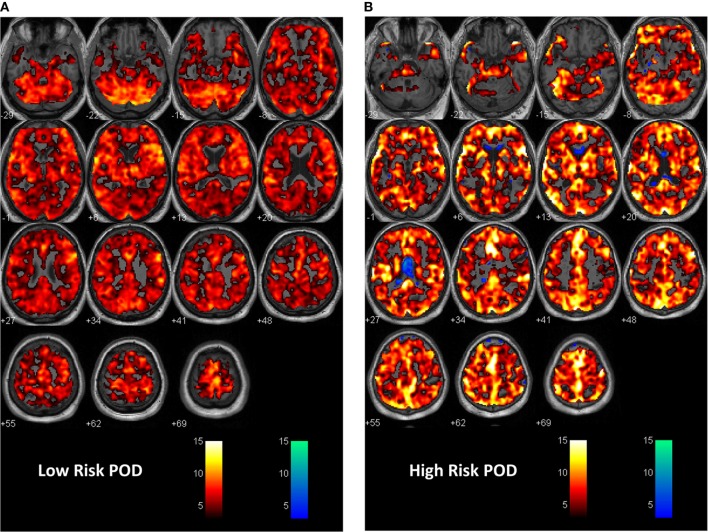
First level analysis with statistical parametric mapping (SPM) showing response to the CO2 stress test in (A) a patient at low risk for postoperative delirium (POD). In this instance, the expected response to the CO2 stimulus as recorded during BOLD imaging is shown. A vigorous response to CO2 is evident from the hot voxel response—shades of orange. The response at the p = 0.001 level occurred in 84% of whole brain parenchyma. The numbers below each image are the distance in millimeters above or below the anterior–posterior commissure. This patient had a non-POD outcome. The color bar is the t-value for fit to the general linear model from the SPM analysis. Voxels are colored if the t-value exceeded 3.11 in this instance. (B) A patient at risk of POD. Here, there is less response to the hypercapnic signal—a 64% response to hypercapnia and now an inverse or intracranial steal signal shown in cold voxels—shades of blue. The inverse voxel count was 4.3% of the total count. This patient had a subthreshold POD outcome. See Ref. (25) for a fuller description of the methodology.
Figure 3
Figure 3
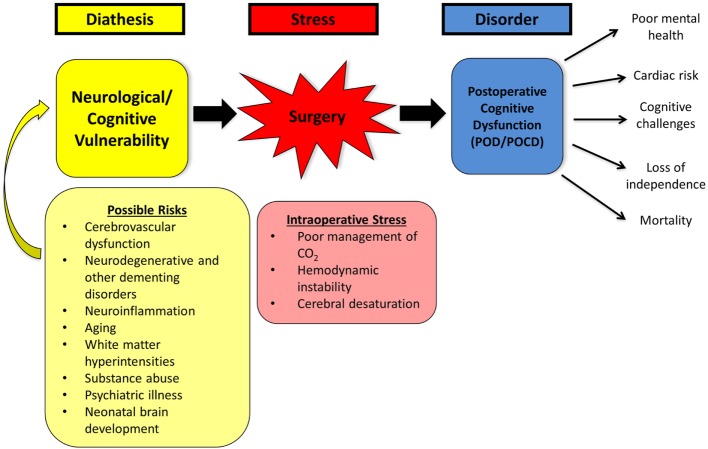
Diagrammatic depiction of the stress–diathesis model for postoperative delirium (POD). See the text for further details.

References

    1. Olney JW, Young C, Wozniak DF, Jevtovic-Todorovic V, Ikonomidou C. Do pediatric drugs cause developing neurons to commit suicide? Trends Pharmacol Sci (2004) 25:135–9. 10.1016/j.tips.2004.01.002 - DOI - PubMed
    1. Jevtovic-Todorovic V. General anesthetics and neurotoxicity: how much do we know? Anesthesiol Clin (2016) 34:439–51. 10.1016/j.anclin.2016.04.001 - DOI - PMC - PubMed
    1. Graham MR, Brownell M, Chateau DG, Dragan RD, Burchill C, Fransoo RR. Neurodevelopmental assessment in kindergarten in children exposed to general anesthesia before the age of 4 years: a retrospective matched cohort study. Anesthesiology (2016) 125:667–77. 10.1097/ALN.0000000000001245 - DOI - PubMed
    1. O’Leary JD, Janus M, Duku E, Wijeysundera DN, To T, Li P, et al. A population-based study evaluating the association between surgery in early life and child development at primary school entry. Anesthesiology (2016) 125:272–9. 10.1097/ALN.0000000000001200 - DOI - PubMed
    1. Glatz P, Sandin RH, Pedersen NL, Bonamy A-K, Eriksson LI, Granath F. Association of anesthesia and surgery during childhood with long-term academic performance. JAMA Pediatr (2017) 171:e163470. 10.1001/jamapediatrics.2016.3470 - DOI - PubMed

LinkOut - more resources