. 2018 May;15(5):6777-6783.
doi: 10.3892/ol.2018.8112. Epub 2018 Feb 23.

Curcumin differentially affects cell cycle and cell death in acute and chronic myeloid leukemia cells

Affiliations

Curcumin differentially affects cell cycle and cell death in acute and chronic myeloid leukemia cells

Macario Martínez-Castillo et al. Oncol Lett. 2018 May.

Abstract

Curcumin is a phytochemical with potent anti-neoplastic properties. The antitumoral effects of curcumin in cells derived from chronic or acute myeloid leukemia have been already described. However, a comparative study of the cytostatic and cytotoxic effects of curcumin on chronic and acute myeloid leukemia cells has not yet been performed. In the present study, the cellular effects of curcumin on cell lines derived from chronic or acute myeloid leukemia were examined. Dose and time-response assays were performed with curcumin on HL-60 and K562 cells. Cell viability was evaluated with trypan blue exclusion test and cell death by flow cytometry using a fluorescent molecular probe. A cell cycle profile was analyzed, and protein markers of cell cycle progression and cell death were investigated. In the present study, the K562 cells showed a higher sensitivity to the cytostatic and cytotoxic effects of curcumin compared with HL-60. In addition, curcumin induced G1 phase arrest in HL-60 cells and G2/M phase arrest in K562 cells. Furthermore, curcumin-related cell death in HL-60 was associated with the processed forms of caspases-9 and -3 proteins, whereas in K562 cells, both the processed and the unprocessed forms were present. Accordingly, activity of these caspases was significantly higher in HL-60 cells compared with that in K562. In conclusion, curcumin elicits different cellular mechanisms in chronic or acute myeloid leukemia cells and the powerful antitumoral effect was more potent in K562 compared with HL-60 cells.

Keywords: HL-60; K562; apoptosis; cell cycle; chemoprevention; curcumin; leukemia.


Figures
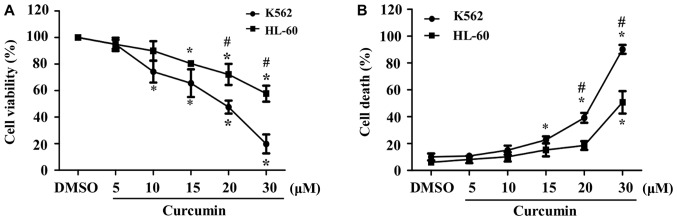
Figure 1.
Figure 1.
Effects of curcumin on growth and death in K562 and HL-60 cells. (A) Cell viability of K562 and HL-60 cell lines after 24 h of treatment with the indicated concentrations of curcumin. (B) Percentage of cell death in K562 and HL-60 after treatment with various concentrations of curcumin for 24 h. The mean ± SD are shown. *P<0.05 vs. the respective cell line control (DMSO); #P<0.05 between K562 and HL-60 cells. Data are representative of at least 3 independent experiments.
Figure 2.
Figure 2.
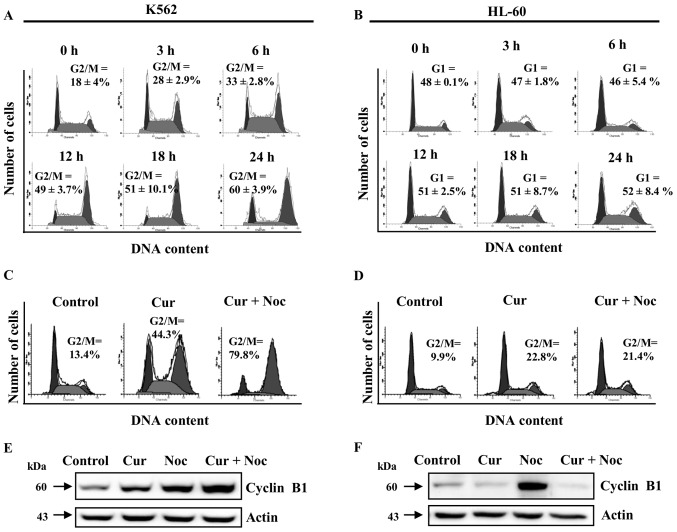
Curcumin differentially alters cell cycle progression in chronic or acute myeloid leukemia cells. (A) K562 and (B) HL-60 cells were treated with curcumin 20 µM for different time points. Cells were fixed and stained with propidium iodide for analysis of cell cycle distribution. (C) K562 and (D) HL-60 cells were treated independently with 20 µM of curcumin (Cur) or with 20 µM of curcumin plus 200 nM of nocodazole (Cur + Noc) by 24 h. Cells were fixed and stained with propidium iodide for analysis of cell cycle distribution. Protein levels of cyclin B1 after the indicated treatment in (E) K562 and (F) HL-60 cells are shown. Actin was used as loading control. Control and time 0 cultures were treated with vehicle (DMSO) for 24 h. Data are representative of at least 3 independent experiments.
Figure 3.
Figure 3.
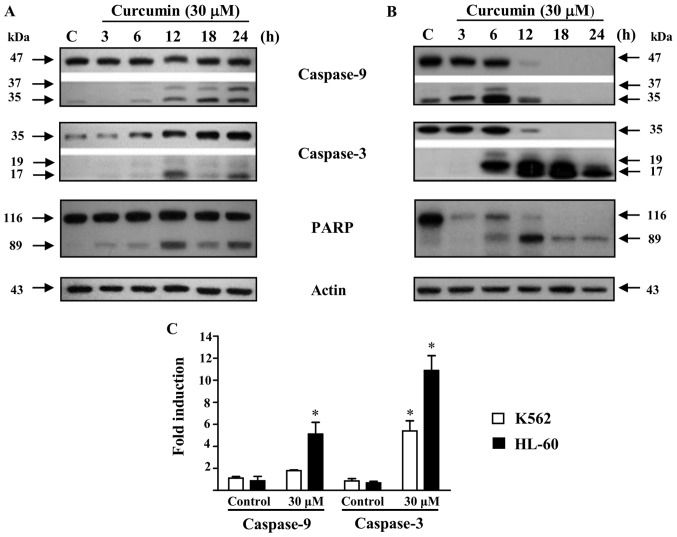
Curcumin induced differential activation of caspases in chronic or acute myeloid leukemia cells. Western blot analysis of caspases and PARP in (A) K562 and (B) HL-60 cells after different times of treatment with 30 µM curcumin. Actin protein was utilized as loading control. Control cultures were treated with vehicle (DMSO) for 24 h. C=Control. Data are representative of at least 3 independent experiments. (C) Cell cultures were treated with 30 µM curcumin for 24 h and activity of caspase-9 and −3 was evaluated in K562 and HL-60. Values are represented as the mean ± standard deviation of at least 3 independent experiments. *P<0.05 vs. the respective cell line control (DMSO).
Figure 4.
Figure 4.
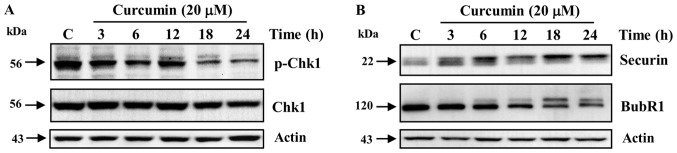
Curcumin exposure promoted a defective DNA damage checkpoint at G2 phase in chronic myeloid leukemia cells. K562 cells were incubated with curcumin 20 µM for different time points. (A) Protein levels of total and phosphorylated Chk1 (p-Chk1) after incubation with curcumin. (B) Phosphorylation status of Securin and BubR1 protein in response to curcumin incubation. Actin was used as loading control. Control cultures were treated with vehicle (DMSO) for 24 h. Data are representative of at least 3 independent experiments.

References

    1. Shakibaei M, Buhrmann C, Kraehe P, Shayan P, Lueders C, Goel A. Curcumin chemosensitizes 5-fluorouracil resistant MMR-deficient human colon cancer cells in high density cultures. PLoS One. 2014;9:e85397. doi: 10.1371/journal.pone.0085397. - DOI - PMC - PubMed
    1. Fan Z, Duan X, Cai H, Wang L, Li M, Qu J, Li W, Wang Y, Wang J. Curcumin inhibits the invasion of lung cancer cells by modulating the PKCα/Nox-2/ROS/ATF-2/MMP-9 signaling pathway. Oncol Rep. 2015;34:691–698. doi: 10.3892/or.2015.4044. - DOI - PubMed
    1. Ferreira LC, Arbab AS, Jardim-Perassi BV, Borin TF, Varma NR, Iskander AS, Shankar A, Ali MM, Zuccari DA. Effect of curcumin on pro-angiogenic factors in the xenograft model of breast cancer. Anticancer Agents Med Chem. 2015;15:1285–1296. doi: 10.2174/1871520615666150520093644. - DOI - PubMed
    1. Huang AC, Lin SY, Su CC, Lin SS, Ho CC, Hsia TC, Chiu TH, Yu CS, Ip SW, Lin TP, Chung JG. Effects of curcumin on N-bis(2-hydroxypropyl) nitrosamine (DHPN)-induced lung and liver tumorigenesis in BALB/c mice in vivo. In Vivo. 2008;22:781–785. - PubMed
    1. Carroll RE, Benya RV, Turgeon DK, Vareed S, Neuman M, Rodriguez L, Kakarala M, Carpenter PM, McLaren C, Meyskens FL, Jr, Brenner DE. phase IIa clinical trial of curcumin for the prevention of colorectal neoplasia. Cancer Prev Res. 2011;4:354–364. doi: 10.1158/1940-6207.CAPR-10-0098. - DOI - PMC - PubMed