


doi: 10.1007/s13238-018-0529-4.
Effect of pH, temperature and freezing-thawing on quantity changes and cellular uptake of exosomes
Affiliations
- PMID: 29616487
- PMCID: PMC6418301
- DOI: 10.1007/s13238-018-0529-4
Item in Clipboard
Effect of pH, temperature and freezing-thawing on quantity changes and cellular uptake of exosomes
Protein Cell.
2019 Apr.
No abstract available
Figures
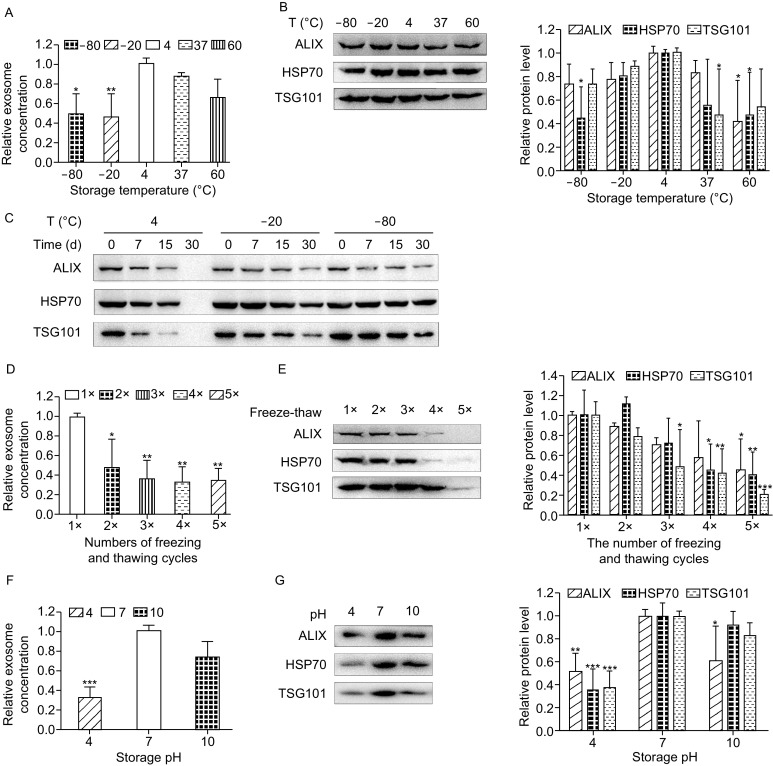
Effect of different storage conditions on the quantity changes of exosomes. (A, D and F) The relative concentrations of exosomes stored in different conditions for 24 h were detected by NTA. Bars represent the mean ± SD from at least three independent experiments. (A) Different temperatures. *P < 0.05, **P < 0.01 vs. 4 °C. (D) Different freezing and thawing cycles. *P < 0.05, **P < 0.01 vs. once. (F) Different pH levels. ***P < 0.001 vs. pH 7. (B, E and G) The levels of three exosomal markers, TSG101, HSP70 and ALIX, were detected by Western blot after samples were stored in different conditions for 24 h. The relative quantitation of proteins was shown below the bands. Bars represent the mean ± SD from at least three independent experiments. (B) Different temperatures. *P < 0.05 vs. 4 °C. (E) Different freezing and thawing cycles. *P < 0.05, **P < 0.01, ***P < 0.001 vs. once. (G) Different pH levels. *P < 0.05, **P < 0.01, ***P < 0.001 vs. pH 7. (C) The levels of three exosomal markers, TSG101, HSP70 and ALIX, were detected by Western blot after exosomes stored at −80 °C, −20 °C and 4 °C for 0, 7, 15 and 30 days

Effect of different storage conditions on the cellular uptake of exosomes. (A) PKH26-labeled exosomes stored in different conditions for 24 h and 293T cells were incubated for 3 h. Cell nuclei were visualized by DAPI staining. The numbers of small red spots (smaller than one tenth of the nuclei) and big red spots (bigger than one tenth of the nuclei) were shown above the images. Scale bars: 100 μm. (B–D) The cellular uptake of exosomes was quantified by counting the number of red fluorescent pots. Bars represent the mean ± SD (n = 4). (B) Different temperatures. **P < 0.01, ***P < 0.001 vs. 4 °C. (C) Different freezing and thawing cycles. *P < 0.05, ***P < 0.001 vs. once. (D) Different pH levels. ***P < 0.001 vs. pH 7
References
-
- Lee M, Ban JJ, Im W, Kim M. Influence of storage condition on exosome recovery. Biotechnol Bioproc E. 2016;21:299–304. doi: 10.1007/s12257-015-0781-x. - DOI
-
- Mincheva-Nilsson L, Baranov V, Nagaeva O, Dehlin E. Isolation and characterization of exosomes from cultures of tissue explants and cell lines. Curr Protoc Immunol. 2016;115:14–42. - PubMed
Publication types
MeSH terms
Substances
LinkOut - more resources
Full Text Sources
Other Literature Sources
