Association of Methylation Signals With Incident Coronary Heart Disease in an Epigenome-Wide Assessment of Circulating Tumor Necrosis Factor α
- PMID: 29617535
- PMCID: PMC6100733
- DOI: 10.1001/jamacardio.2018.0510
Association of Methylation Signals With Incident Coronary Heart Disease in an Epigenome-Wide Assessment of Circulating Tumor Necrosis Factor α
Erratum in
-
Error in End Matter.JAMA Cardiol. 2018 Jun 1;3(6):505. doi: 10.1001/jamacardio.2018.1429. JAMA Cardiol. 2018. PMID: 29799969 Free PMC article. No abstract available.
Abstract
Importance: Tumor necrosis factor α (TNF-α) is a proinflammatory cytokine with manifold consequences for mammalian pathophysiology, including cardiovascular disease. A deeper understanding of TNF-α biology may enhance treatment precision.
Objective: To conduct an epigenome-wide analysis of blood-derived DNA methylation and TNF-α levels and to assess the clinical relevance of findings.
Design, setting, and participants: This meta-analysis assessed epigenome-wide associations in circulating TNF-α concentrations from 5 cohort studies and 1 interventional trial, with replication in 3 additional cohort studies. Follow-up analyses investigated associations of identified methylation loci with gene expression and incident coronary heart disease; this meta-analysis included 11 461 participants who experienced 1895 coronary events.
Exposures: Circulating TNF-α concentration.
Main outcomes and measures: DNA methylation at approximately 450 000 loci, neighboring DNA sequence variation, gene expression, and incident coronary heart disease.
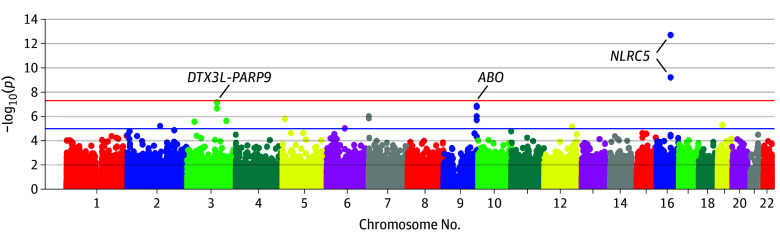
Results: The discovery cohort included 4794 participants, and the replication study included 816 participants (overall mean [SD] age, 60.7 [8.5] years). In the discovery stage, circulating TNF-α levels were associated with methylation of 7 cytosine-phosphate-guanine (CpG) sites, 3 of which were located in or near DTX3L-PARP9 at cg00959259 (β [SE] = -0.01 [0.003]; P = 7.36 × 10⁻⁸), cg08122652 (β [SE] = -0.008 [0.002]; P = 2.24 × 10⁻⁷), and cg22930808(β [SE] = -0.01 [0.002]; P = 6.92 × 10⁻⁸); NLRC5 at cg16411857 (β [SE] = -0.01 [0.002]; P = 2.14 × 10⁻¹³) and cg07839457 (β [SE] = -0.02 [0.003]; P = 6.31 × 10⁻¹⁰); or ABO, at cg13683939 (β [SE] = 0.04 [0.008]; P = 1.42 × 10⁻⁷) and cg24267699 (β [SE] = -0.009 [0.002]; P = 1.67 × 10⁻⁷), after accounting for multiple testing. Of these, negative associations between TNF-α concentration and methylation of 2 loci in NLRC5 and 1 in DTX3L-14 PARP9 were replicated. Replicated TNF-α-linked CpG sites were associated with 9% to 19% decreased risk of incident coronary heart disease per 10% higher methylation per CpG site (cg16411857: hazard ratio [HR], 0.86; 95% CI, 0.78-1.95; P = .003; cg07839457: HR, 0.89; 95% CI, 0.80-0.94; P = 3.1 × 10⁻⁵; cg00959259: HR, 0.91; 95% CI, 0.84-0.97; P = .002; cg08122652: HR, 0.81; 95% CI, 0.74-0.89; P = 2.0 × 10⁻⁵).
Conclusions and relevance: We identified and replicated novel epigenetic correlates of circulating TNF-α concentration in blood samples and linked these loci to coronary heart disease risk, opening opportunities for validation and therapeutic applications.
Conflict of interest statement
Figures
References
-
- Brenner D, Blaser H, Mak TW. Regulation of tumour necrosis factor signalling: live or let die. Nat Rev Immunol. 2015;15(6):362-374. - PubMed
-
- Pope JE. Rheumatoid arthritis: TNF inhibitors and cardiovascular risk management in RA. Nat Rev Rheumatol. 2016;12(6):317-318. - PubMed
-
- Graf J. Study of adalimumab to lower cardiovascular risk in RA patients with well controlled joint disease. https://clinicaltrials.gov/ct2/show/NCT01893996. Published May 2, 2017. Accessed February 26, 2018.
-
- Ridker PM, Everett BM, Thuren T, et al. ; CANTOS Trial Group . Antiinflammatory therapy with canakinumab for atherosclerotic disease. N Engl J Med. 2017;377(12):1119-1131. - PubMed
Publication types
MeSH terms
Substances
Grants and funding
- WT_/Wellcome Trust/United Kingdom
- MR/K026992/1/MRC_/Medical Research Council/United Kingdom
- R01 ES025225/ES/NIEHS NIH HHS/United States
- P30 ES023515/ES/NIEHS NIH HHS/United States
- K24 DK080140/DK/NIDDK NIH HHS/United States
- N01HC25195/HL/NHLBI NIH HHS/United States
- U01 DK078616/DK/NIDDK NIH HHS/United States
- G0500539/MRC_/Medical Research Council/United Kingdom
- R01 HL087679/HL/NHLBI NIH HHS/United States
- BB/F019394/1/BB_/Biotechnology and Biological Sciences Research Council/United Kingdom
- CSO_/Chief Scientist Office/United Kingdom
- G0600705/MRC_/Medical Research Council/United Kingdom
- G1002319/MRC_/Medical Research Council/United Kingdom
- Z99 AG999999/ImNIH/Intramural NIH HHS/United States
- HHSN268201500001I/HL/NHLBI NIH HHS/United States
- R01 ES021733/ES/NIEHS NIH HHS/United States
- R00 ES023450/ES/NIEHS NIH HHS/United States
- K99 HL136875/HL/NHLBI NIH HHS/United States
- R01 HL104135/HL/NHLBI NIH HHS/United States
LinkOut - more resources
Full Text Sources
Other Literature Sources