Review
. 2018;10(5-6):442-454.
doi: 10.1159/000487515. Epub 2018 Apr 4.

Pseudomonas aeruginosa and Klebsiella pneumoniae Adaptation to Innate Immune Clearance Mechanisms in the Lung

Review

Pseudomonas aeruginosa and Klebsiella pneumoniae Adaptation to Innate Immune Clearance Mechanisms in the Lung

Sebastian A Riquelme et al. J Innate Immun. 2018.

Abstract

Many different species of gram-negative bacteria are associated with infection in the lung, causing exacerbations of chronic obstructive pulmonary disease, cystic fibrosis (CF), and ventilator-associated pneumonias. These airway pathogens must adapt to common host clearance mechanisms that include killing by antimicrobial peptides, antibiotics, oxidative stress, and phagocytosis by leukocytes. Bacterial adaptation to the host is often evident phenotypically, with increased extracellular polysaccharide production characteristic of some biofilm-associated organisms. Given the relatively limited repertoire of bacterial strategies to elude airway defenses, it seems likely that organisms sharing the same ecological niche might also share common strategies to persistently infect the lung. In this review, we will highlight some of the major factors responsible for the adaptation of Pseudomonas aeruginosa to the lung, addressing how growth in biofilms enables persistent infection, relevant to, but not limited to, the pathogenesis of infection in CF. In contrast, we will discuss how carbapenem-resistant Klebsiella pneumoniae evade immune clearance, an organism often associated with ventilator-associated pneumonia and health-care-acquired pneumonias, but not a typical pathogen in CF.

Keywords: Bacterial adaptation; Bacterial infection; Biofilm; Cystic fibrosis; Immune evasion; Inflammasome; Klebsiella pneumoniae; Pathogen-associated molecular patterns; Pseudomonas aeruginosa; Reactive oxygen species.


Figures

Fig. 1
Fig. 1
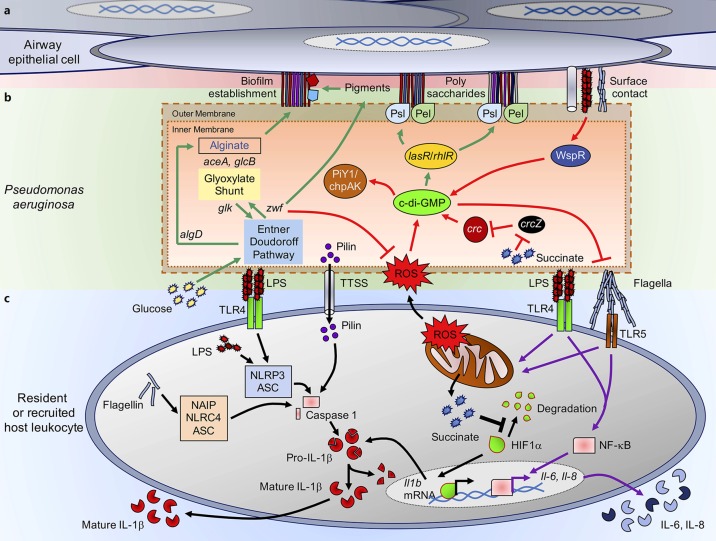
Pseudonomas aeruginosa biofilm production and interactions with host immunity. a Airway epithelial cells contact P. aeruginosa during infection triggering chemotactic signaling and biofilm production. Polysaccharide structures generated by bacterial metabolism are anchored to the extracellular matrix of these cells. bP. aeruginosa metabolic pathways provide biofilm components. Intracellular pathways that direct the metabolism of glucose (green arrows) through the Entner-Doudoroff (central loci zwf and glk) and glyoxylate shunt (mediated by aceA and glcB) pathways. Glucose flux through these pathways allows the production of carbohydrates that form extracellular polysaccharides for the attachment to the airway cells. Upon contact with the host cell, surface recognition and activation of WspR and cyclic (c)-di-GMP production (red arrows) result in stimulation of lasR and rhlR loci and production of PslA and PelA, which support formation of extracellular polysaccharides. c-di-GMP coordinates biofilm formation and bacterial motility, switching from flagellar- to a pilus-dependent twitching motility through activation of the PiY1/chpAK complex. Both endogenous/exogenous reactive oxygen species (ROS) sources and catabolite repressor succinate collaborate in the synthesis of c-di-GMP. Intracellular ROS and redox balance are regulated by NADPH generated by zwf activity. cP. aeruginosa interaction with host immunity. Pathogen-associated molecular patterns, such as lipopolysaccharide (LPS), flagella, pilus, or type three secretion system components (TTSS), activate proinflammatory surface receptors in immune cells. Both TLR4/MD2-LPS and TLR5-flagella surface interactions trigger activation of transcription factor NF-κB and mitochondrial destabilization (purple arrows). NF-κB induces production and secretion of inflammatory cytokines, such as IL-6 and IL-8. Mitochondrial collapse is accompanied by accumulation of ROS and succinate release and hypoxia-induced factor-1α (HIF1α) stabilization, which acts as a transcription factor that mediates production of pro- IL-1β (black arrows). Pro-IL-1β is cleaved to its mature form by caspase-1 produced by three different inflammasome systems: (1) NAIP/NLRC4/ASC activated by cytoplasmic uptake of flagellin; (2) NLRP3/ASC activated by cytoplasmic uptake of LPS; and (3) pilin secreted by P. aeruginosa.
Fig. 2
Fig. 2
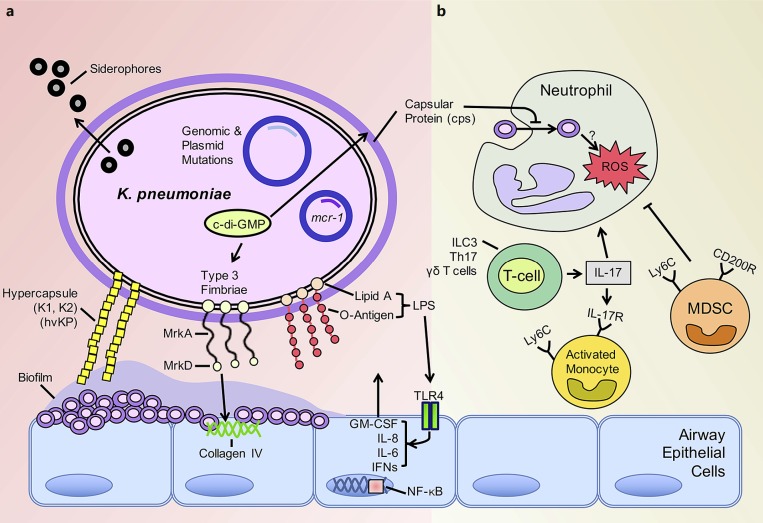
Klebsiella pneumoniae biofilm production and evasion of host immunity. aK. pneumoniae avidly forms biofilms on epithelial cells and abiotic surfaces. Induction of the cyclic (c)-di-GMP system increases production of type 3 fimbriae and subsequent biofilm formation. The hypervirulent K. pneumoniae (hvKP) forms biofilm enhanced by the abundant production of capsular protein. The composition of lipid A, a major component of lipopolysaccharide (LPS) and specific target of colistin, is altered in K. pneumoniae harboring the mcr-1 plasmid. Siderophores are utilized by nearly all K. pneumoniae to scavenge iron for bacterial growth. b Neutrophils readily take up ST258 isolates intracellularly although intracellular killing is impaired. Neutrophil function is inhibited by recruitment of immunosuppressive myeloid-derived suppressor cells (MDSC). IL-17 is produced predominantly by ILC3s, Th17 cells, and γδ T cells in response to K. pneu moniae infection. Monocytes are then activated by IL-17, with the potential to be microbicidal. Heterogeneity in IL-17 levels as well as monocyte plasticity in response to carbapenem-resistant K. pneumoniae isolates may explain the variability in the phenotype of these cells recruited to the site of infection.

References

    1. Elborn JS. Cystic fibrosis. Lancet. 2016;388:2519–2531. - PubMed
    1. Gutierrez HH, Sanchez I, Schidlow DV. Cystic fibrosis care in Chile. Curr Opin Pulm Med. 2009;15:632–637. - PubMed
    1. Silva Filho LV, Castanos C, Ruiz HH. Cystic fibrosis in Latin America - improving the awareness. J Cyst Fibros. 2016;15:791–793. - PubMed
    1. Masekela R, Zampoli M, Westwood AT, White DA, Green RJ, Olorunju S, Kwofie-Mensah M. Phenotypic expression of the 3120 + 1G>A mutation in non-Caucasian children with cystic fibrosis in South Africa. J Cyst Fibros. 2013;12:363–366. - PubMed
    1. Westwood T, Henderson B, Ramsay M, Medical and Scientific Advisory Committee of the South African Cystic Fibrosis Association Diagnosing cystic fibrosis in South Africa. S Afr Med J. 2006;96:304–306. - PubMed

Publication types