Clinical Trial
. 2018 Jul 2;218(3):378-387.
doi: 10.1093/infdis/jiy177.

A Respiratory Syncytial Virus Vaccine Based on the Small Hydrophobic Protein Ectodomain Presented With a Novel Lipid-Based Formulation Is Highly Immunogenic and Safe in Adults: A First-in-Humans Study

Affiliations
Clinical Trial

A Respiratory Syncytial Virus Vaccine Based on the Small Hydrophobic Protein Ectodomain Presented With a Novel Lipid-Based Formulation Is Highly Immunogenic and Safe in Adults: A First-in-Humans Study

Joanne M Langley et al. J Infect Dis. .

Abstract

Background: Respiratory syncytial virus infection can cause lower respiratory tract infection in older adults comparable to influenza, but no vaccines are available.

Methods: This was a randomized, observer-blinded, first-in-humans study of a novel synthetic RSV antigen based on the ectodomain of the small hydrophobic glycoprotein (SHe) of RSV subgroup A, formulated with either the lipid and oil-based vaccine platform DepoVax (DPX-RSV[A]) or alum (RSV[A]-Alum), in healthy, 50-64-year-old individuals. Two dose levels (10 or 25 µg) of SHe with each formulation were compared to placebo. A booster dose was administered on day 56.

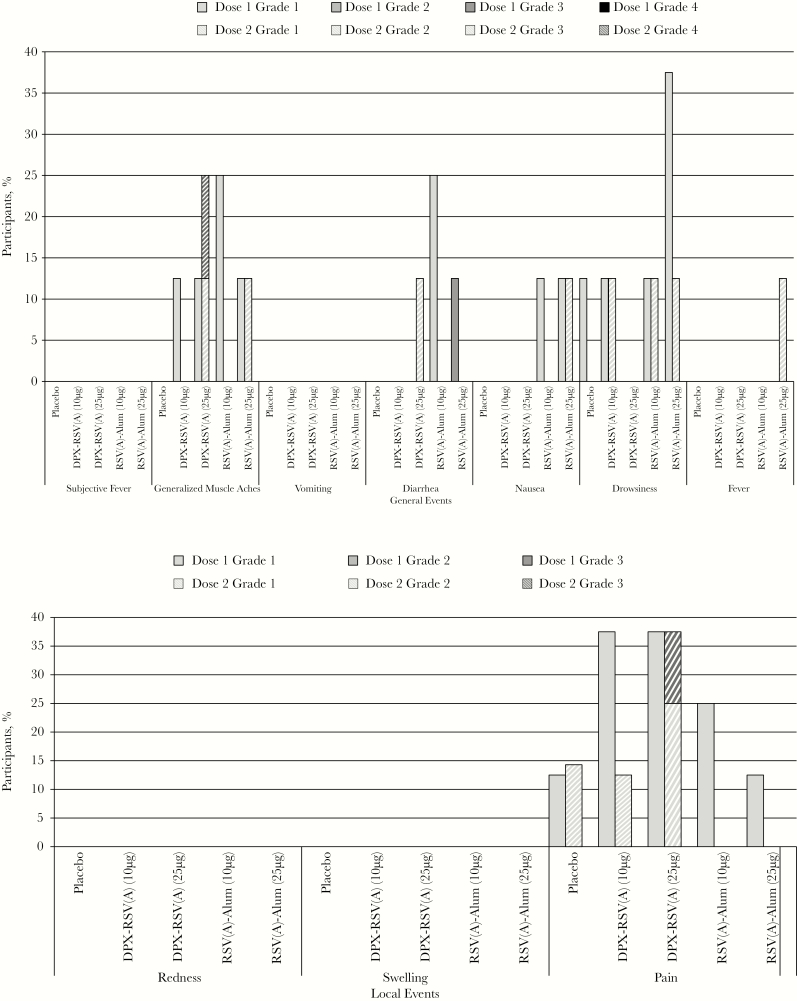
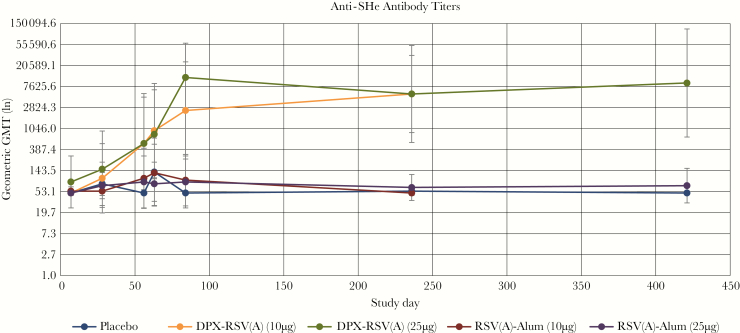
Results: There was no indication that the vaccine was unsafe. Mild pain, drowsiness, and muscles aches were the most common solicited adverse events (AEs), and the frequencies of the AEs did not increase after dose 2. Robust anti-SHe-specific immune responses were demonstrated in the DPX-RSV(A) 10-μg and 25-μg groups (geometric mean titer, approximately 10-fold and 100-fold greater than that of placebo at days 56 and 236, respectively), and responses were sustained in the DPX-RSV(A) 25-μg group at day 421. Responses to the RSV(A)-Alum vaccines were very low.

Conclusions: A novel antigen from the SH protein of RSV, formulated in a lipid and oil-based vaccine platform, was highly immunogenic, with sustained antigen-specific antibody responses, and had an acceptable safety profile.


Figures
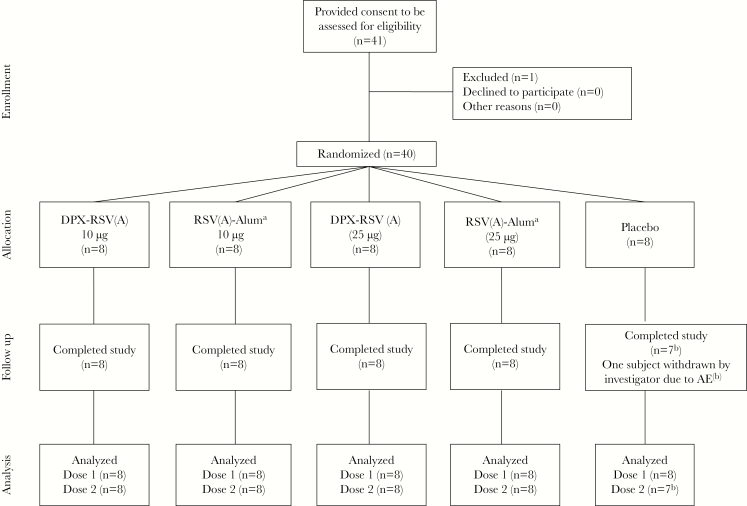
Figure 1.
Figure 1.
Participant flow through the study. See “Methods” for a description of vaccine formulations. DPX, DepoVax; RSV(A), respiratory syncytial virus subgroup A. aParticipants in the RSV(A)-Alum group received placebo on day 56, rather than RSV(A)-Alum. bOne subject was withdrawn by the investigators because of an adverse event.
Figure 2.
Figure 2.
Percentage of participants with solicited injection site and general adverse events on days 0–6 after vaccination (doses 1 and 2 at days 0 and 56). Grade 3 (severe) pain was defined as pain that is significant at rest and prevents normal everyday activities. Redness and swelling were considered present if the greatest surface diameter of each was >100 mm. Grade 3 (severe) systemic adverse events were defined as those that prevent normal everyday activities. aParticipants in the RSV(A)-Alum group received placebo on day 56, rather than RSV(A)-Alum. See “Methods” for a description of vaccine formulations. DPX, DepoVax; RSV(A), respiratory syncytial virus subgroup A.
Figure 3.
Figure 3.
Geometric mean antibody titers (GMTs) to respiratory syncytial virus subgroup A (RSV[A]) small hydrophobic protein ectodomain (SHe), by vaccine study group, on days 0–236 among all participants and to day 421 among step 2 participants. Error bars depict 95% confidence intervals. In step 1, SHe-containing vaccines had 10 µg of SHe antigen. In step 2 SHe-containing vaccines had 25 µg of SHe antigen. Two dose levels (10 or 25 µg) of the SHe antigen with each formulation were compared to placebo. A booster dose was administered on day 56. See “Methods” for a description of vaccine formulations. DPX, DepoVax.
Figure 4.
Figure 4.
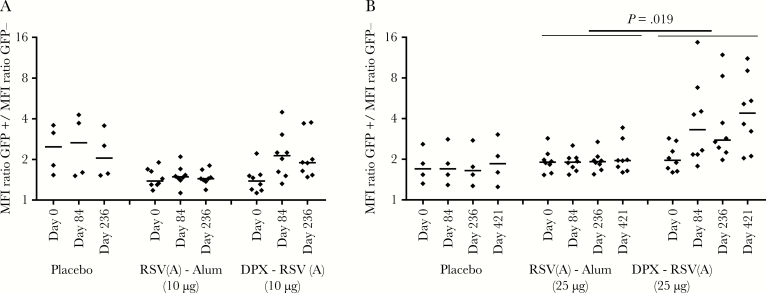
Binding of serum immunoglobulin G (IgG) to respiratory syncytial virus (RSV) small hydrophobic protein (SH) on the surface of cells. DPX-RSV(A) vaccination of human volunteers induces serum IgG that can bind to cells expressing the RSV SH surface protein. HEK293T cells coexpressing RSV SH and green fluorescent protein (GFP; Hek-SH) were analyzed by flow cytometry for human IgG binding, using sera sampled at the indicated time points after the last immunization with placebo, RSV(A)-Alum, or DPX-RSV(A). Data denote the ratio of the mean fluorescence intensity (MFI) of cells expressing SH (ie, GFP-positive cells) to the MFI of control cells (ie, GFP-negative cells) in individual serum samples. Short horizontal lines represent mean values. A, Data from low-dose (step 1) vaccine recipients. B, Data from high-dose (step 2) vaccine recipients. See “Methods” for a description of vaccine formulations. DPX, DepoVax.

References

    1. Shi T, McAllister DA, O’Brien KL, et al. Global, regional, and national disease burden estimates of acute lower respiratory infections due to respiratory syncytial virus in young children in 2015: a systematic review and modelling study. Lancet 2017; 390:946–58. - PMC - PubMed
    1. Boeckh M. The challenge of respiratory virus infections in hematopoietic cell transplant recipients. Br J Haematol 2008; 143:455–67. - PMC - PubMed
    1. Falsey AR, Hennessey PA, Formica MA, Cox C, Walsh EE. Respiratory syncytial virus infection in elderly and high-risk adults. N Engl J Med 2005; 352:1749–59. - PubMed
    1. Zhou H, Thompson WW, Viboud CG, et al. Hospitalizations associated with influenza and respiratory syncytial virus in the United States, 1993–2008. Clin Infect Dis 2012; 54:1427–36. - PMC - PubMed
    1. Lee N, Lui GC, Wong KT, et al. High morbidity and mortality in adults hospitalized for respiratory syncytial virus infections. Clin Infect Dis 2013; 57:1069–77. - PubMed

Publication types

MeSH terms

Grants and funding