Lessons from the Crypt: HMGA1-Amping up Wnt for Stem Cells and Tumor Progression
- PMID: 29618461
- PMCID: PMC6435269
- DOI: 10.1158/0008-5472.CAN-17-3045
Lessons from the Crypt: HMGA1-Amping up Wnt for Stem Cells and Tumor Progression
Abstract
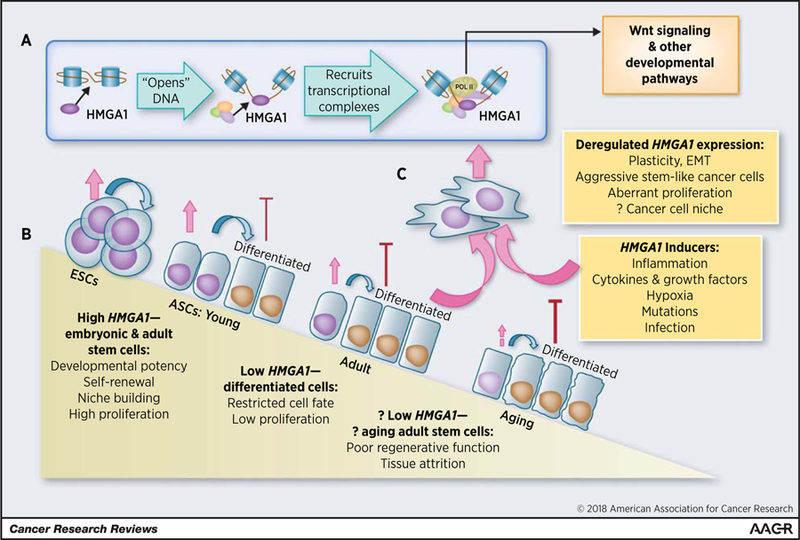
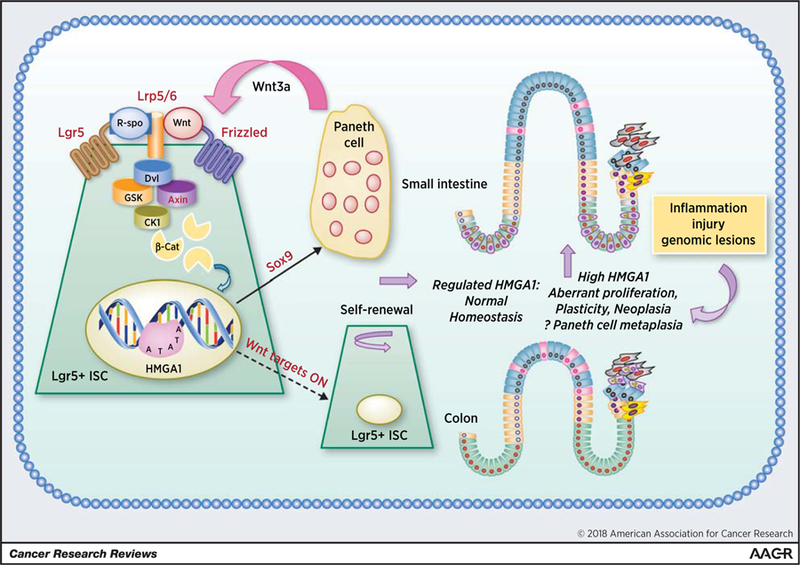
High mobility group A1 (HMGA1) chromatin remodeling proteins are enriched in aggressive cancers and stem cells, although their common function in these settings has remained elusive until now. Recent work in murine intestinal stem cells (ISC) revealed a novel role for Hmga1 in enhancing self-renewal by amplifying Wnt signaling, both by inducing genes expressing Wnt agonist receptors and Wnt effectors. Surprisingly, Hmga1 also "builds" a stem cell niche by upregulating Sox9, a factor required for differentiation to Paneth cells; these cells constitute an epithelial niche by secreting Wnt and other factors to support ISCs. HMGA1 is also highly upregulated in colon cancer compared with nonmalignant epithelium and SOX9 becomes overexpressed during colon carcinogenesis. Intriguingly, HMGA1 is overexpressed in diverse cancers with poor outcomes, where it regulates developmental genes. Similarly, HMGA1 induces genes responsible for pluripotency and self-renewal in embryonic stem cells. These findings demonstrate that HMGA1 maintains Wnt and other developmental transcriptional networks and suggest that HMGA1 overexpression fosters carcinogenesis and tumor progression through dysregulation of these pathways. Studies are now needed to determine more precisely how HMGA1 modulates chromatin structure to amplify developmental genes and how to disrupt this process in cancer therapy. Cancer Res; 78(8); 1890-7. ©2018 AACR.
©2018 American Association for Cancer Research.
Conflict of interest statement
Disclosure of Potential Conflicts of Interest
No potential conflicts of interest were disclosed.
Figures
References
-
- Nelson WG, Pienta KJ, Barrack ER, Coffey DS. The role of the nuclear matrix in the organization and function of DNA. Ann Rev Biopys Chem 1986;15:457–75. - PubMed
-
- Brown R, Curry E, Magnani L, Wilhelm-Benartzi CS, Borley J. Poised epigenetic states and acquired drug resistance in cancer. Nat Rev Cancer 2014;14:747–53. - PubMed
-
- Reeves R, Beckerbauer L. HMGI/Y proteins: flexible regulators of transcription and chromatin structure. Biochim Biophys Acta 2001; 1519:13–29. - PubMed
Publication types
MeSH terms
Substances
Grants and funding
LinkOut - more resources
Full Text Sources
Other Literature Sources
Medical
Molecular Biology Databases
Research Materials