Group B Streptococcus Vaginal Carriage in Pregnant Women as Deciphered by Clustered Regularly Interspaced Short Palindromic Repeat Analysis
- PMID: 29618502
- PMCID: PMC5971545
- DOI: 10.1128/JCM.01949-17
Group B Streptococcus Vaginal Carriage in Pregnant Women as Deciphered by Clustered Regularly Interspaced Short Palindromic Repeat Analysis
Abstract
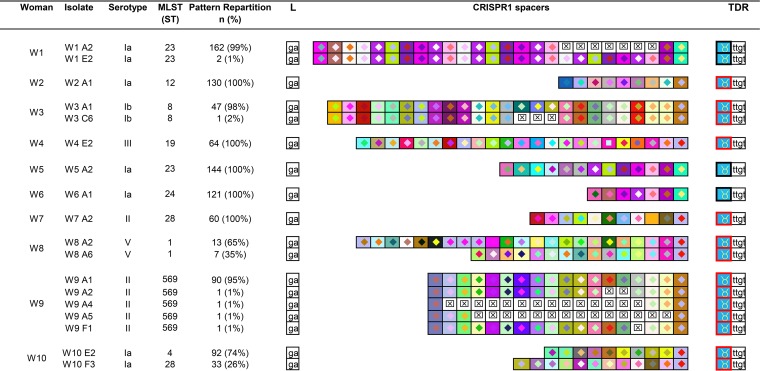
We evaluated the diversity of group B Streptococcus (GBS) vaginal carriage populations in pregnant women. For this purpose, we studied each isolate present in a primary culture of a vaginal swab using a new approach based on clustered regularly interspaced short palindromic repeats (CRISPR) locus analysis. To evaluate the CRISPR array composition rapidly, a restriction fragment length polymorphism (RFLP) analysis was performed. For each different pattern observed, the CRISPR array was sequenced and capsular typing and multilocus sequence typing (MLST) were performed. A total of 970 isolates from 10 women were analyzed by CRISPR-RFLP. Each woman carrying GBS isolates presented one to five specific "personal" patterns. Five women showed similar isolates with specific and unique restriction patterns, suggesting the carriage of a single GBS clone. Different patterns were observed among isolates from the other five women. For three of these, CRISPR locus sequencing highlighted low levels of internal modifications in the locus backbone, whereas there were high levels of modifications for the last two women, suggesting the carriage of two different clones. These two clones were closely related, having the same ancestral spacer(s), the same capsular type and, in one case, the same ST, but showed different antibiotic resistance patterns in pairs. Eight of 10 women were colonized by a single GBS clone, while two of them were colonized by two strains, leading to a risk of selection of more-virulent and/or more-resistant clones during antibiotic prophylaxis. This CRISPR analysis made it possible to separate isolates belonging to a single capsular type and sequence type, highlighting the greater discriminating power of this approach.
Keywords: CRISPR. Streptococcus agalactiae; carriage; diversity; genotyping.
Copyright © 2018 American Society for Microbiology.
Figures
References
-
- Agence Nationale d'Accréditation et d'Évaluation en Santé. 2001. Antenatal prevention of early neonatal bacterial infection (September 2001). https://www.has-sante.fr/portail/upload/docs/application/pdf/Antenatal_p.... - PubMed
-
- Schrag S, Gorwitz R, Fultz-Butts K, Schuchat A. 2002. Prevention of perinatal group B streptococcal disease. Revised guidelines from CDC. MMWR Recomm Rep 51(RR-11):1–22. - PubMed
-
- Regan JA, Klebanoff MA, Nugent RP. 1991. The epidemiology of group B streptococcal colonization in pregnancy. Vaginal Infections and Prematurity Study Group. Obstet Gynecol 77:604–610. - PubMed
MeSH terms
LinkOut - more resources
Full Text Sources
Other Literature Sources