


Positive biodiversity-productivity relationships in forests: climate matters
- PMID: 29618520
- PMCID: PMC5938561
- DOI: 10.1098/rsbl.2017.0747
Positive biodiversity-productivity relationships in forests: climate matters
Abstract
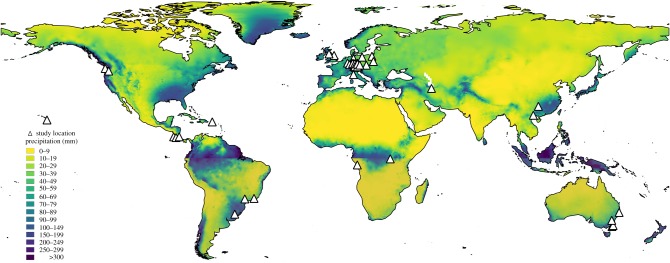
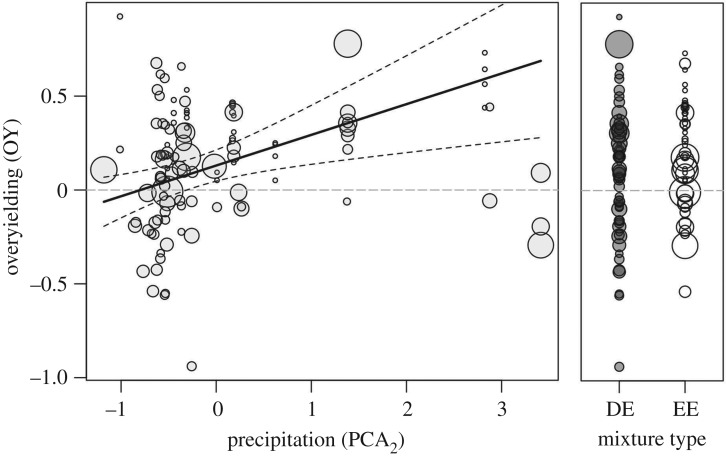
While it is widely acknowledged that forest biodiversity contributes to climate change mitigation through improved carbon sequestration, conversely how climate affects tree species diversity-forest productivity relationships is still poorly understood. We combined the results of long-term experiments where forest mixtures and corresponding monocultures were compared on the same site to estimate the yield of mixed-species stands at a global scale, and its response to climatic factors. We found positive mixture effects on productivity using a meta-analysis of 126 case studies established at 60 sites spread across five continents. Overall, the productivity of mixed-species forests was 15% greater than the average of their component monocultures, and not statistically lower than the productivity of the best component monoculture. Productivity gains in mixed-species stands were not affected by tree age or stand species composition but significantly increased with local precipitation. The results should guide better use of tree species combinations in managed forests and suggest that increased drought severity under climate change might reduce the atmospheric carbon sequestration capacity of natural forests.
Keywords: biodiversity; ecosystem functioning; meta-analysis; overyielding; precipitation.
© 2018 The Author(s).
Conflict of interest statement
We declare we have no competing interests.
Figures
References
-
- Jactel H, et al. 2017. Tree diversity drives forest stand resistance to natural disturbances. Curr. For. Rep. 3, 223–243. (10.1007/s40725-017-0064-1) - DOI
-
- Zhang Y, Chen HYH, Reich PB. 2012. Forest productivity increases with evenness, species richness and trait variation: a global meta-analysis. J. Ecol. 100, 742–749. (10.1111/j.1365-2745.2011.01944.x) - DOI
-
- Ratcliffe S, et al. 2016. Modes of functional biodiversity control on tree productivity across the European continent. Glob. Ecol. Biogeogr. 25, 251–262. (10.1111/geb.12406) - DOI
Publication types
MeSH terms
Associated data
LinkOut - more resources
Full Text Sources
Other Literature Sources