. 2018 Apr 4;8(1):5602.
doi: 10.1038/s41598-018-23936-9.

Metacognitive ability predicts learning cue-stimulus associations in the absence of external feedback

Affiliations

Metacognitive ability predicts learning cue-stimulus associations in the absence of external feedback

Marine Hainguerlot et al. Sci Rep. .

Abstract

Learning how certain cues in our environment predict specific states of nature is an essential ability for survival. However learning typically requires external feedback, which is not always available in everyday life. One potential substitute for external feedback could be to use the confidence we have in our decisions. Under this hypothesis, if no external feedback is available, then the agents' ability to learn about predictive cues should increase with the quality of their confidence judgments (i.e. metacognitive efficiency). We tested and confirmed this novel prediction in an experimental study using a perceptual decision task. We evaluated in separate sessions the metacognitive abilities of participants (N = 65) and their abilities to learn about predictive cues. As predicted, participants with greater metacognitive abilities learned more about the cues. Knowledge of the cues improved accuracy in the perceptual task. Our results provide strong evidence that confidence plays an active role in improving learning and performance.


Conflict of interest statement

The authors declare no competing interests.

Figures
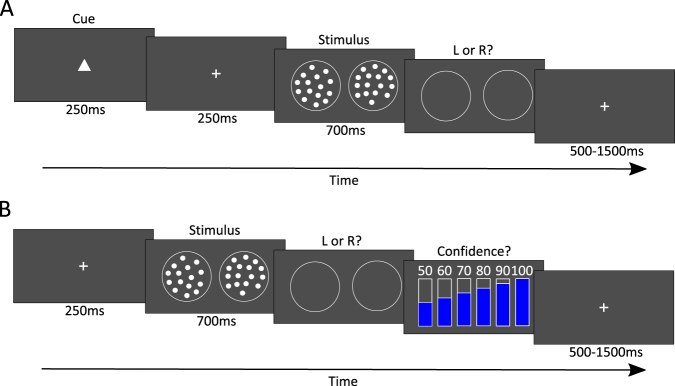
Figure 1
Figure 1
Experimental Design. In both sessions, participants performed the same perceptual task. On each trial, they had to decide which circle (left or right) contained more dots. (A) Learning session. A cue in the form of a geometric shape (a square, circle or triangle) was presented before the stimulus. Two cues were respectively predictive of the left and right circle whereas one cue was non- predictive. Participants were not informed about the associations between these cues and the stimulus categories. At the end of the session, they had to identify the cue-stimuli associations. (B) Confidence Session. Participants gave a confidence rating after each decision.
Figure 2
Figure 2
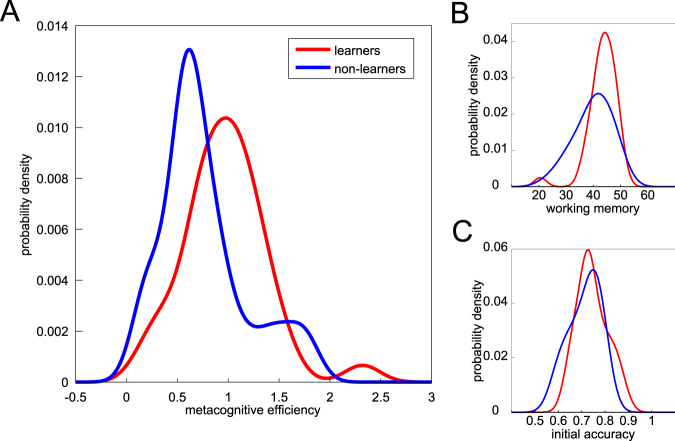
Predicting cue identification. (A) Distributions of the metacognitive efficiency (ratio of meta-d’ over d’) across participants who successfully identified the 3 cue-stimuli associations (“learners”), and participants who did not (“non-learners”). (B) Distributions of working memory scores for “learners” and “non-learners”. (C) Distributions of the initial accuracy in the learning session, for “learners” and “non-learners”.
Figure 3
Figure 3
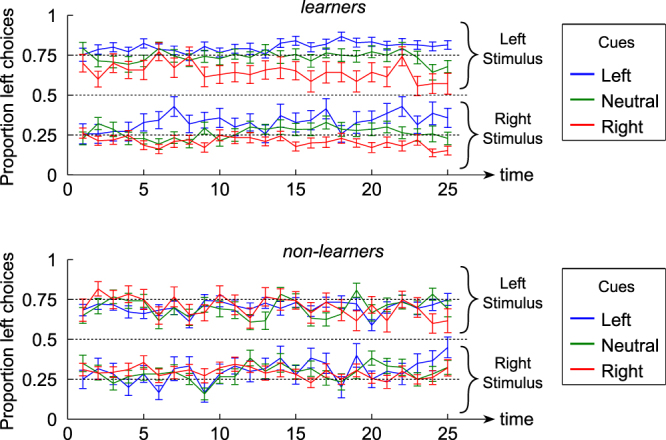
Timecourse of the cue influence. The proportion of left choices is plotted for each stimulus and cue, as a function of time, separately for “learners” and “non-learners” participants. Each point in time represents a block of 8 trials. Error bars represent the mean and the standard error of the mean across participants, in each group.

References

    1. Sutton, R. S. & Barto, A. G. Reinforcement Learning. (MIT Press, 1998).
    1. Rescorla, R. & Wagner, A. In Classical Conditioning II: Current Research and Theory (eds Black, A. & Prokasy, W.) 64–99 (Appleton-Century-Crofts, 1972).
    1. Courville AC, Daw ND, Touretzky DS. Bayesian theories of conditioning in a changing world. Trends Cogn. Sci. 2006;10:294–300. doi: 10.1016/j.tics.2006.05.004. - DOI - PubMed
    1. Behrens TE, Woolrich MW, Walton ME, Rushworth MF. Learning the value of information in an uncertain world. Nat Neurosci. 2007;10:1214–21. doi: 10.1038/nn1954. - DOI - PubMed
    1. Daniel R, Pollmann S. Striatal activations signal prediction errors on confidence in the absence of external feedback. NeuroImage. 2012;59:3457–3467. doi: 10.1016/j.neuroimage.2011.11.058. - DOI - PubMed

Publication types