


Influence of Endurance Training During Childhood on Total Hemoglobin Mass
- PMID: 29618981
- PMCID: PMC5871736
- DOI: 10.3389/fphys.2018.00251
Influence of Endurance Training During Childhood on Total Hemoglobin Mass
Abstract
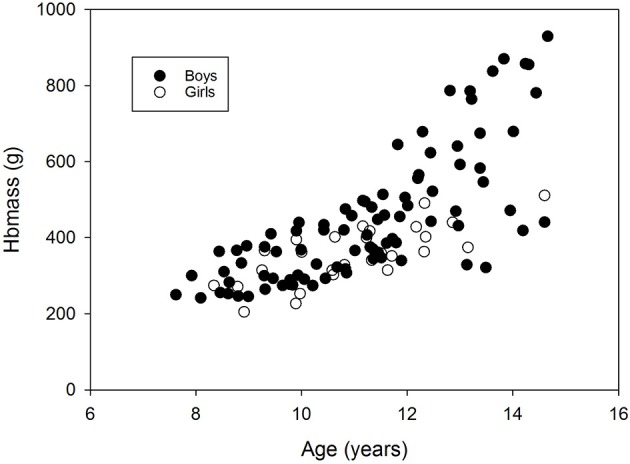
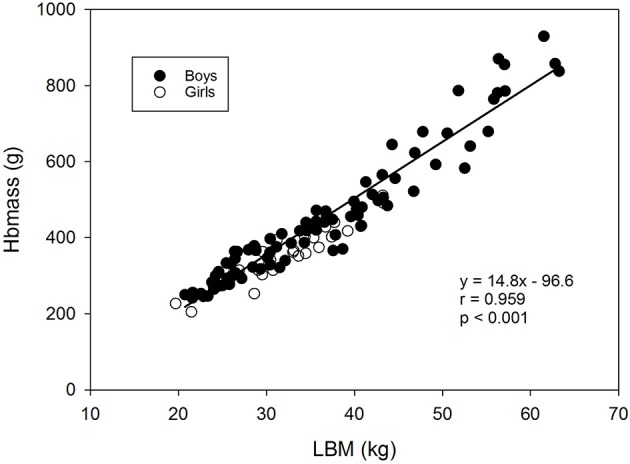
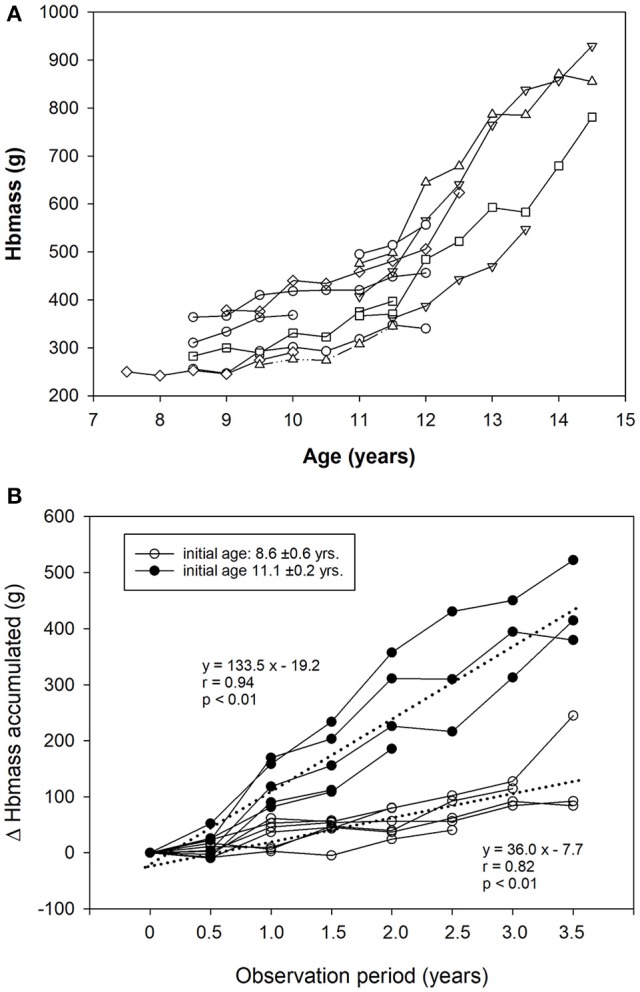
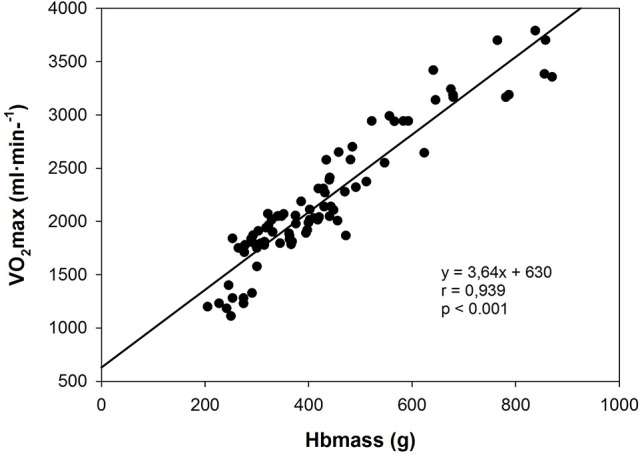
Elite endurance athletes are characterized by markedly increased hemoglobin mass (Hbmass). It has been hypothesized that this adaptation may occur as a response to training at a very young age. Therefore, the aim of this study was to monitor changes in Hbmass in children aged 8-14 years following systematic endurance training. In the first study, Hbmass, VO2max, and lean body mass (LBM) were measured in 17 endurance-trained children (13 boys and 4 girls; aged 9.7 ± 1.3 years; training history 1.5±1.8 years; training volume 3.5 ± 1.6 h) twice a year for up to 3.5 years. The same parameters were measured once in a control group of 18 age-matched untrained children. Hbmass and blood volume (BV) were measured using the optimized CO-rebreathing technique, VO2max by an incremental test on a treadmill, and LBM by skin-fold measurements. In the second pilot study, the same parameters were measured in 9 young soccer athletes (aged 7.8 ± 0.2 years), and results were assessed in relation to soccer performance 2.5 years later. The increase in mean Hbmass during the period of study was 50% which was closely related to changes in LBM (r = 0.959). A significant impact of endurance training on Hbmass was observed in athletes exercising more than 4 h/week [+25.4 g compared to the group with low training volume (<2 h/week)]. The greatest effects were related to LBM (11.4 g·kg-1 LBM) and overlapped with the effects of age. A strong relationship was present between absolute Hbmass and VO2max (r = 0.939), showing that an increase of 1 g hemoglobin increases VO2max by 3.6 ml·min-1. Study 2 showed a positive correlation between Hbmass and soccer performance 2.5 years later at age 10.3 ± 0.3 years (r = 0.627, p = 0.035). In conclusion, children with a weekly training volume of more than 4 h show a 7% higher Hbmass than untrained children. Although this training effect is significant and independent of changes in LBM, the major factor driving the increase in Hbmass is still LBM.
Keywords: blood volume; childhood; endurance training; lean body mass; soccer; talent; total hemoglobin mass.
Figures
References
-
- Astrand P.-O. (1952). Experimental Studies of Physical Working Capacity in Relation to Sex and Age. Copenhagen: Ejnar Munksgaard.
-
- Bar-Or O., Rowland T. W. (2004). Pediatric Exercise Medicine: From Physiologic Principles to Health Care Application. Champaign, IL: Human Kinetics Pub Inc.
LinkOut - more resources
Full Text Sources
Other Literature Sources
Miscellaneous
