Appendicular Skeletal Muscle Mass Reference Values and the Peak Muscle Mass to Identify Sarcopenia among Iranian Healthy Population
- PMID: 29619149
- PMCID: PMC5869961
- DOI: 10.4103/ijpvm.IJPVM_295_17
Appendicular Skeletal Muscle Mass Reference Values and the Peak Muscle Mass to Identify Sarcopenia among Iranian Healthy Population
Abstract
Background: Sacopenia is a common problem in elderly with the adverse outcomes. The objective of this study was to estimate the peak appendicular skeletal muscle mass (ASM) and age of its attainment by sex among the Iranian population.
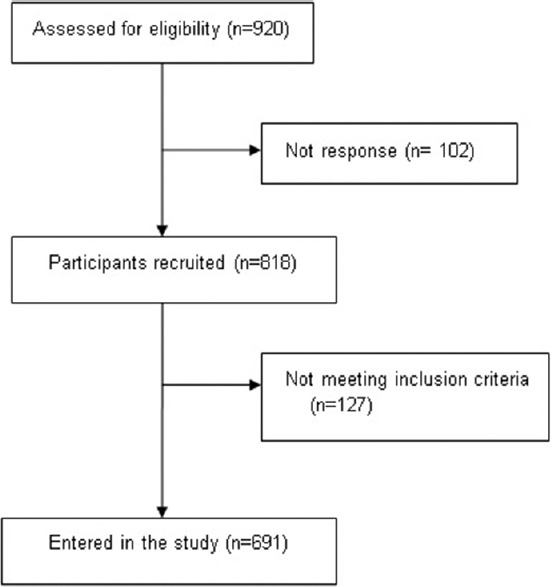
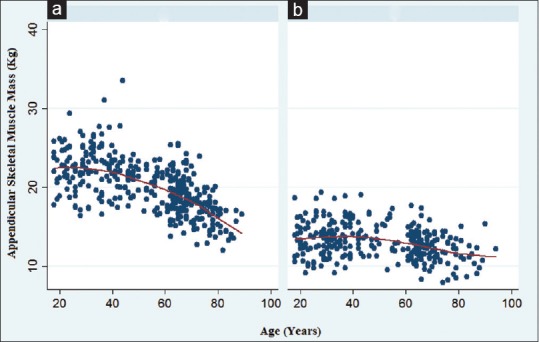
Methods: A total of 691 men and women aged 18-94 years participated in this cross-sectional, population-based study in Bushehr, Iran. ASM was measured by dual X-ray absorptiometry. Cutoff points for men and women were established considering two standard deviations (SDs) below the mean values of the skeletal muscle index (SMI) for young reference groups. The relationship between ASM and age was described by the second-degree regression models. Two SDs below the mean SMIs of reference groups were as cutoff values of low muscle mass in Iranian population.
Results: The peak ASM values were 21.35 ± 0.12 Kg and 13.68 ± 0.10 Kg, and the age at peak ASM were 26 (24-28) years and 34 (33-35) years for men and women, respectively. Mean and SD of SMI in those ages were 7.01 ± 0.02 Kg/m2 and 5.44 ± 0.02 Kg/m2 among men and women, respectively. Calculated cutoff values of low muscle mass among the Iranian population were 7.0 Kg/m2 and 5.4 Kg/m2 among men and women, respectively.
Conclusions: Iranian reference values of SMI for both genders were similar to Asia Working Group for Sarcopenia recommendation and lower than the United States and European values. Further studies from different nations and the Middle East countries are needed to obtain reference values for populations, enabling the researchers for comparison and also more valid reports on sarcopenia prevalence.
Keywords: Iran; peak muscle mass; reference values; sarcopenia.
Conflict of interest statement
There are no conflicts of interest.
Figures
References
-
- Janssen I, Ross R. Linking age-related changes in skeletal muscle mass and composition with metabolism and disease. J Nutr Health Aging. 2005;9:408–19. - PubMed
-
- Landi F, Liperoti R, Russo A. Sarcopenia as a risk factor for falls in elderly individuals: results from the ilSIRENTE study. Clin Nutr. 2012;31:652–8. - PubMed
-
- Janssen I, Heymsfield SB, Ross R. Low relative skeletal muscle mass (sarcopenia) in older persons is associated with functional impairment and physical disability. J Am Geriatr Soc. 2002;50:889–96. - PubMed
LinkOut - more resources
Full Text Sources
Other Literature Sources