Comparative Study
. 2018 Oct;102(10):1710-1716.
doi: 10.1097/TP.0000000000002196.

Reduced Access to Liver Transplantation in Women: Role of Height, MELD Exception Scores, and Renal Function Underestimation

Affiliations
Comparative Study

Reduced Access to Liver Transplantation in Women: Role of Height, MELD Exception Scores, and Renal Function Underestimation

Alina M Allen et al. Transplantation. 2018 Oct.

Abstract

Background: Sex-based disparities in liver transplantation (LT) are incompletely understood. We assessed the role of height, Model for End-Stage Liver Disease (MELD), MELD-Na, and exception points in the disparate access to LT.

Methods: Adults waitlisted for LT at Organ Procurement and Transplantation Network between 2002 and 2013 were included. Covariates associated with likelihood of LT were analyzed by Cox proportional model. In a separate cohort of waitlisted adults with glomerular filtration rate measurement by iothalamate clearance (n = 611), we determined the number of creatinine-derived MELD points in men versus women, across all ranges of glomerular filtration rate. The impact of correcting the MELD score deficit in women on LT was modeled.

Results: Among 90 720 Organ Procurement and Transplantation Network registrants, women had higher mortality than men (4 years after listing: 22% vs 18%, P < 0.0001), and lower likelihood of LT (49% vs 58%, P < 0.0001); women were 20% less likely to be transplanted (hazard ratio, 0.80; 95% confidence interval, 0.78-0.81). Differences in height and MELD exception scores accounted for most of the LT deficit in women (hazard ratio, 0.91; 95% confidence interval, 0.89-0.94). Women received between 1 and 2.4 fewer creatinine-derived MELD points than men with similar renal dysfunction. MELD-Na worsened the gender disparity. Addition of 1 or 2 MELD points to women significantly impacted LT access.

Conclusions: Differences in height and MELD exception points explained most of the sex-based disparity in LT. Additionally, MELD score underestimated disease severity in women by up to 2.4 points and MELD Na exacerbated this disparity. The degree of underestimation based on MELD had significant impact on allocation.


Conflict of interest statement

Conflict of interest: The authors have nothing to disclose.

Figures

Figure 1
Figure 1
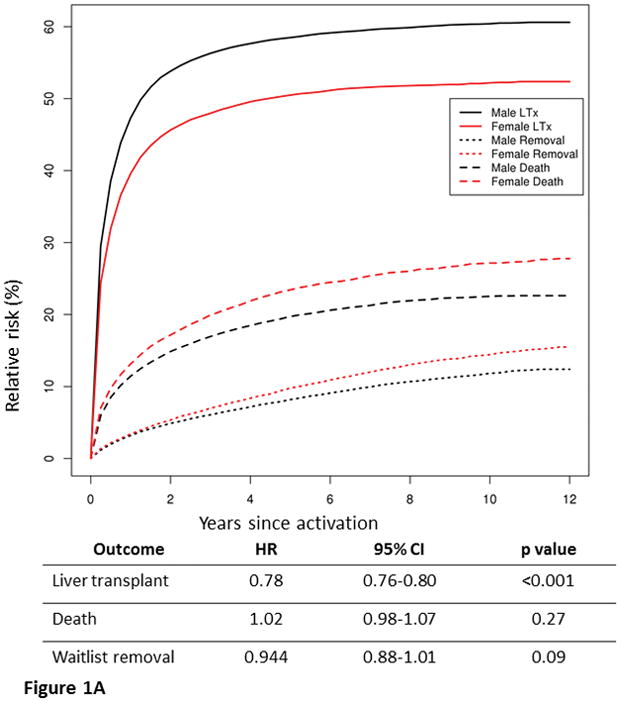
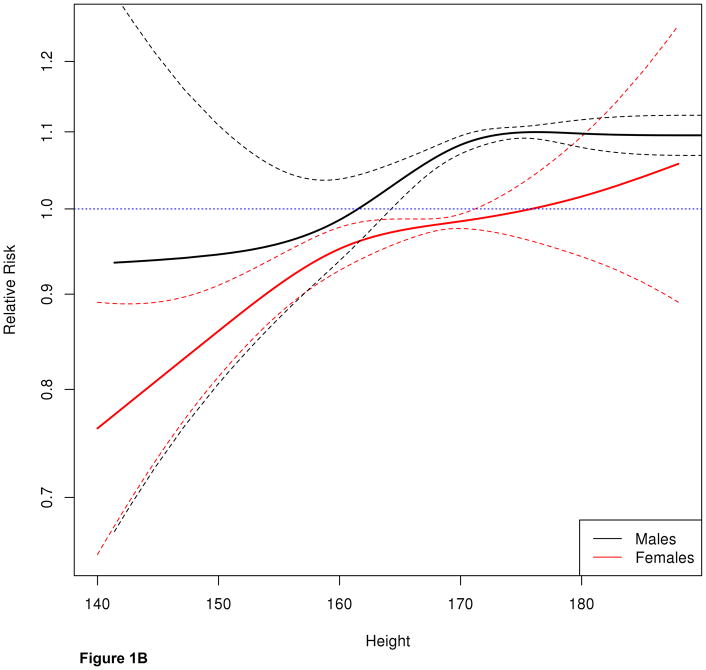
Figure 1A. Risk of liver transplantation, waitlist mortality and removal in men and women among 90,720 OPTN registrants between 2002–2013. The graph represents Aalen-Johansen curves, which are an extension of Kaplan-Meier curves when more than 2 outcomes are possible. The curves are stratified for the following covariates at the time of listing: calculated MELD score, age, UNOS region, blood type and height. Women were less likely than men to undergo LT, more likely to die on the waitlist and to be removed from the list. The Table shows results of regression analysis of the impact of female sex on the 3 outcomes, when stratified by calculated MELD score at listing, age, UNOS region, blood type and height. Female sex is independent risk factor for LT risk but not for waitlist mortality or removal. Figure 1B. Spline curve illustrating the effect of height on liver transplantation stratified by calculated MELD, blood type, age and region. In men and women, the likelihood of LT increased with height in a linear fashion. While the overall pattern was similar between men and women, even the tallest (170 cm) women were approximately 10% less likely than men with similar covariates to receive LT.
Figure 1
Figure 1
Figure 1A. Risk of liver transplantation, waitlist mortality and removal in men and women among 90,720 OPTN registrants between 2002–2013. The graph represents Aalen-Johansen curves, which are an extension of Kaplan-Meier curves when more than 2 outcomes are possible. The curves are stratified for the following covariates at the time of listing: calculated MELD score, age, UNOS region, blood type and height. Women were less likely than men to undergo LT, more likely to die on the waitlist and to be removed from the list. The Table shows results of regression analysis of the impact of female sex on the 3 outcomes, when stratified by calculated MELD score at listing, age, UNOS region, blood type and height. Female sex is independent risk factor for LT risk but not for waitlist mortality or removal. Figure 1B. Spline curve illustrating the effect of height on liver transplantation stratified by calculated MELD, blood type, age and region. In men and women, the likelihood of LT increased with height in a linear fashion. While the overall pattern was similar between men and women, even the tallest (170 cm) women were approximately 10% less likely than men with similar covariates to receive LT.
Figure 2
Figure 2
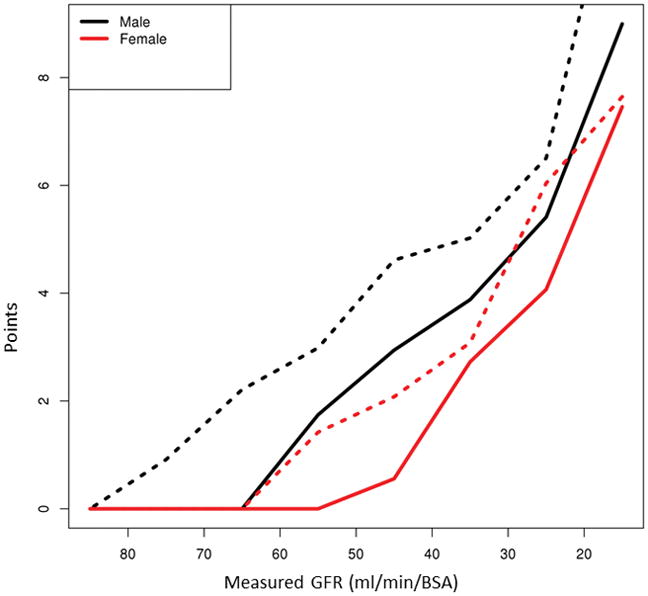
The number of creatinine-derived MELD points (solid lines) and creatinine+sodium derived MELD Na points (dashed lines) in men versus women by range of glomerular filtration rate. Women accrue fewer MELD points derived from serum creatinine and starting at a later stage of renal dysfunction than men with similar measured GFR. Using MELD Na formula, the number of MELD points derived from creatinine plus serum sodium remained higher in men than women across all measured GFR ranges.
Figure 3
Figure 3
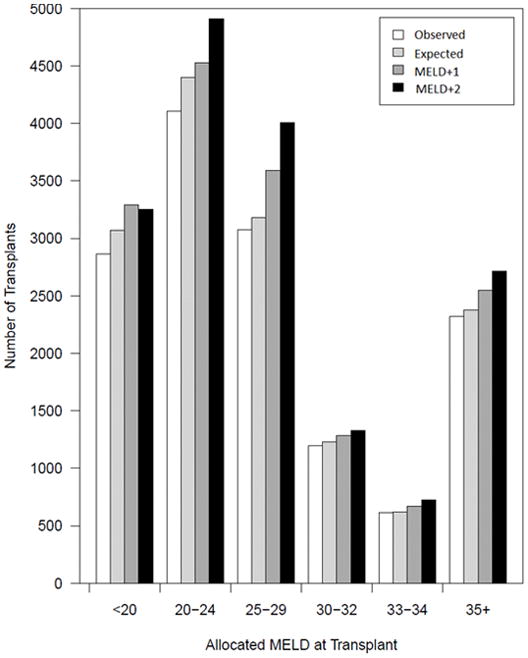
Estimated impact of 1 or 2 MELD points addition on the expected number of liver transplants in women. The bars show the actual LT rates (observed), the probability of receiving a transplant stratified by the current recipient allocated MELD, height, blood type and region (expected) and the predicted probability of receiving a transplant after adding 1 (MELD+1) or 2 (MELD+2) points to the calculated MELD of women with abnormal serum creatinine. The model c-statistic was 0.58.

References

    1. Moylan CA, Brady CW, Johnson JL, et al. Disparities in liver transplantation before and after introduction of the MELD score. JAMA. 2008;300:2371–8. - PMC - PubMed
    1. Mathur AK, Schaubel DE, Gong Q, et al. Sex-based disparities in liver transplant rates in the United States. Am J Transplant. 2011;11:1435–43. - PMC - PubMed
    1. Lai JC, Terrault NA, Vittinghoff E, et al. Height contributes to the gender difference in wait-list mortality under the MELD-based liver allocation system. Am J Transplant. 2010;10:2658–64. - PMC - PubMed
    1. Bryce CL, Angus DC, Arnold RM, et al. Sociodemographic differences in early access to liver transplantation services. Am J Transplant. 2009;9:2092–101. - PMC - PubMed
    1. Cholongitas E, Marelli L, Kerry A, et al. Female liver transplant recipients with the same GFR as male recipients have lower MELD scores--a systematic bias. Am J Transplant. 2007;7:685–92. - PubMed

Publication types

MeSH terms