


Complex Regulatory Networks Governing Production of the Glycopeptide A40926
- PMID: 29621136
- PMCID: PMC6022936
- DOI: 10.3390/antibiotics7020030
Complex Regulatory Networks Governing Production of the Glycopeptide A40926
Abstract
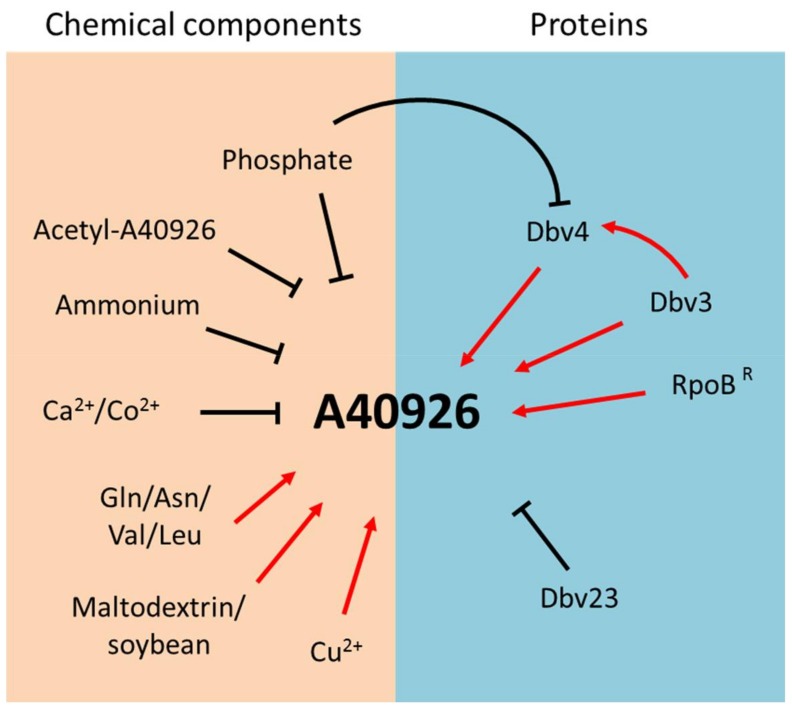
Glycopeptides (GPAs) are an important class of antibiotics, with vancomycin and teicoplanin being used in the last 40 years as drugs of last resort to treat infections caused by Gram-positive pathogens, including methicillin-resistant Staphylococcus aureus. A few new GPAs have since reached the market. One of them is dalbavancin, a derivative of A40926 produced by the actinomycete Nonomuraea sp. ATCC 39727, recently classified as N. gerenzanensis. This review summarizes what we currently know on the multilevel regulatory processes governing production of the glycopeptide A40926 and the different approaches used to increase antibiotic yields. Some nutrients, e.g., valine, l-glutamine and maltodextrin, and some endogenous proteins, e.g., Dbv3, Dbv4 and RpoBR, have a positive role on A40926 biosynthesis, while other factors, e.g., phosphate, ammonium and Dbv23, have a negative effect. Overall, the results available so far point to a complex regulatory network controlling A40926 in the native producing strain.
Keywords: A40926; LAL; LuxR solo; StrR; dalbavancin; dbv cluster; glycopeptide antibiotics; regulatory genes.
Conflict of interest statement
The authors declare no conflict of interest.
Figures
References
-
- Kittila T., Kittel C., Tailhades J., Butz D., Schoppet M., Buttner A., Goode R.J.A., Schittenhelm R.B., van Pee K.H., Sussmuth R.D., et al. Halogenation of glycopeptide antibiotics occurs at the amino acid level during non-ribosomal peptide synthesis. Chem. Sci. 2017;8:5992–6004. doi: 10.1039/C7SC00460E. - DOI - PMC - PubMed
Publication types
LinkOut - more resources
Full Text Sources
Other Literature Sources
Molecular Biology Databases
