Review
. 2018 Apr 5;19(4):1089.
doi: 10.3390/ijms19041089.

Applications of CRISPR/Cas System to Bacterial Metabolic Engineering

Affiliations
Review

Applications of CRISPR/Cas System to Bacterial Metabolic Engineering

Suhyung Cho et al. Int J Mol Sci. .

Abstract

The clustered regularly interspaced short palindromic repeats/CRISPR-associated (CRISPR/Cas) adaptive immune system has been extensively used for gene editing, including gene deletion, insertion, and replacement in bacterial and eukaryotic cells owing to its simple, rapid, and efficient activities in unprecedented resolution. Furthermore, the CRISPR interference (CRISPRi) system including deactivated Cas9 (dCas9) with inactivated endonuclease activity has been further investigated for regulation of the target gene transiently or constitutively, avoiding cell death by disruption of genome. This review discusses the applications of CRISPR/Cas for genome editing in various bacterial systems and their applications. In particular, CRISPR technology has been used for the production of metabolites of high industrial significance, including biochemical, biofuel, and pharmaceutical products/precursors in bacteria. Here, we focus on methods to increase the productivity and yield/titer scan by controlling metabolic flux through individual or combinatorial use of CRISPR/Cas and CRISPRi systems with introduction of synthetic pathway in industrially common bacteria including Escherichia coli. Further, we discuss additional useful applications of the CRISPR/Cas system, including its use in functional genomics.

Keywords: CRISPR/Cas; CRISPRa; CRISPRi; gene regulation; genome editing; metabolic engineering.


Conflict of interest statement

The authors declare no conflict of interest.

Figures
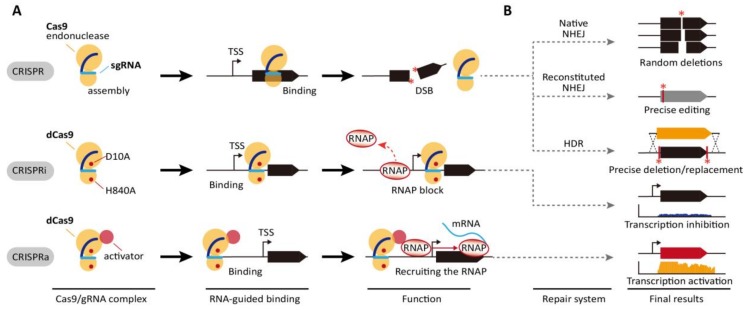
Figure 1
Figure 1
The CRISPR, CRISPRi, and CRISPRa systems. (A) CRISPR/Cas system consists of a Cas9 protein and a designed chimeric sgRNA complementary to the genomic target sequence (blue line). Upon the binding to the specific DNA sequence by Cas9-sgRNA complex, the DNA is cleaved by Cas9 with endonuclease activity. CRISPR interference (CRISPRi) is caused by a catalytically dead Cas9 (D10A and H840A mutations indicated by red dots), denoted as dCas9. The dCas9-sgRNA complex binds to the upstream region of the gene of interest, resulting that the process of RNA polymerase (RNAP) is inhibited and consequently transcription is blocked. CRISPR activation (CRISPRa) is applied for gene activation by the fusion of dCas9 and transcription activators such as RNAP ω subunit in E. coli. (B) Double strand break formed by CRISPR/Cas system can be repaired by the error prone non-homologous end joining (native NHEJ) pathway, resulting in the formation of random sized deletions around the targeted DNA sequence. With expression of a ligase such as LigD, NHEJ pathway creates the precise editing (reconstituted NHEJ). With the presence of homologous template, the gene deletion or replacement by homology-directed repair (HDR) is generated with high efficiency and the precision with near 100% frequency [8,19]. The asterisk indicates DSB-dependent modified region.
Figure 2
Figure 2
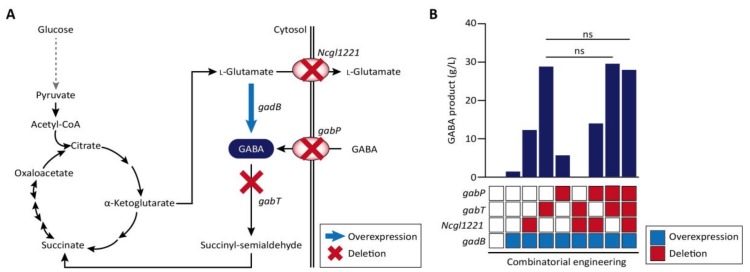
A metabolic engineering strategy for GABA production in wild-type C. glutamicum. (A) Metabolic pathway for GABA production in C. glutamicum, where genes Ncgl1221, gabT and gabP encoding the l-glutamate transporter, GABA transaminase and GABA permease, respectively, are targeted for deletion, using CRISPR/Cas, and gadB is overexpressed. Dotted arrow indicates simplified schematic of glycolysis pathway. The enzymatic reactions are represented by two-way or single black arrows, according to the reversibility of the reactions. (B) Through combinatorial gene regulation of four genes, the key gene for GABA production was screened [59].
Figure 3
Figure 3
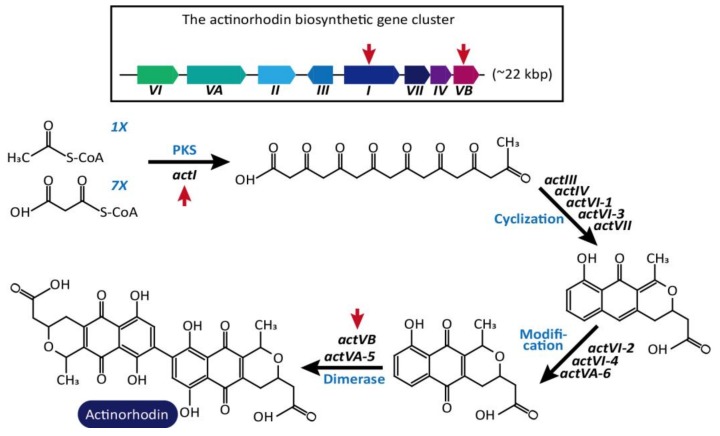
Regulation of actinorhodin biosynthetic pathway in S. coelicolor A3. The organization of the actinorhodin biosynthetic gene cluster (22 kbp) is shown. 1× Acetyl-CoA and 7× malonyl-CoA creates the long carbon skeleton by actI. Then, the carbon backbone is cyclized to form a (S)-DNPA by actIII, actIV, actVI-1, actVI-3, and actVII, and modified to DHK by actVI-2, actVI-4, and actVA-6. Two DHK molecules finally produce actinorhodin through dimerization by actVB and actVA-5. The biosynthesis of blue-pigmented polyketide antibiotic actinorhodin was inactivated by targeting actI and actVB by CRISPR/Cas9 [19] Red arrows indicate sgRNA targets.
Figure 4
Figure 4
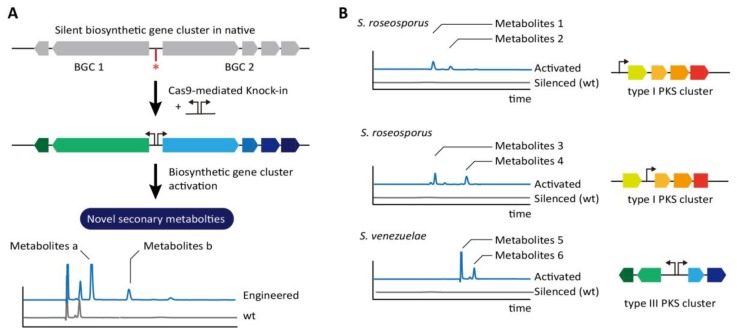
Identification of novel metabolites through insertion of synthetic promoter in the upstream of silent biosynthetic gene cluster (BGC) in native (A) Using CRISPR-Cas9, efficient and precise introduction of promoter cassettes (red-shaded arrows) induces the expression of biosynthetic genes and triggers the production of unique metabolites that are not detected in the wild-type strain. The asterisk indicates DSB-dependent modified region. (B) The metabolites of different type are shown according to the promoter insertion location in type I PKS cluster in S. roseosporus. In S. venezuelae, the insertion of a bidirectional promoter cassette between a type III PKS gene encoding an RppA synthase and a cytochrome P450 gene resulted in production of novel pigmented products [71].
Figure 5
Figure 5
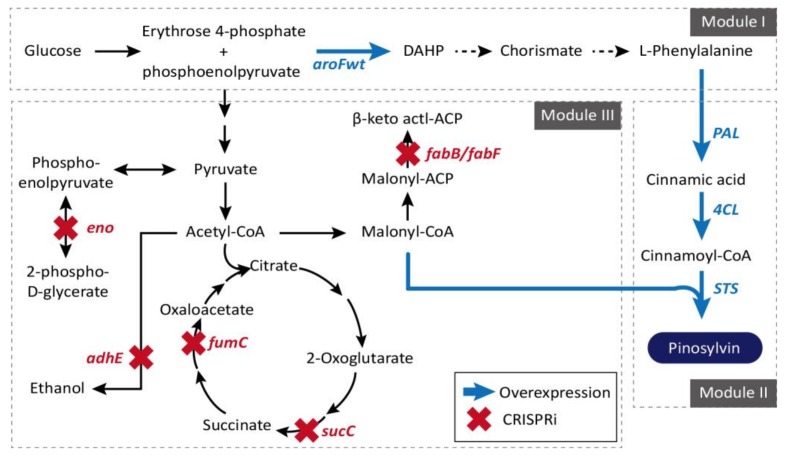
For high-yield pinosylvin synthesis, three different modules are selected and redirected. Genes selected for efficient channeling of the carbon flux toward malonyl-CoA, shown in red, are inhibited through CRISPRi. The metabolic pathway that performs heterologous biosynthesis of (2S)-naringenin from L-tyrosine in E. coli shown in blue was overexpressed. CHI: chalcone isomerase; CHS: chalcone synthase; 4CL: 4-coumarate:CoA ligase; E4P: erythrose-4-phosphate; PEP: phosphoenolpyruvate; TAL: tyrosine ammonia lyase [76].

References

    1. Ishino Y., Shinagawa H., Makino K., Amemura M., Nakata A. Nucleotide sequence of the iap gene, responsible for alkaline phosphatase isozyme conversion in Escherichia coli, and identification of the gene product. J. Bacteriol. 1987;169:5429–5433. doi: 10.1128/jb.169.12.5429-5433.1987. - DOI - PMC - PubMed
    1. Grissa I., Vergnaud G., Pourcel C. CRISPRfinder: A web tool to identify clustered regularly interspaced short palindromic repeats. Nucleic Acids Res. 2007;35:W52–W57. doi: 10.1093/nar/gkm360. - DOI - PMC - PubMed
    1. Carroll D. Genome engineering with zinc-finger nucleases. Genetics. 2011;188:773–782. doi: 10.1534/genetics.111.131433. - DOI - PMC - PubMed
    1. Urnov F.D., Miller J.C., Lee Y.L., Beausejour C.M., Rock J.M., Augustus S., Jamieson A.C., Porteus M.H., Gregory P.D., Holmes M.C. Highly efficient endogenous human gene correction using designed zinc-finger nucleases. Nature. 2005;435:646–651. doi: 10.1038/nature03556. - DOI - PubMed
    1. Boch J., Scholze H., Schornack S., Landgraf A., Hahn S., Kay S., Lahaye T., Nickstadt A., Bonas U. Breaking the code of DNA binding specificity of Tal-type III effectors. Science. 2009;326:1509–1512. doi: 10.1126/science.1178811. - DOI - PubMed