A Pharmacogenetic Approach to the Treatment of Patients With PPARG Mutations
- PMID: 29622583
- PMCID: PMC5967605
- DOI: 10.2337/db17-1236
A Pharmacogenetic Approach to the Treatment of Patients With PPARG Mutations
Abstract
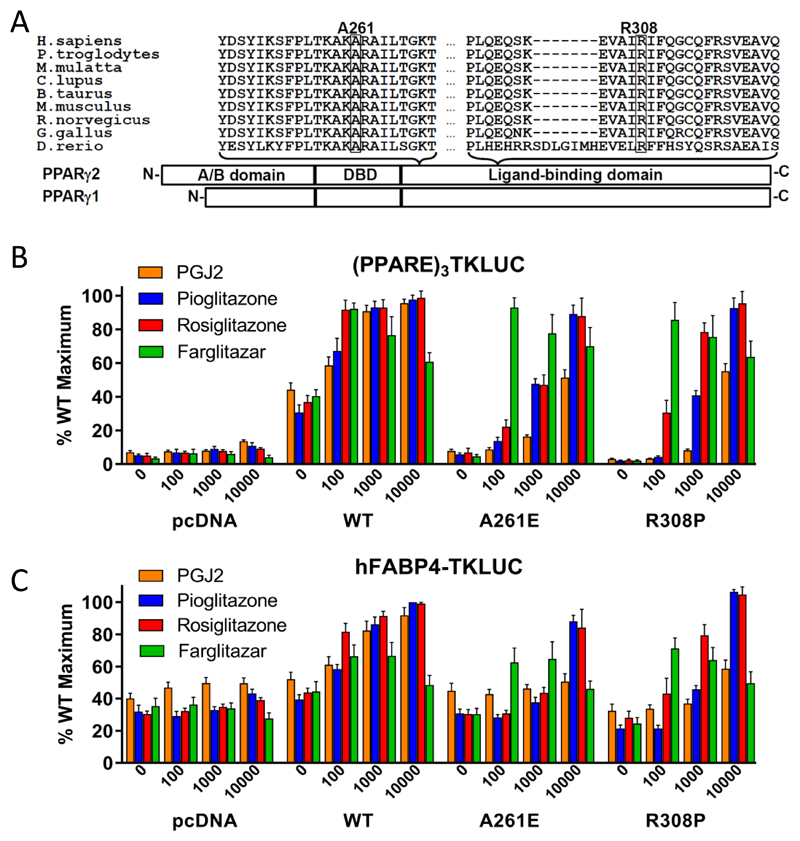
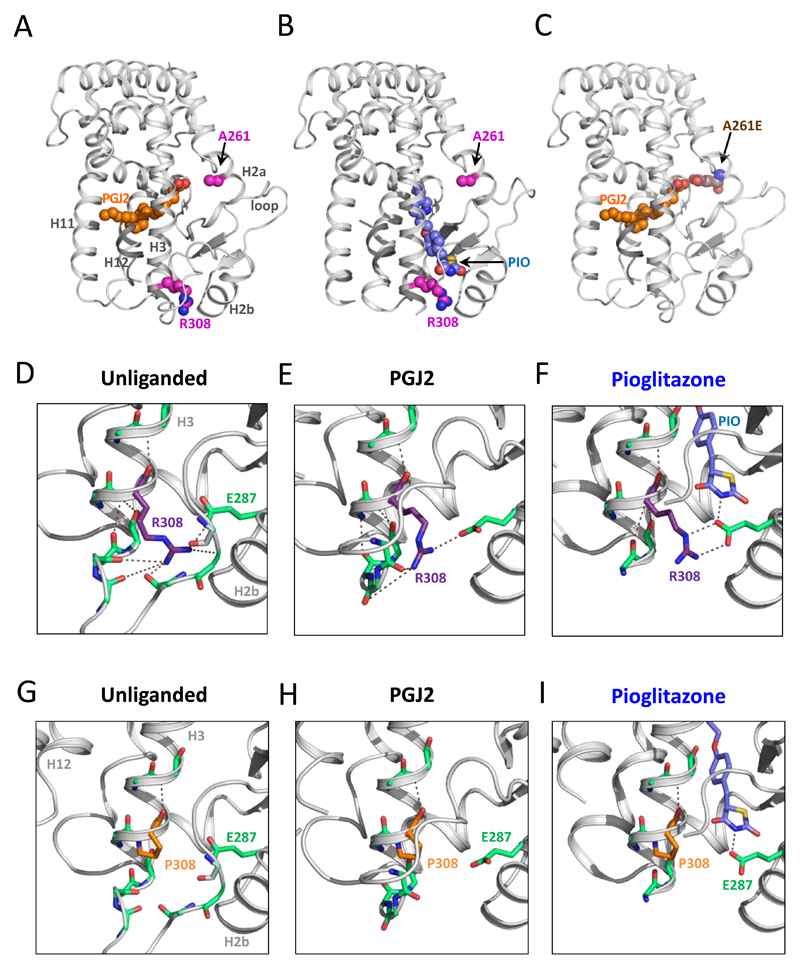
Loss-of-function mutations in PPARG cause familial partial lipodystrophy type 3 (FPLD3) and severe metabolic disease in many patients. Missense mutations in PPARG are present in ∼1 in 500 people. Although mutations are often binarily classified as benign or deleterious, prospective functional classification of all missense PPARG variants suggests that their impact is graded. Furthermore, in testing novel mutations with both prototypic endogenous (e.g., prostaglandin J2 [PGJ2]) and synthetic ligands (thiazolidinediones, tyrosine agonists), we observed that synthetic agonists selectively rescue function of some peroxisome proliferator-activated receptor-γ (PPARγ) mutants. We report on patients with FPLD3 who harbor two such PPARγ mutations (R308P and A261E). Both PPARγ mutants exhibit negligible constitutive or PGJ2-induced transcriptional activity but respond readily to synthetic agonists in vitro, with structural modeling providing a basis for such differential ligand-dependent responsiveness. Concordant with this finding, dramatic clinical improvement was seen after pioglitazone treatment of a patient with R308P mutant PPARγ. A patient with A261E mutant PPARγ also responded beneficially to rosiglitazone, although cardiomyopathy precluded prolonged thiazolidinedione use. These observations indicate that detailed structural and functional classification can be used to inform therapeutic decisions in patients with PPARG mutations.
© 2018 by the American Diabetes Association.
Conflict of interest statement
The authors report no potential conflicts of interest relevant to this article.
Figures
References
-
- Spiegelman BM. PPAR-gamma: Adipogenic regulator and thiazolidinedione receptor. Diabetes. 1998;47:507–514. - PubMed
-
- Lazar M. PPAR gamma, 10 years later. Biochimie. 2005;87(1):9–13. - PubMed
-
- Hallenborg P, Petersen RK, Kouskoumvekaki I, Newman JW, Madsen L, Kristiansen K. The elusive endogenous adipogenic PPARG agonists: Lining up the suspects. Progress in Lipid Research. 2016;61:149–162. - PubMed
-
- Barroso I, Gurnell M, Crowley VEF, Agostini M, Schwabe JW, Soos MA, et al. Dominant negative mutations in human PPAR gamma associated with severe insulin resistance, diabetes mellitus and hypertension. Nature. 1999;402:880–883. - PubMed
Publication types
MeSH terms
Substances
Grants and funding
LinkOut - more resources
Full Text Sources
Other Literature Sources
Medical