Review
. 2019 Apr 5;294(14):5396-5407.
doi: 10.1074/jbc.TM117.000893. Epub 2018 Apr 5.

Mitochondrial proteostasis in the context of cellular and organismal health and aging

Affiliations
Review

Mitochondrial proteostasis in the context of cellular and organismal health and aging

Erica A Moehle et al. J Biol Chem. .

Abstract

As a central hub of cellular metabolism and signaling, the mitochondrion is a crucial organelle whose dysfunction can cause disease and whose activity is intimately connected to aging. We review how the mitochondrial network maintains proteomic integrity, how mitochondrial proteotoxic stress is communicated and resolved in the context of the entire cell, and how mitochondrial systems function in the context of organismal health and aging. A deeper understanding of how mitochondrial protein quality control mechanisms are coordinated across these distinct biological levels should help explain why these mechanisms fail with age and, ultimately, how routes to intervention might be attained.

Keywords: aging; mitochondria; proteostasis; stress; unfolded protein response (UPR).


Conflict of interest statement

The authors declare that they have no conflicts of interest with the contents of this article.

Figures
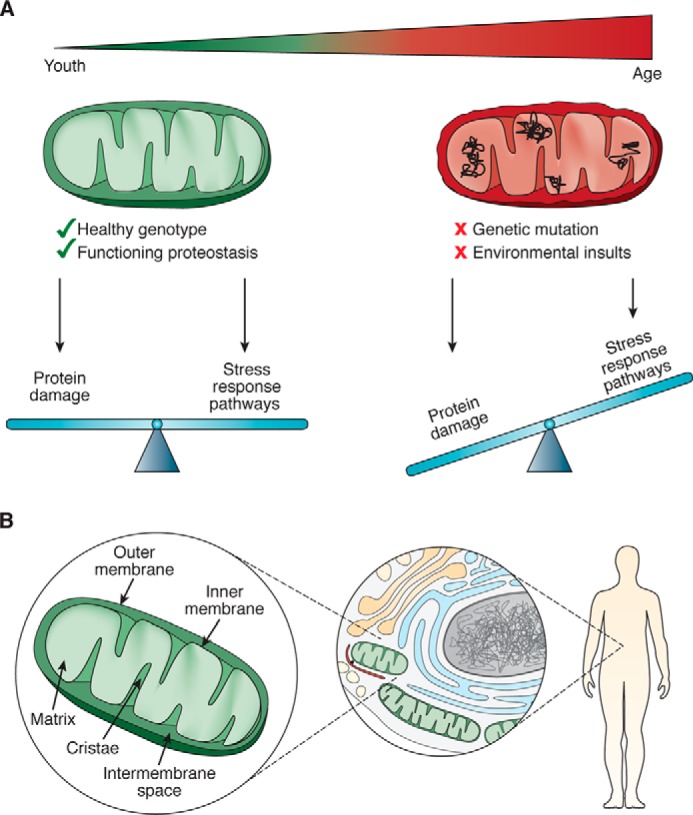
Figure 1.
Figure 1.
Factors that impact mitochondrial proteostasis. A, mitochondria must balance the damage that occurs to its proteins with activation of pathways evolved to counteract this damage. B, mitochondrial proteostasis occurs at multiple scales: at the level of the mitochondrion, the mitochondrion's interaction with the rest of the cell, and with the organism as it impacts metabolism, health, and life span.
Figure 2.
Figure 2.
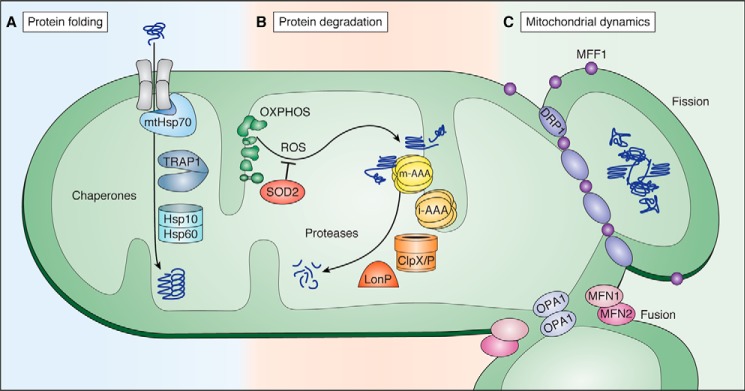
Protein quality control machines at work within mitochondria. A, protein folding chaperones that function in the mitochondrial matrix to fold nascent polypeptides or repair mis-folded proteins. B, proteins can be damaged by the ROS generated by components of the OXPHOS machinery. Proteases in the intermembrane space and matrix degrade these damaged proteins. C, fission and fusion work dynamically to alter the shape of the mitochondrial network to dilute or segregate areas of damage.
Figure 3.
Figure 3.
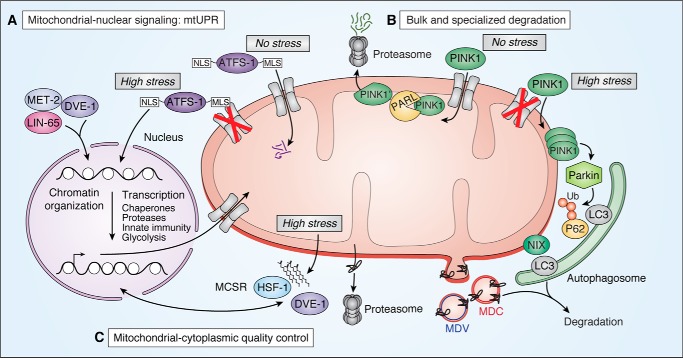
Mitochondrial proteostasis mechanisms that function at the level of the cell. A, mitochondrial–nuclear communication as described in C. elegans. Mitochondria signal proteotoxic stress to the nucleus to up-regulate genes that will aid in restoring mitochondrial health as well as enact epigenetic changes across the genome. We focus on the ATFS-1 and LIN-65/MET-2/DVE-1 pathways. During basal conditions (No stress), the MLS targets ATFS-1 for mitochondrial import and subsequent degradation. During mitochondrial stress (High stress), low mitochondrial membrane potential and blocked mitochondrial import impairs mitochondrial targeting of ATFS-1, instead allowing NLS-dependent nuclear localization of ATFS-1, where it activates various gene transcription pathways. NLS, nuclear localization sequence; MLS, mitochondrial localization sequence. For a complete summary of all identified mtUPR players, we direct the reader to two recent mtUPR-focused reviews (154, 155). B, mechanisms of mitochondrial degradation via mitophagy for bulk degradation (top) or specialized, vesicle-dependent degradation (bottom). Mitophagy by either the PINK1/Parkin or NIX pathways in humans requires recognition of defective mitochondria, followed by recruitment and engulfment by an autophagosome membrane, and shuttling to the lysosome. Under basal conditions (No stress), PINK1 is targeted to the mitochondria and rapidly degraded. In one described mechanism, this occurs via mitochondrial import and N-terminal cleavage by the inner membrane protease PARL (99). N-terminally cleaved PINK1 (PINK1′) is then shuttled to the cytoplasm for proteasomal degradation. MDC (Saccharomyces cerevisiae) and MDV (humans) have both been shown to selectively target mitochondrial protein and other metabolite cargo for degradation. C, mitochondrial–cytoplasmic quality control mechanisms include the MCSR from C. elegans and proteasome-dependent degradation of mitochondrial outer membrane proteins. HSF-1, heat-shock factor 1.

References

    1. Pagliarini D. J., Calvo S. E., Chang B., Sheth S. A., Vafai S. B., Ong S.-E., Walford G. A., Sugiana C., Boneh A., Chen W. K., Hill D. E., Vidal M., Evans J. G., Thorburn D. R., Carr S. A., and Mootha V. K. (2008) A mitochondrial protein compendium elucidates complex I disease biology. Cell 134, 112–123 - PMC - PubMed
    1. Dick F. D. (2006) Parkinson's disease and pesticide exposures. Br. Med. Bull. 79–80, 219–231 - PubMed
    1. Nyström T. (2005) Role of oxidative carbonylation in protein quality control and senescence. EMBO J. 24, 1311–1317 10.1038/sj.emboj.7600599 - DOI - PMC - PubMed
    1. Corral-Debrinski M., Stepien G., Shoffner J. M., Lott M. T., Kanter K., and Wallace D. C. (1991) Hypoxemia is associated with mitochondrial DNA damage and gene induction. Implications for cardiac disease. JAMA 266, 1812–1816 10.1001/jama.1991.03470130092035 - DOI - PubMed
    1. Corral-Debrinski M., Horton T., Lott M. T., Shoffner J. M., McKee A. C., Beal M. F., Graham B. H., and Wallace D. C. (1994) Marked changes in mitochondrial DNA deletion levels in Alzheimer brains. Genomics 23, 471–476 10.1006/geno.1994.1525 - DOI - PubMed

Publication types

Substances