Review
. 2018 May;15(5):291-308.
doi: 10.1038/nrgastro.2018.7. Epub 2018 Apr 6.

Expert consensus document: Advances in the diagnosis and classification of gastric and intestinal motility disorders

Affiliations
Review

Expert consensus document: Advances in the diagnosis and classification of gastric and intestinal motility disorders

Jutta Keller et al. Nat Rev Gastroenterol Hepatol. 2018 May.

Abstract

Disturbances of gastric, intestinal and colonic motor and sensory functions affect a large proportion of the population worldwide, impair quality of life and cause considerable health-care costs. Assessment of gastrointestinal motility in these patients can serve to establish diagnosis and to guide therapy. Major advances in diagnostic techniques during the past 5-10 years have led to this update about indications for and selection and performance of currently available tests. As symptoms have poor concordance with gastrointestinal motor dysfunction, clinical motility testing is indicated in patients in whom there is no evidence of causative mucosal or structural diseases such as inflammatory or malignant disease. Transit tests using radiopaque markers, scintigraphy, breath tests and wireless motility capsules are noninvasive. Other tests of gastrointestinal contractility or sensation usually require intubation, typically represent second-line investigations limited to patients with severe symptoms and are performed at only specialized centres. This Consensus Statement details recommended tests as well as useful clinical alternatives for investigation of gastric, small bowel and colonic motility. The article provides recommendations on how to classify gastrointestinal motor disorders on the basis of test results and describes how test results guide treatment decisions.


Figures
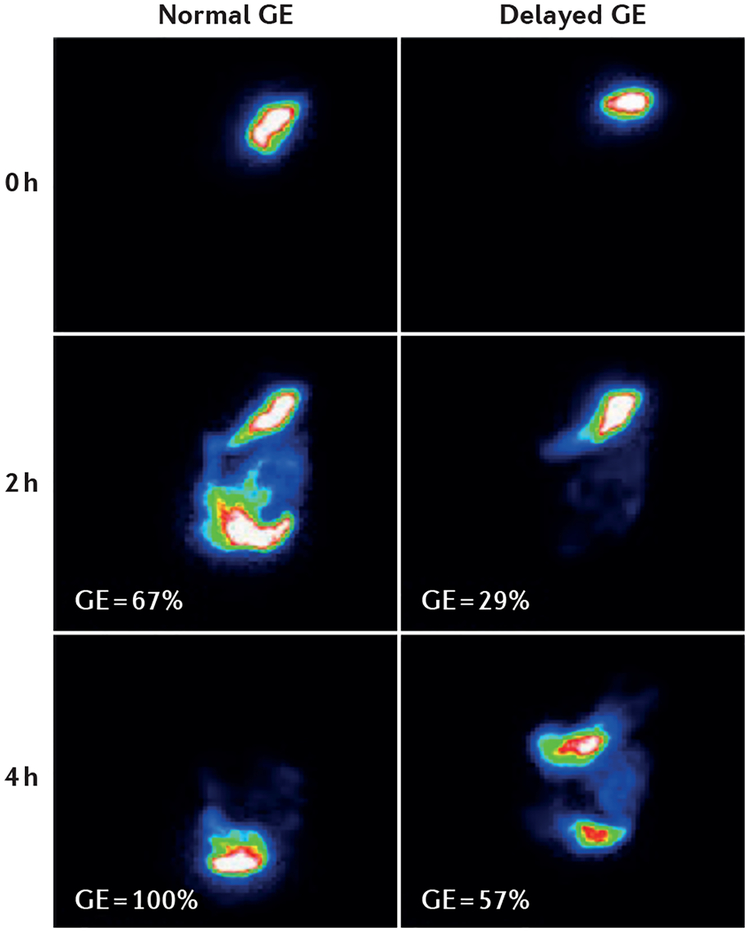
Figure 1 |
Figure 1 |. Representative examples of gastric emptying as assessed using scintigraphy.
Standardized scintigraphic study of gastric emptying of solids with consumption of a 320 kcal radiolabelled meal (scrambled eggs labelled with 99mTc; Mayo Clinic protocol) and imaging over 4 h. In the individual with normal gastric emptying (GE) (left panel), large amounts of the meal are emptied from the stomach at 2 h, and GE is completed at4 h. In the individual with delayed GE (right panel), gastric retention of the test meal at 2 h and particularly at 4 h is increased (normative values were determined from 319 healthy volunteers; clinically relevant delayed GE is defined as a percentage retention >75% at 2 h and >25% at 4 h).
Figure 2 |
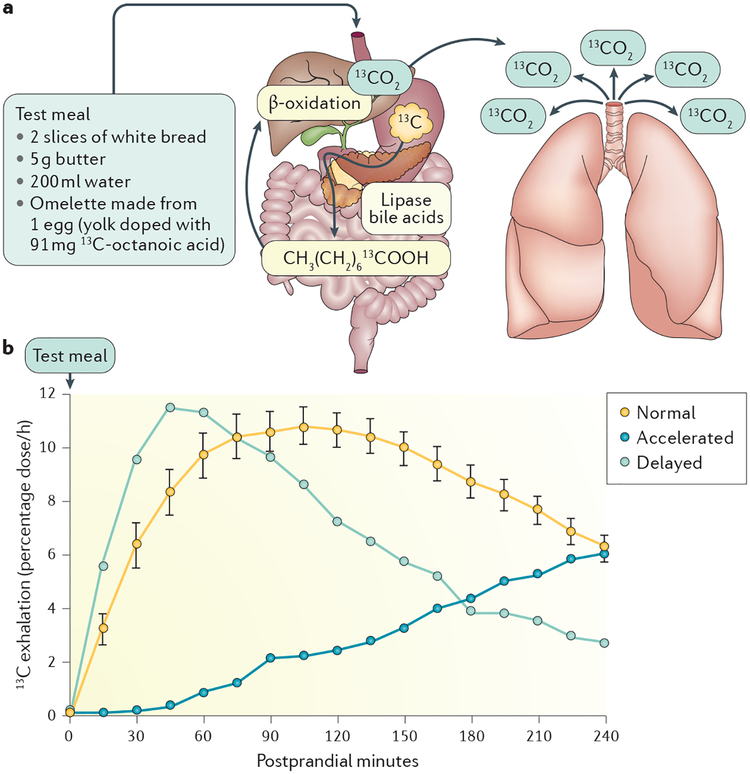
Figure 2 |. 13C-octanoic acid gastric emptying breath test.
The test principle underlying the 13C-octanoic acid breath test (part a) is as follows: 13C-octaonoic acid is rapidly absorbed after gastric emptying and transported to the liver. Hepatic metabolism leads to production and exhalation of 13CO2. Thus, alterations of the 13C:12C ratio in breath samples collected at multiple time points postprandially reflect gastric emptying. Examples (part b) of values for accelerated, normal and delayed gastric emptying are shown. Normal data (mean ± s.e.m.) are derived from 20 healthy individuals.
Figure 3 |
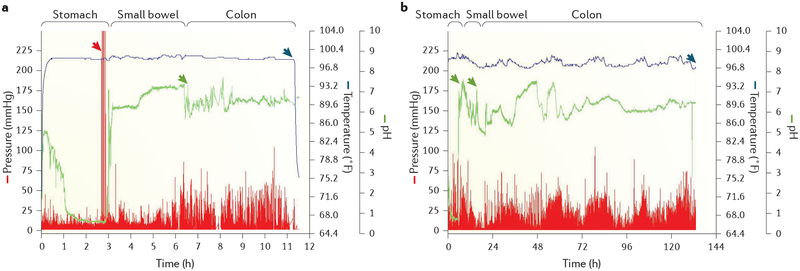
Figure 3 |. Example wireless motility recording.
Wireless motility recordings in a healthy male participant (part a) and a female patient with severe constipation (part b) are shown. Gastric emptying in the control individual (part a) occurs after ~3 h (upper limit of normal: 5–6 h) and is preceded by strong antral contractions suggestive of antral phase III motility (red arrow). A constant decrease in pH at ~6 h 30 min (green arrow) marks ileocaecal transit, such that small bowel transit time is estimated to be ~3 h 30 min (normal range: 2.5–8 h). Abrupt temperature drop (blue arrow) shows that the capsule is excreted after ~11h 30 min, such that colonic transit time is ~5 h, which is equivalent to the lower limit of normal. In the patient with severe constipation (part b), gastric emptying time is relatively long (~5 h, first green arrow), ileocaecal transit occurs ~16 h after ingestion of the motility capsule (second green arrow), and excretion of the capsule does not occur until 133 h (blue arrow), such that both small bowel transit time (~11 h) and colonic transit time (~117 h) are prolonged. Please note that the timescales are different for the left and right panels.
Figure 4 |
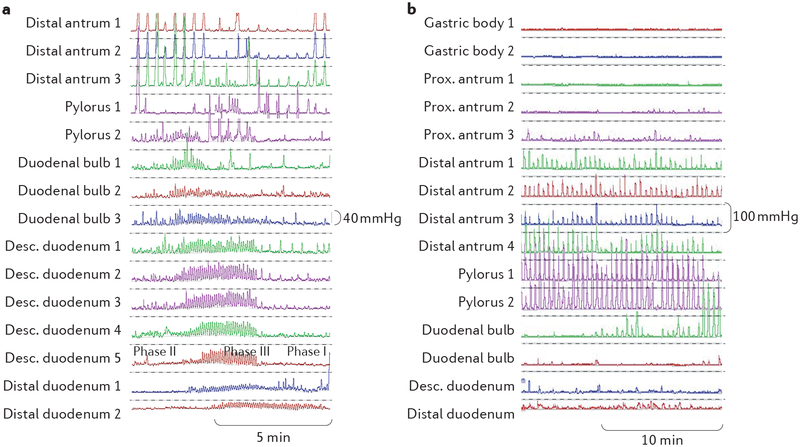
Figure 4 |. Example plots of high-resolution gastroduodenal manometry.
High-resolution gastroduodenal manometry plots are shown for normal fasting (part a) and postprandial (part b) motility. Antral motility is characterized by high-amplitude contractions with a maximal contraction rate of ~3 per min. Amplitudes of contraction in the small bowel are lower, but frequency is higher (up to ~12 per min). During the fasting state (part a), there is a constant transition between phases I to III of the interdigestive migrating motor complex (MMC) with motor quiescence during phase I, irregular contractions that are propagated over only smaller segments during phase II and regular, aborally propagated contractions that usually start in the stomach and traverse long segments of the small bowel during phase III. Postprandially (part b), MMC activity is interrupted and replaced by irregular contractions that serve to mix the luminal contents and to slowly propel them towards the more distal intestine. Desc., descending; Prox., proximal.
Figure 5 |
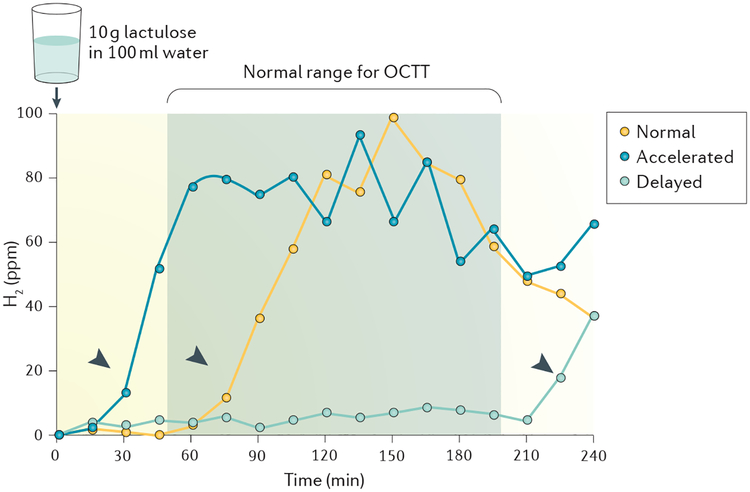
Figure 5 |. Lactulose H2 breath test for measurement of orocaecal transit time.
Representative lactulose H2 breath tests (LHBTs) are shown for accelerated (30 min), normal (75 min) and delayed (225 min) orocaecal transit times (OCTTs). The test requires H2 measurements at regular intervals after ingestion of lactulose. H2 values of >10 ppm over basal values followed by at least two subsequent increments (arrows) indicate caecal delivery of the nonabsorbable substrate with subsequent bacterial metabolism. This increase in H2 exhalation normally occurs 50–200 min after ingestion of the marker substance (normal range for OCTT marked in grey).
Figure 6 |
Figure 6 |. Assessment of colonic transit time with radiopaque markers.
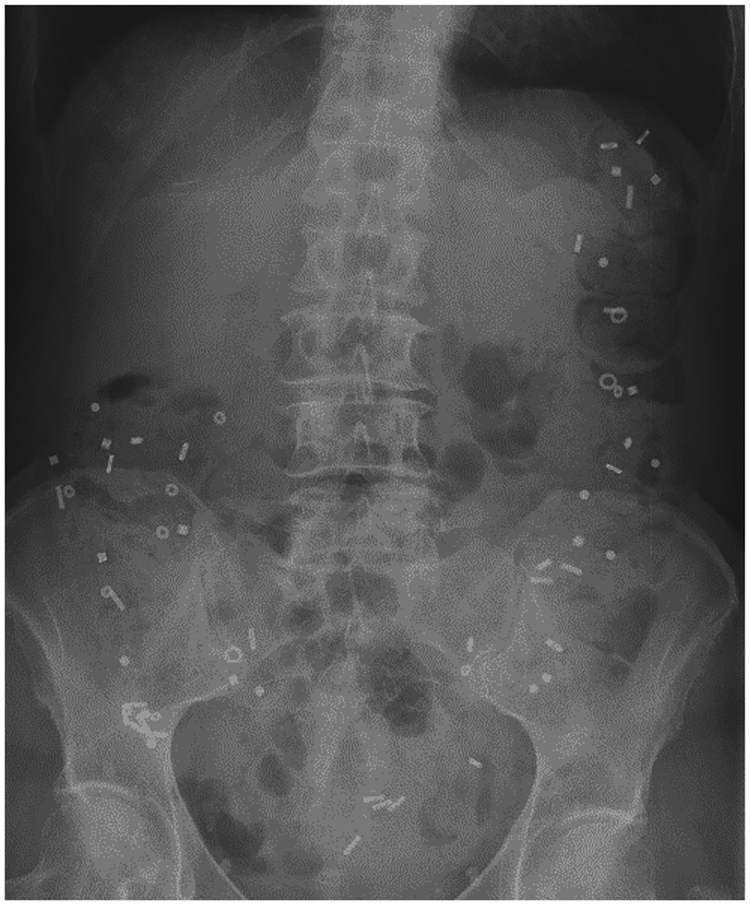
A radiopaque marker test of a patient who ingested 10 markers every morning for 6 days is shown. The plain abdominal radiograph was taken on day 7 and shows that all 60 markers are retained; accordingly, colonic transit time is ≥144 h ((number of retained capsules × 24 h)/(number of capsules ingested per day)). Normal values include colonic transit times ≤70 h in a mixed population, ≤50 h in men and ≤70–106 h in women. Note that in this case, the markers are evenly distributed throughout the colon, which is regarded as typical of, but is not completely specific for, slow-transit constipation.
Figure 7 |
Figure 7 |. Example colonic high-resolution manometry.
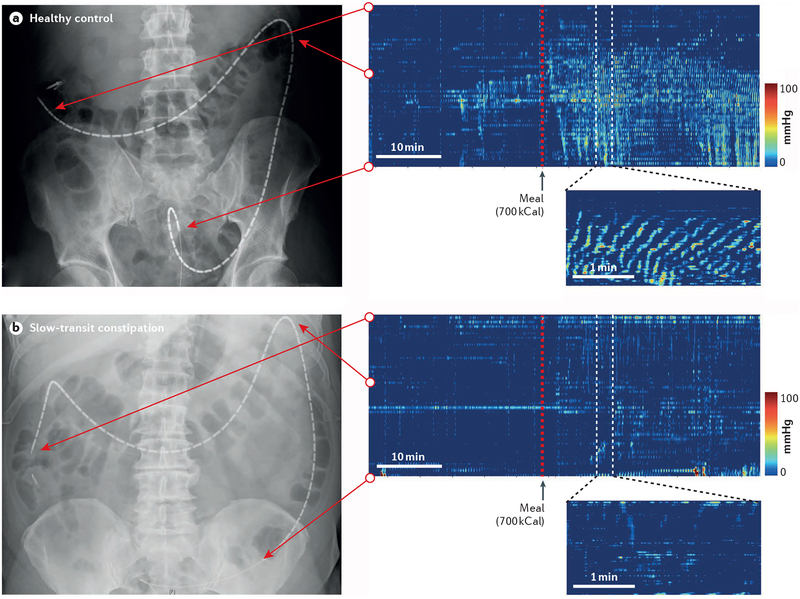
Colonic high-resolution manometry recordings in a healthy individual (part a) and a patient with slow-transit constipation (part b) are shown. Note the physiological increase in colonic contractility that occurs within minutes after the test meal. In the patient with slow-transit constipation, the frequency and amplitudes of colonic contractions are markedly reduced and the motor response to feeding is virtually absent.
Figure 8 |
Figure 8 |. Assessment of colonic tone using a barostat device.
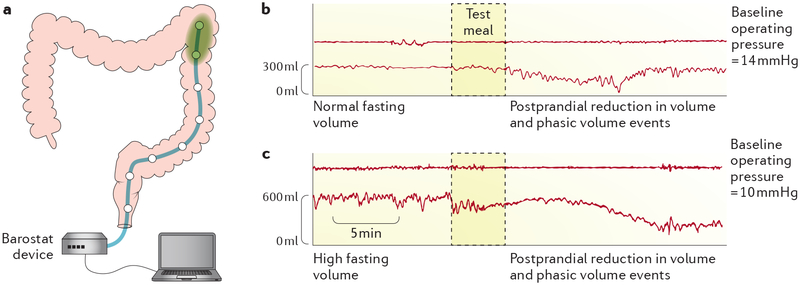
The barostat balloon is placed into the colon endoscopically (part a). The barostat device keeps intraballoon pressure at a pre-set level chosen to ensure apposition of the balloon to the colonic wall without relevant distension. Phasic and tonic contractions therefore induce a decrease in baseline balloon volume. The panels show phasic and tonic contractile activity measured under constant pressure conditions in the colon of a patient with slow-transit constipation (part b) and in the colon of a patient with chronic megacolon (part c). Note the large colonic volume (indicating low tone) during fasting in part c and the persistence of phasic contractile activity despite the low colonic tone.

References

    1. Stanghellini V et al. Gastroduodenal disorders. Gastroenterology 150, 1380–1392 (2016). - PubMed
    1. Mearin F et al. Bowel disorders. Gastroenterology 150, 1393–1407.e5 (2016).
    1. Camilleri M et al. American Neurogastroenterology and Motility Society consensus statement on intraluminal measurement of gastrointestinal and colonic motility in clinical practice. Neurogastroenterol. Motil 20, 1269–1282 (2008). - PubMed
    1. Rao SS et al. Evaluation of gastrointestinal transit in clinical practice: position paper of the American and European Neurogastroenterology and Motility Societies. Neurogastroenterol. Motil 23, 8–23 (2011). - PubMed
    1. Keller J, Beglinger C, Holst JJ, Andresen V & Layer P Mechanisms of gastric emptying disturbances in chronic and acute inflammation of the distal gastrointestinal tract. Am. J. Physiol. Gastrointest. Liver Physiol 297, G861–G868 (2009). - PubMed

Publication types

MeSH terms