


Methodology and results of integrated WNV surveillance programmes in Serbia
- PMID: 29624622
- PMCID: PMC5889191
- DOI: 10.1371/journal.pone.0195439
Methodology and results of integrated WNV surveillance programmes in Serbia
Abstract
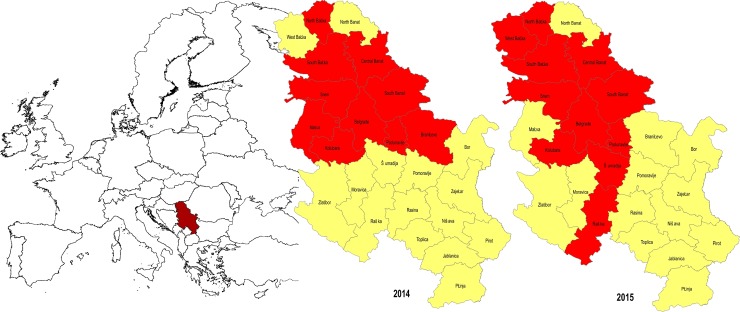
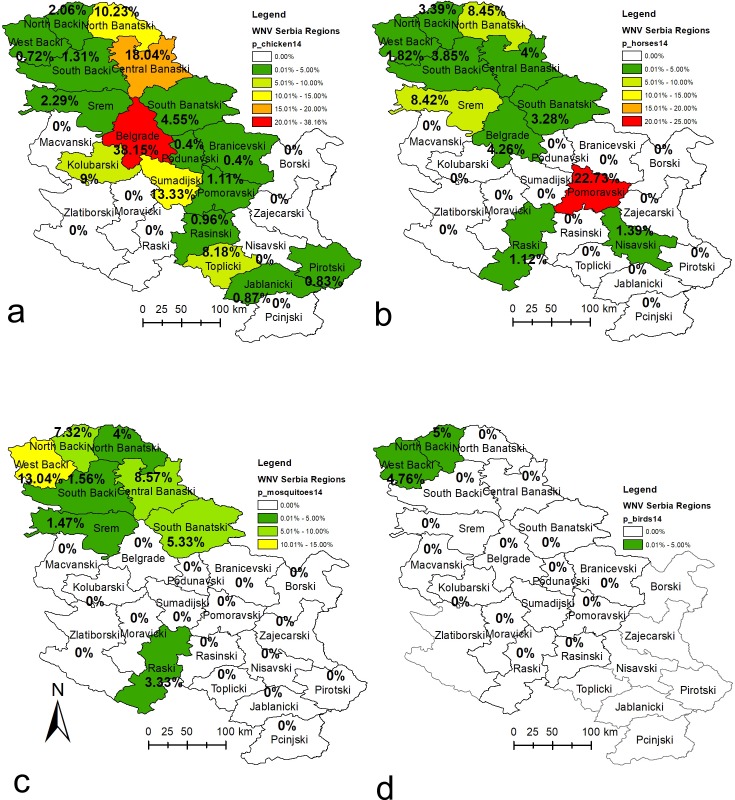
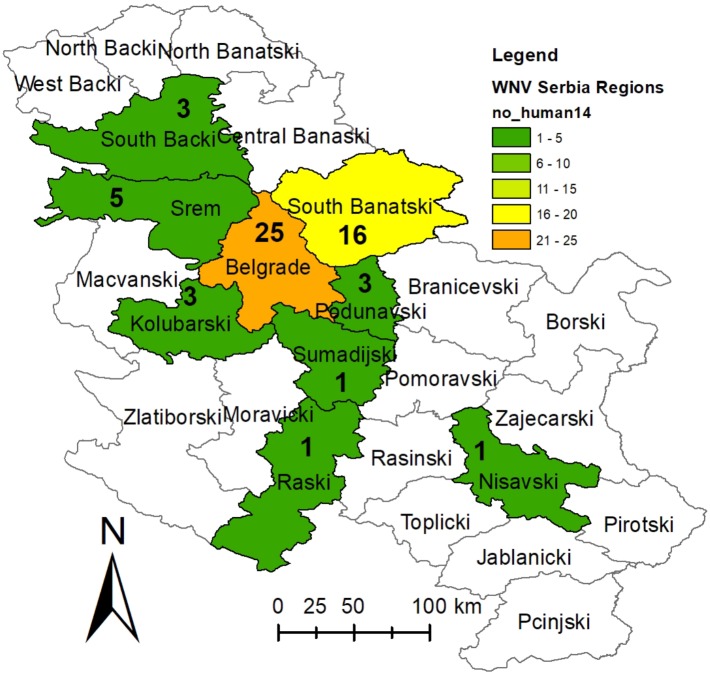
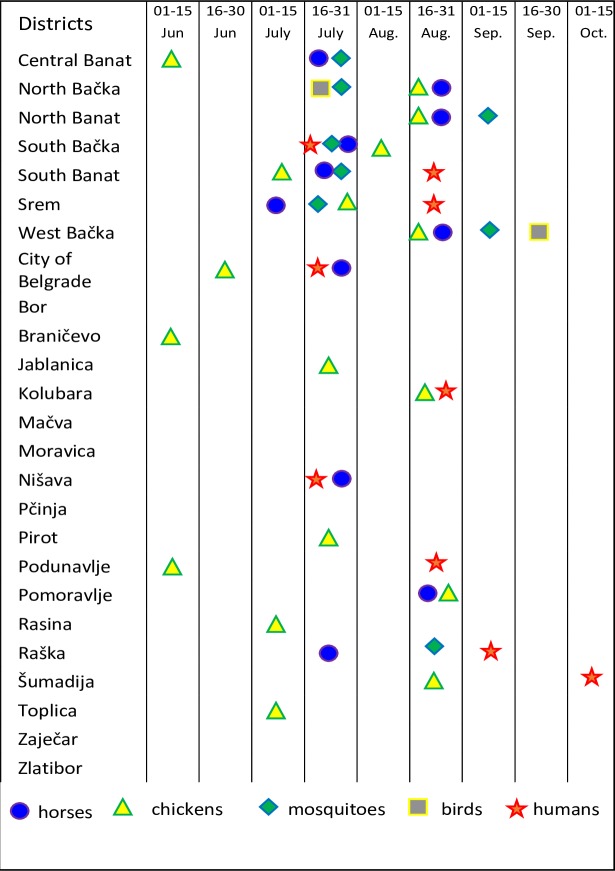
Studies conducted during the past few years have confirmed active West Nile virus (WNV) circulation in Serbia. Based on these studies and the epidemiological situation, the Veterinary Directorate of the Ministry of Agriculture and Environmental Protection launched national WNV surveillance programmes in 2014 and 2015. The programmes encompassed the territory of Serbia and were conducted by the veterinary service in collaboration with entomologists and ornithologists. The objective of the programmes was early detection of WNV and timely reporting to the public health service and local authorities to increase both clinical and mosquito control preparedness. The WNV surveillance programmes were based on direct and indirect surveillance of the presence of WNV by the serological testing of initially seronegative sentinel horses and chickens as well as through viral detection in pooled mosquito and wild bird samples. The most intense WNV circulation was observed in all seven districts of Vojvodina Province (northern Serbia) and Belgrade City, where most of the positive samples were detected among sentinel animals, mosquitoes and wild birds. The West Nile virus surveillance programmes in 2014 and 2015 showed satisfactory results in their capacity to indicate the spatial distribution of the risk for humans and their sensitivity to early detect viral circulation at the enzootic level. Most of the human cases were preceded by the detection of WNV circulation as part of the surveillance programmes. According to the existing data, it can be reasonably assumed that WNV infection, now an endemic infection in Serbia, will continue to present a significant problem for the veterinary service and public health.
Conflict of interest statement
Figures
Similar articles
-
Intensive West Nile Virus Circulation in Serbia in 2018-Results of Integrated Surveillance Program.Pathogens. 2021 Oct 8;10(10):1294. doi: 10.3390/pathogens10101294. Pathogens. 2021. PMID: 34684243 Free PMC article.
-
West Nile virus 'circulation' in Vojvodina, Serbia: Mosquito, bird, horse and human surveillance.Mol Cell Probes. 2017 Feb;31:28-36. doi: 10.1016/j.mcp.2016.10.011. Epub 2016 Oct 21. Mol Cell Probes. 2017. PMID: 27777104
-
Monitoring West Nile virus (WNV) infection in wild birds in Serbia during 2012: first isolation and characterisation of WNV strains from Serbia.Euro Surveill. 2013 Oct 31;18(44):20622. doi: 10.2807/1560-7917.es2013.18.44.20622. Euro Surveill. 2013. PMID: 24176657
-
Vector surveillance for West Nile virus.Ann N Y Acad Sci. 2001 Dec;951:74-83. doi: 10.1111/j.1749-6632.2001.tb02686.x. Ann N Y Acad Sci. 2001. PMID: 11797806 Review.
-
[West Nile virus infection].Enferm Infecc Microbiol Clin. 2011 Dec;29 Suppl 5:21-6. doi: 10.1016/S0213-005X(11)70040-4. Enferm Infecc Microbiol Clin. 2011. PMID: 22305666 Review. Spanish.
Cited by
-
Criteria for selecting sentinel unit locations in a surveillance system for vector-borne disease: A decision tool.Front Public Health. 2022 Nov 10;10:1003949. doi: 10.3389/fpubh.2022.1003949. eCollection 2022. Front Public Health. 2022. PMID: 36438246 Free PMC article. Review.
-
Depicting the RNA Virome of Hematophagous Arthropods from Belgrade, Serbia.Viruses. 2020 Sep 2;12(9):975. doi: 10.3390/v12090975. Viruses. 2020. PMID: 32887342 Free PMC article.
-
Intensive West Nile Virus Circulation in Serbia in 2018-Results of Integrated Surveillance Program.Pathogens. 2021 Oct 8;10(10):1294. doi: 10.3390/pathogens10101294. Pathogens. 2021. PMID: 34684243 Free PMC article.
-
Emerging Trends in the Epidemiology of West Nile and Usutu Virus Infections in Southern Europe.Front Vet Sci. 2019 Dec 6;6:437. doi: 10.3389/fvets.2019.00437. eCollection 2019. Front Vet Sci. 2019. PMID: 31867347 Free PMC article. Review.
-
Serosurvey of West Nile virus (WNV) in free-ranging raptors from Brazil.Braz J Microbiol. 2021 Mar;52(1):411-418. doi: 10.1007/s42770-020-00393-z. Epub 2020 Oct 27. Braz J Microbiol. 2021. PMID: 33108590 Free PMC article.
References
-
- Calistri P, Giovannini A, Hubalek Z, Ionescu A, Monaco F, Savini G, et al. Epidemiology of West Nile in Europe and the Mediterranean basin. The Open Virol. J. 2010;4:29–37. doi: 10.2174/1874357901004020029 - DOI - PMC - PubMed
-
- Weissenböck H, Hubálek Z, Bakonyi T, Nowotny N. Zoonotic mosquito-borne flaviviruses: worldwide presence of agents with proven pathogenicity and potential candidates of future emerging diseases. Vet. Microbiol. 2010;140:271–80. doi: 10.1016/j.vetmic.2009.08.025 - DOI - PubMed
-
- Castillo-Olivares J, Wood J. West Nile infection in horses. Vet. Res. 2004;35:467–83. doi: 10.1051/vetres:2004022 - DOI - PubMed
-
- Erdélyi K, Ursu K, Ferenczi E, Szeeredi L, Ratz F, Skare J, et al. Clinical and pathological features of linage 2 West Nile virus: Infections in birds of prey in Hungary. Vector Borne Zoonotic Dis. 2007;7(2):181–88 doi: 10.1089/vbz.2006.0586 - DOI - PubMed
Publication types
MeSH terms
Substances
LinkOut - more resources
Full Text Sources
Other Literature Sources
Medical
Miscellaneous
