. 2018 Apr;30(4):780-795.
doi: 10.1105/tpc.17.00787. Epub 2018 Apr 6.

A Y-Encoded Suppressor of Feminization Arose via Lineage-Specific Duplication of a Cytokinin Response Regulator in Kiwifruit

Affiliations

A Y-Encoded Suppressor of Feminization Arose via Lineage-Specific Duplication of a Cytokinin Response Regulator in Kiwifruit

Takashi Akagi et al. Plant Cell. 2018 Apr.

Abstract

Dioecy, the presence of male and female flowers on distinct individuals, has evolved independently in multiple plant lineages, and the genes involved in this differential development are just starting to be uncovered in a few species. Here, we used genomic approaches to investigate this pathway in kiwifruits (genus Actinidia). Genome-wide cataloging of male-specific subsequences, combined with transcriptome analysis, led to the identification of a type-C cytokinin response regulator as a potential sex determinant gene in this genus. Functional transgenic analyses in two model systems, Arabidopsis thaliana and Nicotiana tabacum, indicated that this gene acts as a dominant suppressor of carpel development, prompting us to name it Shy Girl (SyGI). Evolutionary analyses in a panel of Actinidia species revealed that SyGI is located in the Y-specific region of the genome and probably arose from a lineage-specific gene duplication. Comparisons with the duplicated autosomal counterpart, and with orthologs from other angiosperms, suggest that the SyGI-specific duplication and subsequent evolution of cis-elements may have played a key role in the acquisition of separate sexes in this species.


Figures

Figure 1.
Figure 1.
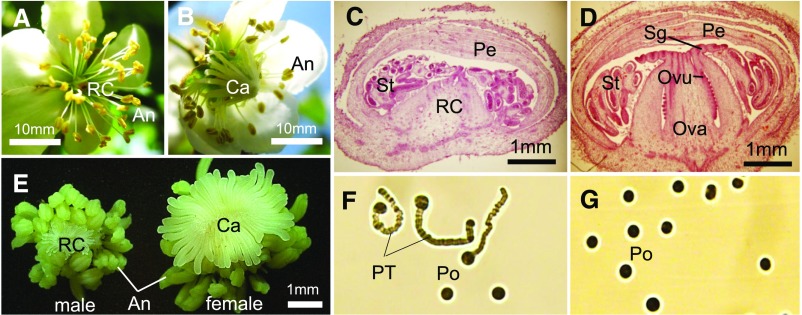
Characteristics of Flower Sexuality in the KE Population. (A) and (B) Male (A) and female (B) opened flowers from individuals in the KE population. An, anthers; Ca, carpel; RC, rudimentary carpel. (C) and (D) Cross sections of male (C) and female (D) flowers in stage 1 (Supplemental Figure 1). Ovu, ovule; Pe, petal; Sg, stigma; St, stamens. (E) Dissected anthers and carpels in male and female flowers in stage 1. (F) and (G) Germination of pollen tubes from male (F) and female (G) flowers. Po, pollen grains; PT, pollen tube. These flower phenotypes are consistent within those previously observed in the genus Actinidia.
Figure 2.
Figure 2.
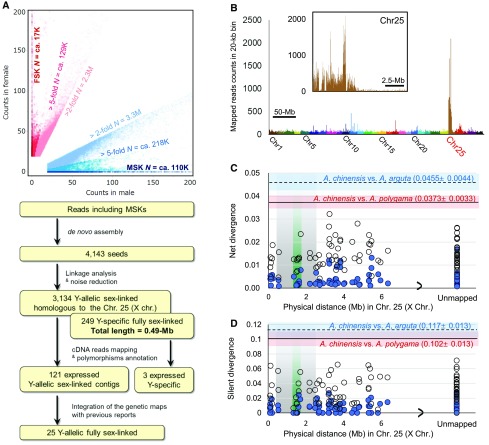
Extraction of Male-Specific Sequences for Sex Determinant Discovery. (A) Distribution of k-mers in genomic and/or transcriptome sequencing reads from the KE population and screening procedure for contigs located on partially or fully sex-linked region and expressed in developing flowers. FSK, female-specific k-mers. (B) Mapping of reads including MSKs to the draft genome of cv Hong Yang (female, 2n = 2x = 2A + XX = 58); ∼53.7% of reads mapped to chromosome 25 (X chromosome of A. chinensis). (C) and (D) Distribution of net divergence (C) and silent divergence (D) values between the X- and Y-allelic sequences of genes located within the PAR on chromosome 25 (blue circles). White circles represent interspecific net divergence values between A. chinensis and A. rufa for each gene. The solid black line within the red rectangle and the black dotted line within the blue rectangle represent the average net divergence (C) and average silent divergence (D) rates, respectively, with standard errors, within 20 putative single-copy genes in the Euasterids genome (Wu et al., 2006, Supplemental Table 3), in A. chinensis versus A. polygama and versus A. arguta, respectively. Only the genes expressed significantly in developing flowers (RPKM > 2.0) are included. Gray and green areas represent hypothetical fully sex-linked regions based on our segregation test and a previous report (Zhang et al., 2015) (see Supplemental Figure 4 for details).
Figure 3.
Figure 3.
Characterization of the SyGI Gene. (A) Phylogenetic tree and signs of selective pressure on SyGI-like type-C response regulators (RR) in representative eudicot species. The CRE1-AHK4 histidine kinase, defined as a type-A response regulator, was used as the outgroup. The SyGI-Achn384741 duplication event is estimated to have arisen ∼20 MYA, which postdates the divergence of Actinidiaceae (Ellison et al., 2012). (B) Expression pattern of SyGI and Achn384741 in flower organs of a male individual from the KE population. SyGI exhibits specific expression in rudimentary carpels. We used rudimentary carpels and normal stamens at stages 1 and 2-3, respectively, which correspond to the earliest stage at which male and female developing structures can be visibly differentiated (Supplemental Figure 1). (C) Complete male-specific conservation of SyGI in the genomes of a variety of Actinidia species. A. deliciosa is hexaploid, and tetraploid A. arguta and A. macrosperma are shown. (D) Expression of SyGI and Achn384741 in developing flowers from a variety of Actinidia species. In males, PCR primers detecting both SyGI and Achn384741 only amplified SyGI (see Methods). M, male; F, female. (E) In higher-ploidy variants of A. arguta, sexuality also cosegregated with the existence of SyGI.
Figure 4.
Figure 4.
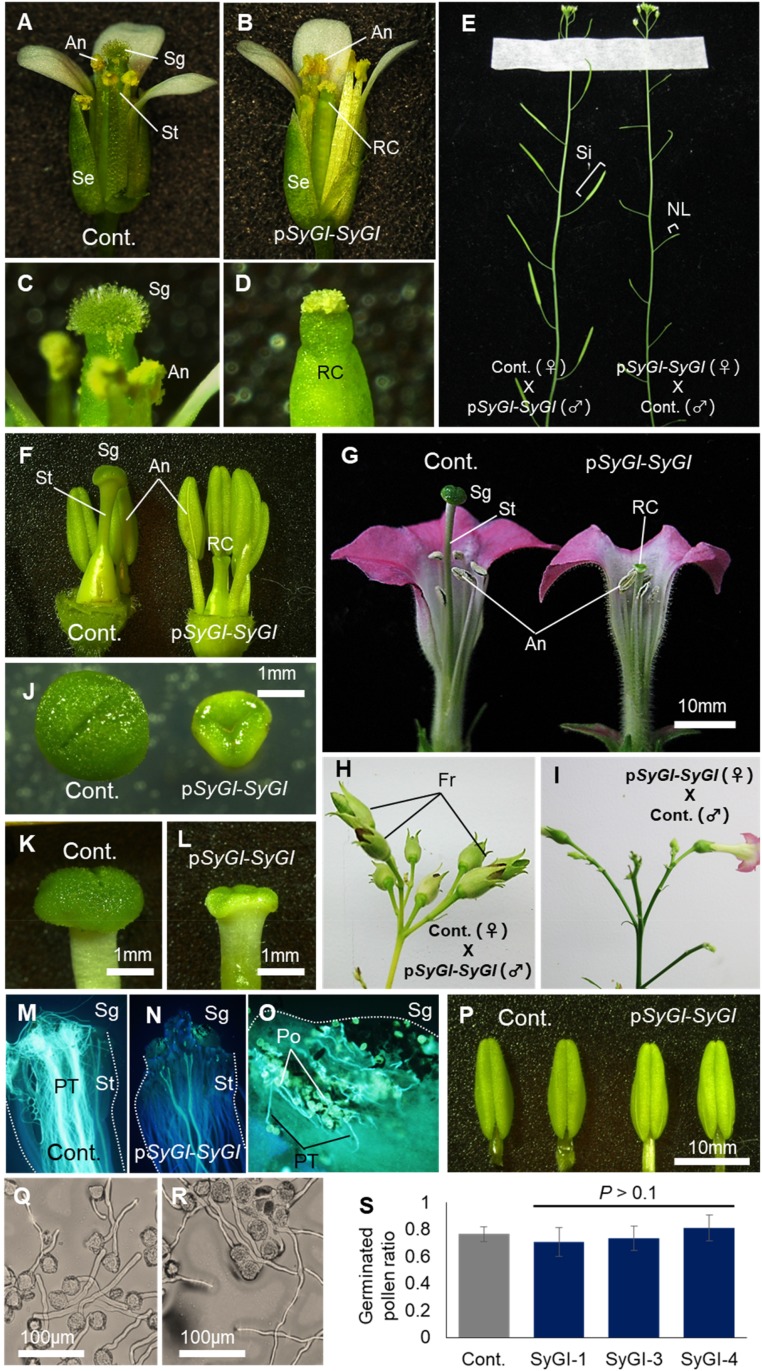
Functional Validation of SyGI. (A) to (D) Phenotypic characterization of representative androgenized Arabidopsis flowers expressing SyGI under the control of its native promoter (pSyGI-SyGI). Compared with control plants ([A] and [C]), mature SyGI-induced plants ([B] and [D]) exhibited rudimentary carpels (RC) with short style (St) and shrunken stigma (Sg), although other organs were unaffected. An, anthers; Se, sepals. (E) Reciprocal crossing between control and pSyGI-SyGI plants. pSyGI-SyGI plants could function as paternal parent but were sterile as maternal parent. Si, siliques; NL, nonfertile legume. (F) to (I) Representative androgenized phenotypes in tobacco flowers expressing SyGI under the control of its native promoter. As in Arabidopsis, pSyGI-SyGI lines exhibited rudimentary carpels, although other flower organs were unaffected ([F], 1 week before flowering; [G], mature flower). Reciprocal crossing of control and pSyGI-SyGI lines supported the idea that expression of SyGI leads to repression of female function only ([H] and [I]). Fr, fruits. (J) to (L) Comparison of stigmas of mature flower from control and pSyGI-SyGI transgenic plants. The observed phenotypes were consistent with pSyGI-SyGI Arabidopsis lines and male Actinidia species. (M) to (S) aniline blue staining of wild type pollen tubes after pollination to control (M) and pSyGI-SyGI pistils ([N] and [O]). Pollen tubes were arrested in the stigma of pSyGI-SyGI lines ([N] and [O]). Anthers from the pSyGI-SyGI lines were not distinguishable from anthers from control plants (P). Pollen from control (Q) and pSyGI-SyGI (R) flowers germinated normally and showed no significant difference in germination ratio (S).
Figure 5.
Figure 5.
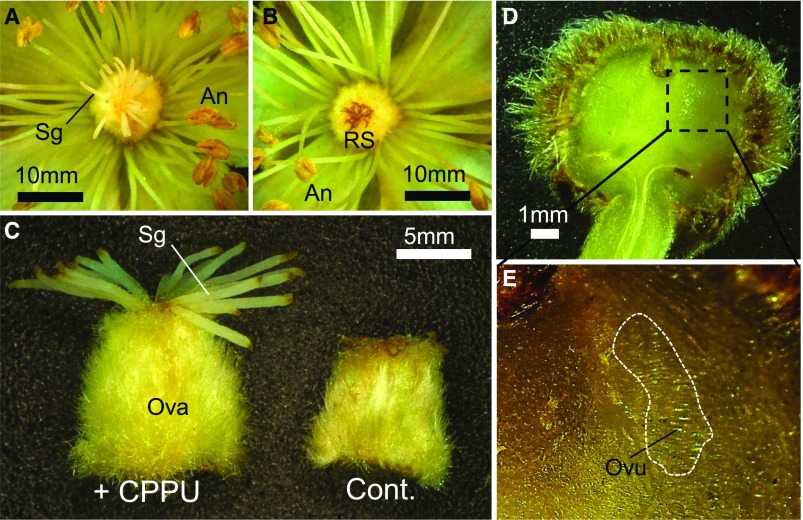
Synthetic Cytokinin (CPPU) Treatment Induced Hermaphroditism in Male Actinidia. Treatment of male individuals from the KE population (A. rufa × A. chinensis) with CPPU at 50 ppm. CPPU-treated male flowers showed incompletely restored stigma (Sg) development (A), while control male plants produced completely rudimentary stigma (RS) (B). An, anthers. Stigma of male flowers (shorter than those of female flowers). Swollen ovary (Ova) of CPPU-treated male flowers, with no ability to bear fertile seeds (C). In A. deliciosa, 50 ppm CPPU treatment induced the formation of small fruits (D) containing ovule-like structures (Ovu) (E).
Figure 6.
Figure 6.
Evolution of Type-C Response Regulators in Angiosperm and Specific Expression Pattern of SyGI. Expression patterns of the orthologs/paralogs of SyGI gene in developing flowers (Fl) and in developing carpels (Ca) in D. lotus (Caucasian persimmon), V. corymbosum (blueberry), and A. chinensis (kiwifruit), all members of the Ericales order. SyGI was the only gene to exhibit strong expression in the carpels, suggesting that the ancestral gene was not expressed in the carpel and that SyGI acquired carpel (pistil) or flower expression specifically. The black circle labeled “d” indicates the node representing the SyGI-Achn384741 duplication.
Figure 7.
Figure 7.
Evolution of SyGI via Actinidia-Specific Duplication. (A) Evolutionary relationship between the Shy Girl-Achn384741 duplication event and the timing of divergence between Actinidia species. The black circles labeled “d” and “a” indicate the node of SyGI-Achn384741 duplication and the divergence between Actinidia species, respectively. The white circle labeled “c” indicates the hypothetical timing of the evolution of cis-elements in the Shy Girl promoter sequence. The rate of silent divergence from the current SyGI to the SyGI-Achn384741 duplication (Ks = 0.1108) is only slightly bigger than to the divergence of Actinidia species (Ks = 0.1099). The estimated time between the two (Ks = 0.0009) corresponds to ∼0.16 million years (MY), suggesting very rapid fixation of the proto-SyGI after the hypothetical evolution of the cis-element. (B) Model for the establishment of SyGI function as a dominant suppressor of feminization. According to the two-mutation model, a male-promoting factor (M/m) could be present in the same haploblock, and the male-sterility mutation might have predated the establishment of duplicated SyGI.
None

Comment in

  • Shy Girl Gives Kiwifruit Male Flowers.
    Caseys C. Caseys C. Plant Cell. 2018 Apr;30(4):739-740. doi: 10.1105/tpc.18.00278. Epub 2018 Apr 6. Plant Cell. 2018. PMID: 29626070 Free PMC article. No abstract available.

References

    1. Akagi T., Ikegami A., Tsujimoto T., Kobayashi S., Sato A., Kono A., Yonemori K. (2009). DkMyb4 is a Myb transcription factor involved in proanthocyanidin biosynthesis in persimmon fruit. Plant Physiol. 151: 2028–2045. - PMC - PubMed
    1. Akagi T., Henry I.M., Tao R., Comai L. (2014). Plant genetics. A Y-chromosome-encoded small RNA acts as a sex determinant in persimmons. Science 346: 646–650. - PubMed
    1. Akagi T., Henry I.M., Kawai T., Comai L., Tao R. (2016). Epigenetic regulation of the sex determination gene MeGI in polyploid persimmon. Plant Cell 28: 2905–2915. - PMC - PubMed
    1. Anders S., Huber W. (2010). Differential expression analysis for sequence count data. Genome Biol. 11: R106. - PMC - PubMed
    1. Argueso C.T., Raines T., Kieber J.J. (2010). Cytokinin signaling and transcriptional networks. Curr. Opin. Plant Biol. 13: 533–539. - PubMed

Publication types