Review
. 2018 Jun 19;46(3):503-512.
doi: 10.1042/BST20170427. Epub 2018 Apr 6.

New insights into the interplay between the translation machinery and nonsense-mediated mRNA decay factors

Affiliations
Review

New insights into the interplay between the translation machinery and nonsense-mediated mRNA decay factors

Etienne Raimondeau et al. Biochem Soc Trans. .

Abstract

Faulty mRNAs with a premature stop codon (PTC) are recognized and degraded by nonsense-mediated mRNA decay (NMD). Recognition of a nonsense mRNA depends on translation and on the presence of NMD-enhancing or the absence of NMD-inhibiting factors in the 3'-untranslated region. Our review summarizes our current understanding of the molecular function of the conserved NMD factors UPF3B and UPF1, and of the anti-NMD factor Poly(A)-binding protein, and their interactions with ribosomes translating PTC-containing mRNAs. Our recent discovery that UPF3B interferes with human translation termination and enhances ribosome dissociation in vitro, whereas UPF1 is inactive in these assays, suggests a re-interpretation of previous experiments and modification of prevalent NMD models. Moreover, we discuss recent work suggesting new functions of the key NMD factor UPF1 in ribosome recycling, inhibition of translation re-initiation and nascent chain ubiquitylation. These new findings suggest that the interplay of UPF proteins with the translation machinery is more intricate than previously appreciated, and that this interplay quality-controls the efficiency of termination, ribosome recycling and translation re-initiation.

Keywords: UPF proteins; mRNA quality control; nonsense-mediated mRNA decay; ribosome; translation termination.


Conflict of interest statement

The Authors declare that there are no competing interests associated with the manuscript.

Figures
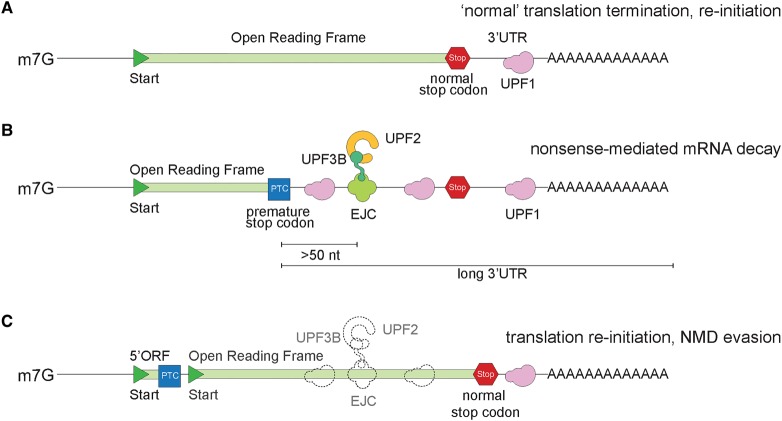
Figure 1.
Figure 1.. Hallmarks of normal and premature stop codons and their 3′-UTR context.
(A) Normal stop codons are positioned in the last exon in proximity of the poly(A) tail. (B) Premature stop codons are characterized by an EJC positioned at least 50–55 nt downstream from the PTC (the effect of the EJC is distance-dependent), accumulation of UPF1 next to the PTC and/or in 3′-UTRs which are longer than usual (see the main text for details). (C) Transcripts with a PTC close to the start codon can evade NMD by translation re-initiation, despite the presence of downstream EJCs.
Figure 2.
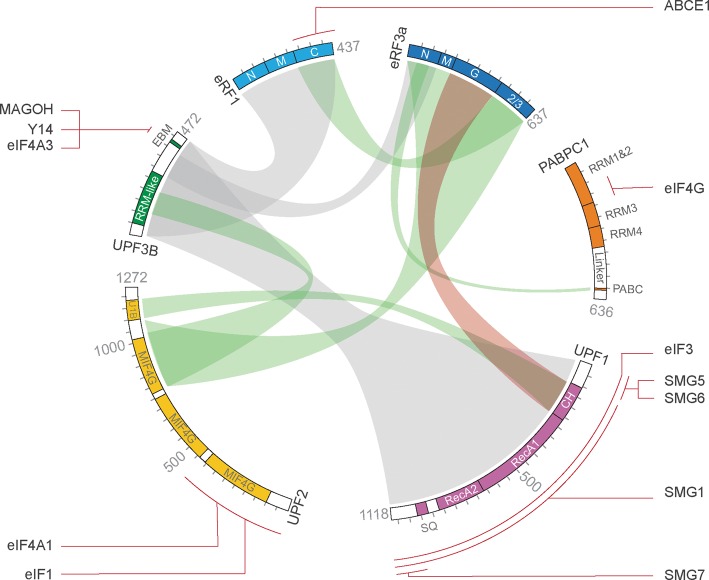
Figure 2.. Scheme illustrating the interactome of translation and NMD factors.
A scheme for each factor UPF1, UPF2, UPF3B, eRF1, eRF3a and PABPC1 is represented in the central circle. Graduations indicate 50 amino acids. Domains specific to each factor are mapped to the scheme. Coloured ribbons are indicating known interactions: green for structural data, grey for in vitro pulldowns using purified proteins and red for in vivo co-immunoprecipitations from cell extracts (adapted from ref. [83]). N: N-terminal domain; M: middle domain; C: C-terminal domain; 2/3: 2 and 3 domains; G: GTPase domain; RRM: RNA-recognition motif; PABC: Poly(A)-binding protein C-terminus. SQ: serine–glutamine-rich domain; CH: cysteine–histidine-rich domain; helicase domain: RecA1 and RecA2; MIF4G: middle domain of eIF4G; U1B: UPF1-binding domain; EBM: exon junction complex-binding motif.
Figure 3.
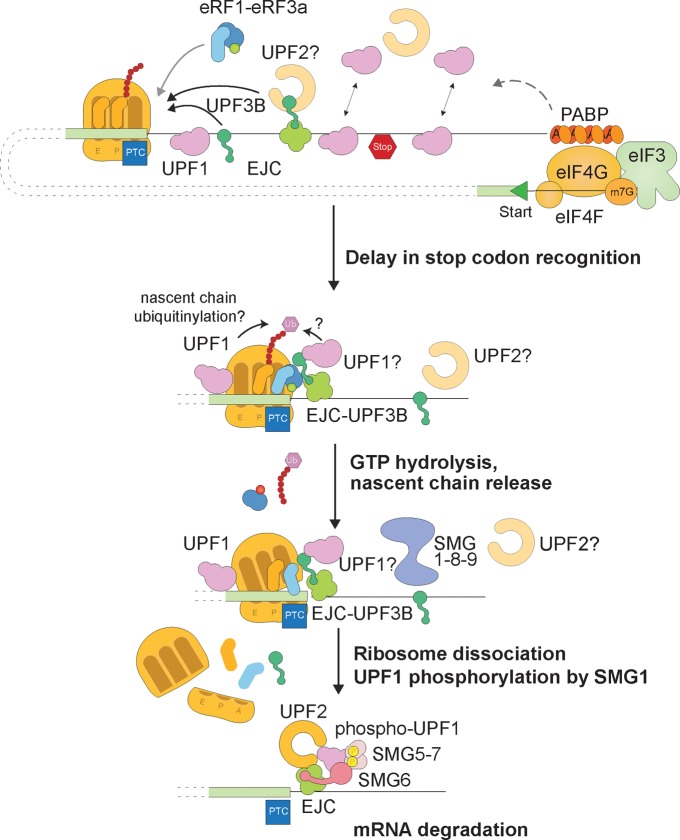
Figure 3.
Modified model for initiation of NMD, adapted from ref. [83]. When a ribosome encounters a PTC, stop codon recognition can be delayed by the presence of UPF3B bound to the EJC, or by UPF3B bound to the mRNA in EJC-independent NMD [27]. Moreover, the long distance to PABP prevents efficient translation termination and re-initiation. At the PTC, the ribosome, release factors, UPF3B and likely also UPF1 can form a complex. Hydroxyl-radical probing suggests that yeast Upf1 binds to the ribosomal L1 stalk, near to the E-site [51]. UPF1 can also bind UPF3B [47]. UPF1 may ubiquitylate the PTC-encoded nascent chain and target the nascent polypeptide to degradation. After termination, UPF3B and UPF1 both could be involved in ribosome dissociation. UPF1 can recruit other NMD factors, including the SMG1–8–9 complex. UPF2 binding displaces UPF3B from the ribosome-release factor complex [47]. UPF2–UPF3B activates the kinase SMG1 leading to UPF1 phosphorylation. Phospho-UPF1 recruits decay factors such as the SMG6 endonuclease and the SMG5–7 heterodimer. SMG6 displaces UPF3B from the EJC and cuts the mRNA close to the PTC.

References

    1. Losson R. and Lacroute F. (1979) Interference of nonsense mutations with eukaryotic messenger RNA stability. Proc. Natl Acad. Sci. U.S.A. 76, 5134–5137 10.1073/pnas.76.10.5134 - DOI - PMC - PubMed
    1. Chang J.C. and Kan Y.W. (1979) Beta 0 thalassemia, a nonsense mutation in man. Proc. Natl Acad. Sci. U.S.A. 76, 2886–2889 10.1073/pnas.76.6.2886 - DOI - PMC - PubMed
    1. Lykke-Andersen S. and Jensen T.H. (2015) Nonsense-mediated mRNA decay: an intricate machinery that shapes transcriptomes. Nat. Rev. Mol. Cell Biol. 16, 665–677 10.1038/nrm4063 - DOI - PubMed
    1. Ottens F. and Gehring N.H. (2016) Physiological and pathophysiological role of nonsense-mediated mRNA decay. Pflugers Arch. 468, 1013–1028 10.1007/s00424-016-1826-5 - DOI - PubMed
    1. Carter M.S., Li S. and Wilkinson M.F. (1996) A splicing-dependent regulatory mechanism that detects translation signals. EMBO J. 15, 5965–5975 PMCID: PMC452383 - PMC - PubMed

Publication types

LinkOut - more resources