


Neighborhood Child Opportunity and Individual-Level Pediatric Acute Care Use and Diagnoses
- PMID: 29626164
- PMCID: PMC5991499
- DOI: 10.1542/peds.2017-2309
Neighborhood Child Opportunity and Individual-Level Pediatric Acute Care Use and Diagnoses
Abstract
: media-1vid110.1542/5751513300001PEDS-VA_2017-2309Video Abstract OBJECTIVES: Although health care providers and systems are increasingly interested in patients' nonmedical needs as a means to improve health, little is known about neighborhood conditions that contribute to child health problems. We sought to determine if a novel, publicly available measure of neighborhood context, the Child Opportunity Index, was associated with pediatric acute care visit frequency and diagnoses.
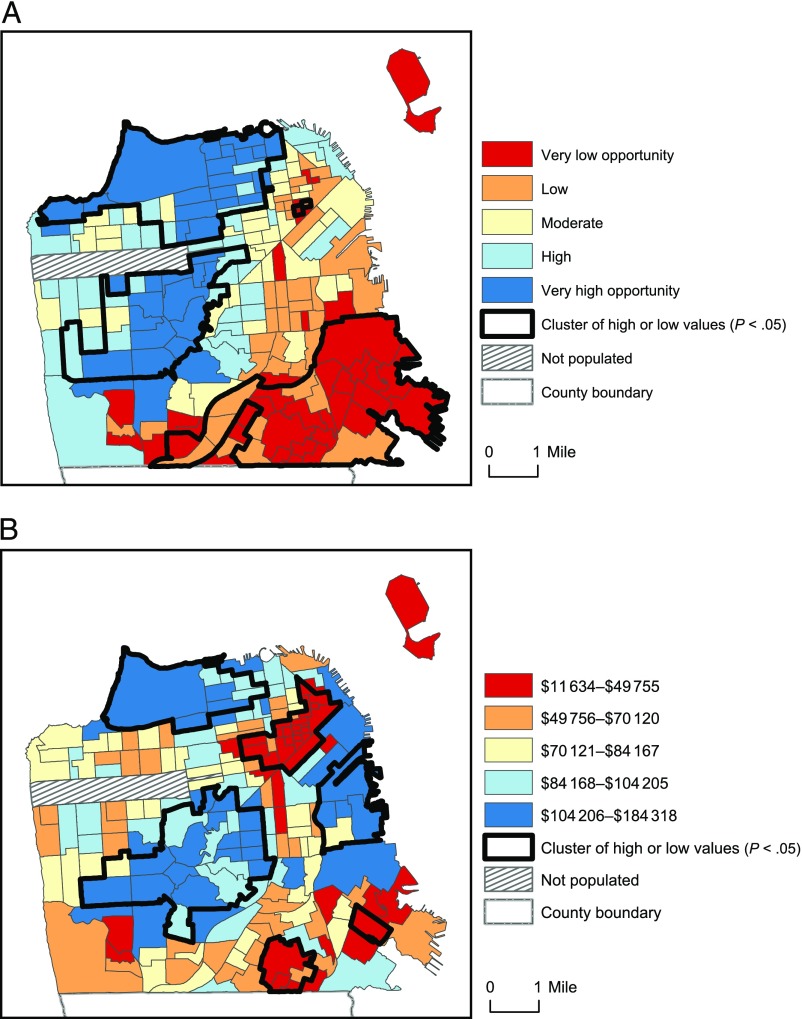
Methods: This cross-sectional study included San Francisco residents <18 years of age with an emergency department and/or urgent care visit to any of 3 medical systems (N = 47 175) between 2007 and 2011. Hot-spot analysis was used to compare the spatial distribution of neighborhood child opportunity and income. Generalized estimating equation logistic regression models were used to examine independent associations between neighborhood child opportunity and frequent acute care use (≥4 visits per year) and diagnosis group after adjusting for neighborhood income and patient age, sex, race and/or ethnicity, payer, and health system.
Results: Neighborhood child opportunity and income had distinct spatial distributions, and we identified different clusters of high- and low-risk neighborhoods. Children living in the lowest opportunity neighborhoods had significantly greater odds of ≥4 acute care visits per year (odds ratio 1.33; 95% confidence interval 1.03-1.73) compared with those in the highest opportunity neighborhoods. Neighborhood child opportunity was negatively associated with visits for respiratory conditions, asthma, assault, and ambulatory care-sensitive conditions but positively associated with injury-related visits.
Conclusions: The Child Opportunity Index could be an effective tool for identifying neighborhood factors beyond income related to child health.
Copyright © 2018 by the American Academy of Pediatrics.
Conflict of interest statement
POTENTIAL CONFLICT OF INTEREST: The authors have indicated they have no potential conflicts of interest to disclose.
Figures
References
-
- Wier L, Yu H, Owens P, Washington R Statistical brief #157: overview of children in the emergency department, 2010. Available at: www.hcup-us.ahrq.gov/reports/statbriefs/sb157.pdf. Accessed November 13, 2016 - PubMed
-
- Rasooly IR, Mullins PM, Alpern ER, Pines JM. US emergency department use by children, 2001-2010. Pediatr Emerg Care. 2014;30(9):602–607 - PubMed
-
- Alpern ER, Clark AE, Alessandrini EA, et al. ; Pediatric Emergency Care Applied Research Network . Recurrent and high-frequency use of the emergency department by pediatric patients. Acad Emerg Med. 2014;21(4):365–373 - PubMed
-
- Ben-Isaac E, Schrager SM, Keefer M, Chen AY. National profile of nonemergent pediatric emergency department visits. Pediatrics. 2010;125(3):454–459 - PubMed
Publication types
MeSH terms
Grants and funding
LinkOut - more resources
Full Text Sources
Other Literature Sources
