Review
. 2018 Jun;47(6):1459-1474.
doi: 10.1002/jmri.26027. Epub 2018 Apr 6.

LI-RADS 2017: An update

Affiliations
Review

LI-RADS 2017: An update

Ania Z Kielar et al. J Magn Reson Imaging. 2018 Jun.

Abstract

The computed tomography / magnetic resonance imaging (CT/MRI) Liver Imaging Reporting & Data System (LI-RADS) is a standardized system for diagnostic imaging terminology, technique, interpretation, and reporting in patients with or at risk for developing hepatocellular carcinoma (HCC). Using diagnostic algorithms and tables, the system assigns to liver observations category codes reflecting the relative probability of HCC or other malignancies. This review article provides an overview of the 2017 version of CT/MRI LI-RADS with a focus on MRI. The main LI-RADS categories and their application will be described. Changes and updates introduced in this version of LI-RADS will be highlighted, including modifications to the diagnostic algorithm and to the optional application of ancillary features. Comparisons to other major diagnostic systems for HCC will be made, emphasizing key similarities, differences, strengths, and limitations. In addition, this review presents the new Treatment Response algorithm, while introducing the concepts of MRI nonviability and viability. Finally, planned future directions for LI-RADS will be outlined.

Level of evidence: 5 Technical Efficacy: Stage 5 J. Magn. Reson. Imaging 2018;47:1459-1474.

Keywords: LI-RADS; MRI; ancillary features; hepatocellular carcinoma; imaging features; liver.


Figures

FIGURE 1:
FIGURE 1:
v2017 LI-RADS CT/MRI algorithm for categorizing liver observations identified in patients “at risk” for HCC. Reprinted with permission from the American College of Radiology.
FIGURE 2:
FIGURE 2:
v2017 LI-RADS demonstrating integration of ancillary features and their effect on the final LI-RADS categorization. Note: Use of ancillary features is considered optional in v2017. Reprinted with permission from the American College of Radiology.
FIGURE 3:
FIGURE 3:
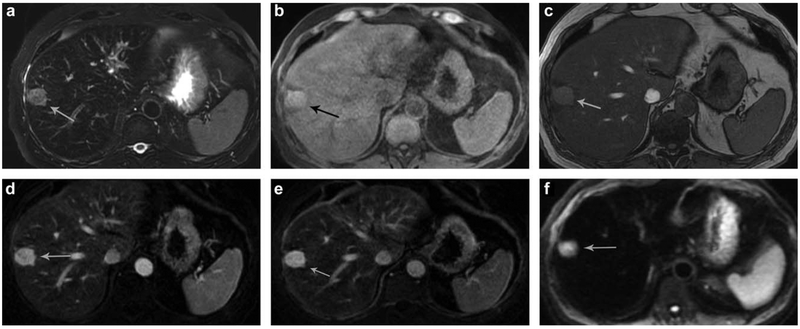
Two observations identified in a 52-year-woman with ethanol-induced liver cirrhosis. The larger observation measures 22 mm (white arrow) and the smaller measures 9 mm (black arrow). Both demonstrate arterial enhancement (a), with washout and peripheral capsule on portal venous phase (b), there is low signal intensity on T1-weighted images, in-phase (c). Given the imaging findings, the larger observation is categorized as LI-RADS-5 and the smaller, due to being <1 cm in maximum diameter, is categorized as LI-RADS-4: this rule was created in order to be consistent with OPTN criteria.
FIGURE 4:
FIGURE 4:
A 39-year-old man with LR-M observation which was pathologically proven to represent a cholangiocarcinoma. The mass is of low signal intensity of fat-saturated T1-weighted images pregadolinium (a). This observation demonstrates rim-like enhancement on the arterial phase (b) with gradual fill-in on PVP (c) and the 5-minute delayed MRI (d) images (white arrows on each). This study was performed with gadoxetic acid, and on the 15-minute delayed images there is lack of uptake by hepatocytes in this area (e). The 5.7-cm mass demonstrates moderately high signal intensity on T2-weighted images, white arrow (f) with bile duct dilation in the atrophic left lobe (white arrow). The mass also demonstrates a rim-like high signal intensity area on diffusion-weighted images (b-800) (g).
FIGURE 5:
FIGURE 5:
A 49-year-old with hepatitis B presented with abdominal pain. Multiphase MRI demonstrates linear, arterial enhancement along the portal vein (a), which demonstrates washout on PVP (b). It is best seen as TIV on coronal PVP (c). There is some high signal intensity along the portal tract on b-800 diffusion-weighted images (d)f but there is no definite restricted diffusion (e).
FIGURE 6:
FIGURE 6:
v2017 LI-RADS Treatment Response Algorithm. Reprinted with permission from the American College of Radiology.
FIGURE 7:
FIGURE 7:
HCC in a 77-year-old man with cirrhosis, (a) Axial “T1-weighted in-phase and (b) out-of-phase images show hypointense mass (white arrow), (c) Axial T1-weighted fat-saturated images obtained before and after contrast administration in (d) late arterial, (e) portal venous, and (f) delayed phase show a mass with an arterial phase hyperenhancement of a several smaller inner nodules (black arrows) within a larger nodule with washout (white arrow). This is consistent with mosaic perfusion (g). Coronal T2-weighted and (h) axial T2-weighted fat-saturated images show T2 isointensity, (i–k) Axial diffusion-weighted images (b-values: 0, 400, and 800 sec/mm2, respectively) and (I) ADC map. Pathology of hepatectomy confirmed HCC.
FIGURE 8:
FIGURE 8:
Example of nodule-in-nodule appearance in a 48-year-old patient with chronic cirrhosis from hepatitis C. There is an area within this nodule which is enhancing on arterial phase (b) (arrow), but it is smaller than the overall size of the observation including in pregadolinium images (a), on the PVP (c) and on 20-minute delayed images after administration of gadoxetic acid.
FIGURE 9:
FIGURE 9:
Iron sparing in an observation HCC in a 54-year-old woman with primary biliary cirrhosis, (a) Axial T1-weighted in-phase and (b) out-of-phase images show iron sparing in a solid mass (arrowhead), in contrast to the signal drop observed in the background liver on the in-phase sequence (acquired with a longer echo time), (c) Axial T1-weighted fat-saturated images obtained before and after contrast administration in (d) late arterial, (e) portal venous, and (f) delayed phase show arterial hyperenhancement with washout (arrow), (g) Coronal T2-weighted and (h) axial T2-weighted fat-saturated images show mild-moderate T2 hyperintensity. (i–k) Axial diffusion-weighted images (b-values: 0, 400, and 800 sec/mm2, respectively) and (I) ADC map. Pathology of liver specimen confirmed HCC.
FIGURE 10:
FIGURE 10:
Iron deposition in an observation. A 58-year-old man with known ethanol-induced cirrhosis. In segment 2 of the liver there is a 10-mm observation which is of low signal intensity on in-phase T1-weighted images and becomes somewhat higher in signal intensity on opposed-phase images (arrow). This is an example of iron deposition within an observation and represents an ancillary feature which is an ancillary feature favoring benignity. Using this ancillary feature, one could decrease the final LI-RADS category by one (so long as no other ancillary features favoring malignancy or HCC in particular were identified to negate this particular ancillary feature).
FIGURE 11:
FIGURE 11:
Blood product in an observation. A 51-year-old man with high signal intensity observation in segment 7 of the liver and no prior for comparison. Due to the high signal intensity of the 26-mm observation on fat-saturated T1-weighted images (b), which was felt to represent blood product in a mass (ancillary feature of HCC specifically), as well as general fatty liver infiltration with low signal intensity throughout the liver parenchyma on T1-weighted, opposed-phase images (c), it can be difficult to determine if there is actual enhancement. This case illustrates utility of subtraction images (d). No washout was identified on PVP, nor on (e) the 3–5 min delayed images, although again, use of subtraction images would be helpful to review, (f) On the diffusion weighted image (b-400), there is high signal intensity in the observation. This case also illustrates moderately high signal intensity on T2-weighted images (a), which is an ancillary feature of malignancy. This was called a LI-RADS-4 observation (arterial enhancement, size >10 mm, and at least one ancillary features of malignancy). Despite there being more than one ancillary feature suggesting malignancy (moderate T2 hyperintensity, blood product in the observation and restricted diffusion on ACD map; not shown), the final category cannot be upgraded higher than LI-RAD-4 without additional “major features.” This was nevertheless a pathologically proven HCC.
FIGURE 12:
FIGURE 12:
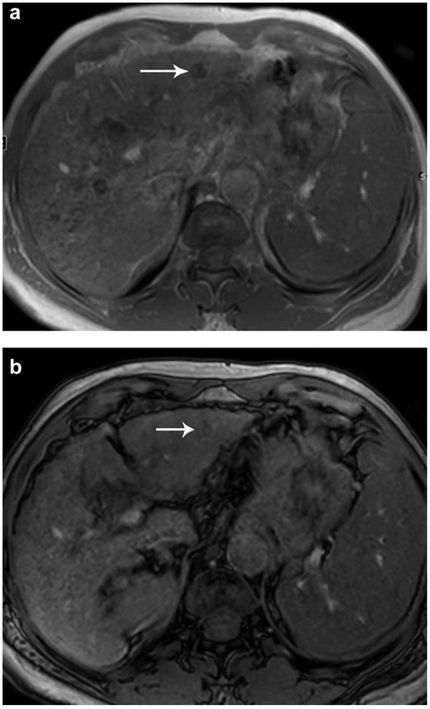
Flow artifact. Example of flow artifact in ascites in a 66-year-old male patient with advanced cirrhosis from ethanol abuse, (a) Single shot fast spin-echo T2-weighted image demonstrates the presence of ascites and motion artifact of the fluid (arrow). In addition, there is a distinct 11-mm observation in segment 7 of the liver, which is of high signal intensity on T1-weighted images (b). On subtraction images, there is subtle but real-appearing arterial enhancement (c). The observation is of low signal intensity on T2-weighted images, which is not an ancillary feature at this time (e). There was no washout identified on this study nor was there a capsule. This was categorized as LI-RADS-3.
FIGURE 13:
FIGURE 13:
Additional observations on gadoxetic acid. A 37-year-old with hepatitis B infection demonstrates presence of a 13-mm sonographically visible, arterially enhancing observation in segment 7 (a) which demonstrates washout (b) and a lack of update of the hepatobiliary contrast agent on the hepatobiliary phase (c) (white arrows). This is consistent with LI-RADS-5 observation. On the 20-minute delayed hepatobiliary images, two additional (d), subcentimeter observations are seen (black arrows) which also demonstrate arterial enhancement (e) but no washout on the PVP (f).
FIGURE 14:
FIGURE 14:
A 72-year-old man undergoing TACE for previously two biopsy-proven HCCs. Both of these biopsy-proven HCC initially were a bit atypical in that they showed arterial enhancement and growth, but no washout (images not shown). At the time of TACE of the larger HCC in segment 7, Lipiodol is seen being taken up by the mass during the fluoroscopic procedure (a). An unenhanced CT scan performed with 1 month post-TACE demonstrates some high density Lipiodol in both HCCs, both in segment 7 (larger one) (b) and segment 6 (smaller one) (c) but the distribution of Lipiodol is not homogeneous. An MRI performed 3 months post-TACE images of the larger mass in segment 7 demonstrates high signal intensity on T1-weighted fat-saturated images, prior to gadolinium administration, consistent with blood products (d). On arterial phase images (e) including subtraction images (f), a few nodular areas are identified with the treated mass in segment 7 and along the periphery, which have the same imaging characteristics as pretreatment (arterial enhancement but no PVP washout (g)). Despite the lack of “washout,” these areas of enhancement are consistent with viable disease since the imaging characteristics are the same as the pretreatment characteristics. In the smaller treated lesion in segment 6, on arterial (h) (black arrow) and PVP imaging (i) (black arrow) there was no nodular enhancement and this was called nonviable. This was confirmed on subsequent MRI follow-up at 6 and 9 months after TACE.

References

    1. Torre LA, Bray F, Siegel RL, et al. Global cancer statistics, 2012. CA Cancer J Clin 2015;65:87–108. - PubMed
    1. Bruix J, Sherman M. Management of hepatocellular carcinoma: an update. Hepatology 2011;53:1020–1022. - PMC - PubMed
    1. Chernyak V, SantilIan CS, Papadatos D, Sirlin CB. LI-RADS((R)) algorithm: CT and MRI. Abdom Radiol 2018;43:111–126. - PubMed
    1. Tang A, Valasek MA, Sirlin CB. Update on the Liver Imaging Reporting and Data System: What the pathologist needs to know. Adv Anat Pathol. 2015;22:314–322. - PubMed
    1. Sirlin CB. The LI-RADS adventure—a personal statement. Abdom Radiol 2018;43:1–2. - PubMed