


Impact of five annual rounds of mass drug administration with ivermectin on onchocerciasis in Sierra Leone
- PMID: 29628019
- PMCID: PMC5890354
- DOI: 10.1186/s40249-018-0410-y
Impact of five annual rounds of mass drug administration with ivermectin on onchocerciasis in Sierra Leone
Abstract
Background: Onchocerciasis is endemic in 12 of the 14 health districts of Sierra Leone. Good treatment coverage of community-directed treatment with ivermectin was achieved between 2005 and 2009 after the 11-year civil conflict. Sentinel site surveys were conducted in 2010 to evaluate the impact of five annual rounds of ivermectin distribution.
Methods: In total, 39 sentinel villages from hyper- and meso-endemic areas across the 12 endemic districts were surveyed using skin snips in 2010. Results were analyzed and compared with the baseline data from the same 39 villages.
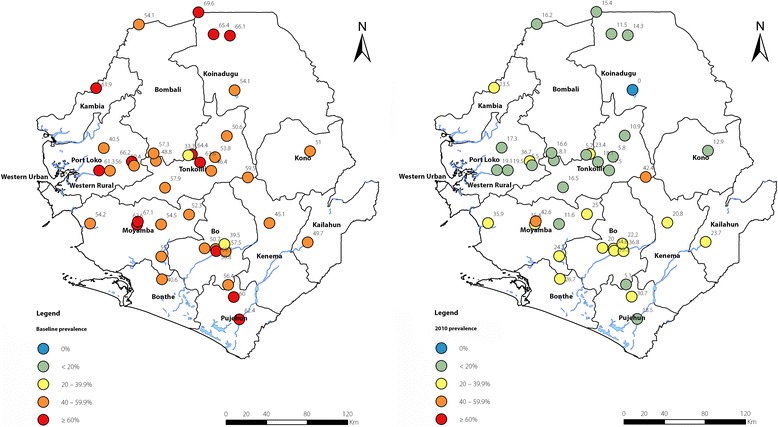
Results: The average microfilaridermia (MF) prevalence across 39 sentinel villages was 53.10% at baseline. The MF prevalence was higher in older age groups, with the lowest in the age group of 1-9 years (11.00%) and the highest in the age group of 40-49 years (82.31%). Overall mean MF density among the positives was 28.87 microfilariae (mf)/snip, increasing with age with the lowest in the age group of 1-9 years and the highest in the age group of 40-49 years. Males had higher MF prevalence and density than females. In 2010 after five rounds of mass drug administration, the overall MF prevalence decreased by 60.26% from 53.10% to 21.10%; the overall mean MF density among the positives decreased by 71.29% from 28.87 mf/snip to 8.29 mf/snip; and the overall mean MF density among all persons examined decreased by 88.58% from 15.33 mf/snip to 1.75 mf/snip. Ten of 12 endemic districts had > 50% reduction in MF prevalence. Eleven of 12 districts had ≥50% reduction in mean MF density among the positives.
Conclusions: A significant reduction of onchocerciasis MF prevalence and mean density was recorded in all 12 districts of Sierra Leone after five annual MDAs with effective treatment coverage. The results suggested that the onchocerciasis elimination programme in Sierra Leone was on course to reach the objective of eliminating onchocerciasis in the country by the year 2025. Annual MDA with ivermectin should continue in all 12 districts and further evaluations are needed across the country to assist the NTDP with programme decision making.
Keywords: Community-directed drug distributor; Community-directed treatment with ivermectin; Disease elimination; Mass drug administration; Onchocerca volvulus; Onchocerciasis; Onchocerciasis-endemic; Post-conflict; Rapid diagnostic test; Skin snip.
Conflict of interest statement
Ethics approval and consent to participate
The surveys were part of the monitoring and evaluation activities of the NOCP of the MOHS, Sierra Leone. Ethical approval for data collection was obtained from the Ethics Committee of the MOHS, Sierra Leone. Upon arrival at the selected communities, the investigating teams met with community leaders and explained the nature of their work and the objectives of the study. Volunteers participated in the studies after informed consent was verbally obtained and recorded by the team leader as literacy rates are low in Sierra Leone. Consent was obtained from participants themselves, or from the parents of all participants below the age of 15 years. Data collection was conducted such that participants will remain anonymous during data entry and analysis. No individual’s identity can be revealed upon publication.
Consent for publication
Not applicable.
Competing interests
The authors declare that they have no competing interests.
Figures
References
-
- Traore MO, Sarr MD, Badji A, Bissan Y, Diawara L, Doumbia K, et al. Proof-of-principle of onchocerciasis elimination with ivermectin treatment in endemic foci in Africa: final results of a study in Mali and Senegal. PLoS Negl Trop Dis. 2012;6:e1825. doi: 10.1371/journal.pntd.0001825. - DOI - PMC - PubMed
-
- Conceptual and operational framework of onchocerciasis elimination with ivermectin treatment. World Health Organization. 2010. http://www.who.int/apoc/oncho_elimination_report_english.pdf. Accessed 4 Jan 2018.
MeSH terms
Substances
LinkOut - more resources
Full Text Sources
Other Literature Sources
