Review
. 2018 Jun;22(6):504-516.
doi: 10.1016/j.tics.2018.03.005. Epub 2018 Apr 5.

The Original Social Network: White Matter and Social Cognition

Affiliations
Review

The Original Social Network: White Matter and Social Cognition

Yin Wang et al. Trends Cogn Sci. 2018 Jun.

Abstract

Social neuroscience has traditionally focused on the functionality of gray matter regions, ignoring the critical role played by axonal fiber pathways in supporting complex social processes. In this paper, we argue that research on white matter is essential for understanding a range of topics in social neuroscience, such as face processing, theory of mind, empathy, and imitation, as well as clinical disorders defined by aberrant social behavior, such as prosopagnosia, autism, and schizophrenia. We provide practical advice on how best to carry out these studies, which ultimately will substantially deepen our understanding of the neurobiological basis of social behavior.

Keywords: diffusion-weighted imaging; social cognition; social disorder; social neuroscience; structural connectivity; white matter.


Figures

Figure 1
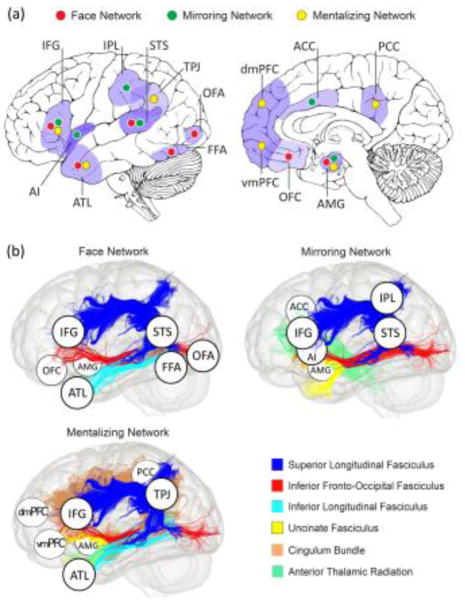
Figure 1
Gray matter and white matter structures that constitute core social brain networks. (a) A depiction of gray matter regions that are highly activated when people perform face perception, imitation/empathy, and mentalizing tasks in an MRI scanner [7,55]. (b) Major white matter bundles associated with each social brain network are depicted. They form the overall architecture of interconnections between social brain regions depicted in (a). Disruption of these fiber tracts (either by brain damage or neuromodulation) can lead to a range of social deficits, such as prosopagnosia [2], impaired empathy and emotion recognition skills [45,104], and mind-blindness [79,80,94,105]. For simplicity and clarity, not all gray and white matter regions/tracts implicated in each network are shown. ACC, anterior cingulate cortex; AI, anterior insula; AMG, amygdala; ATL, anterior temporal lobe; dMPFC, dorsomedial prefrontal cortex; FFA, fusiform face area; IFG, inferior frontal gyrus; IPL, inferior parietal lobule; OFC, orbitofrontal cortex; OFA, occipital face area; PCC, posterior cingulate cortex; STS, superior temporal sulcus; TPJ, temporo-parietal junction; vMPFC, ventromedial prefrontal cortex. This figure is adapted from [22].
Key Figure
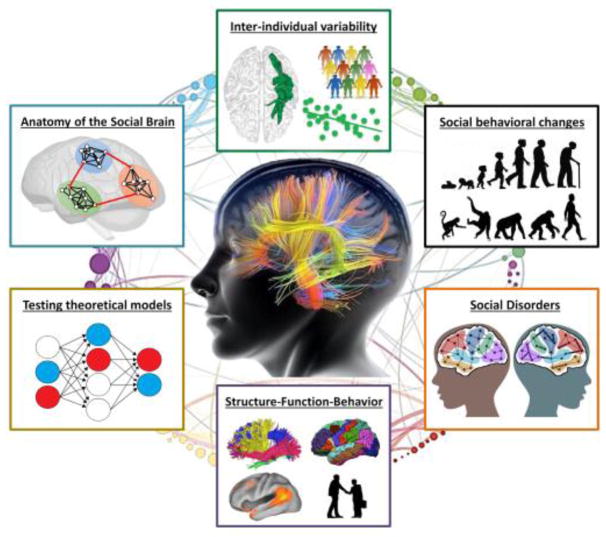
Key Figure
The advantages of examining white matter for social neuroscience. When compared to functional approaches (e.g. fMRI, EEG, MEG, TMS), studying white matter allows for several unique insights (described in a clockwise manner). First, white matter mapping can reveal network-level anatomy, functioning, plasticity and compensation of the social brain. Second, white matter characteristics, distinct from gray matter properties and genetic factors, can be effectively used to account for remarkable inter-individual variability of social skills and behavior. Third, white matter research can unravel the structural correlates of social behavioral changes during development, aging, disease, and across species. Fourth, our understanding of social disorders such as prosopagnosia, autism and schizophrenia will benefit significantly from investigation of white matter; structural connectivity can be treated as a legitimate and reliable biomarker for clinical diagnosis and therapy. Fifth, collecting multimodal brain data including functional and diffusion imaging enable us to infer “structure-function” relationships that subserve social cognition and behavior. Finally, clarifying white matter pathways in the social brain can be used to guide the construction of new neurobiologically realistic models for social processing as well as to validate existing theories in social neuroscience.

References

    1. Douglas Fields R. White matter in learning, cognition and psychiatric disorders. Trends Neurosci. 2008;31:361–370. - PMC - PubMed
    1. Rokem A, et al. The visual white matter: The application of diffusion MRI and fiber tractography to vision science. J Vis. 2017;17:1–30. - PMC - PubMed
    1. Ciccarelli O, et al. Diffusion-based tractography in neurological disorders: concepts, applications, and future developments. Lancet Neurol. 2008;7:715–727. - PubMed
    1. Thomas AG, et al. The fornix in health and disease: an imaging review. RadioGraphics. 2011;31:1107–1121. - PubMed
    1. Friederici AD. Chapter 10 – White-matter pathways for speech and language processing. Handbook of Clinical Neurology. 2015;129:177–186. - PubMed

Publication types

LinkOut - more resources