


nArgBP2-SAPAP-SHANK, the core postsynaptic triad associated with psychiatric disorders
- PMID: 29628500
- PMCID: PMC5938024
- DOI: 10.1038/s12276-017-0018-5
nArgBP2-SAPAP-SHANK, the core postsynaptic triad associated with psychiatric disorders
Abstract
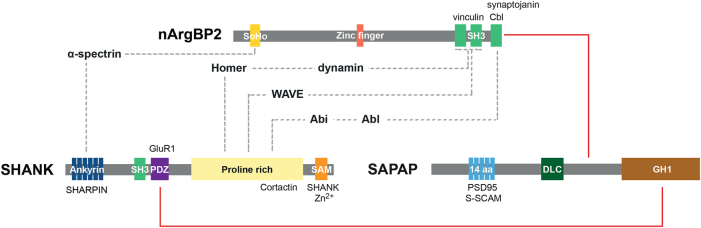
Despite the complex genetic architecture, a broad spectrum of psychiatric disorders can still be caused by mutation(s) in the same gene. These disorders are interrelated with overlapping causative mechanisms including variations in the interaction among the risk-associated proteins that may give rise to the specific spectrum of each disorder. Additionally, multiple lines of evidence implicate an imbalance between excitatory and inhibitory neuronal activity (E/I imbalance) as the shared key etiology. Thus, understanding the molecular mechanisms underlying E/I imbalance provides essential insight into the etiology of these disorders. One important class of candidate risk genes is the postsynaptic scaffolding proteins, such as nArgBP2, SAPAP, and SHANK that regulate the actin cytoskeleton in dendritic spines of excitatory synapses. This review will cover and discuss recent studies that examined how these proteins, especially nArgBP2, are associated with psychiatric disorders. Next, we propose a possibility that variations in the interaction among these proteins in a specific brain region might contribute to the onset of diverse phenotypes of psychiatric disorders.
Conflict of interest statement
The authors declare that they have no conflict of interest.
Figures


References
-
- Bourgeron T. A synaptic trek to autism. Curr. Opin. Neurobiol. 2009;19:231–234. - PubMed
-
- Zoghbi HY. Postnatal neurodevelopmental disorders: meeting at the synapse? Science. 2003;302:826–830. - PubMed
-
- Benes FM, Berretta S. GABAergic interneurons: implications for understanding schizophrenia and bipolar disorder. Neuropsychopharmacology. 2001;25:1–27. - PubMed
Publication types
MeSH terms
Substances
LinkOut - more resources
Full Text Sources
Other Literature Sources
Medical
