Effect of Esmolol and Diltiazem Infusions on Hemodynamic Response to Pneumoperitoneum on Laparoscopic Simple Nephrectomy: A Randomized Controlled Trial
- PMID: 29628560
- PMCID: PMC5872900
- DOI: 10.4103/aer.AER_203_17
Effect of Esmolol and Diltiazem Infusions on Hemodynamic Response to Pneumoperitoneum on Laparoscopic Simple Nephrectomy: A Randomized Controlled Trial
Abstract
Background: Several studies have been conducted in search of appropriate drugs to attenuate hemodynamic responses in laparoscopic cholecystectomy, but till date, no such study has been conducted on patients undergoing laparoscopic nephrectomy.
Aim: The study was designed to assess the effect of esmolol and diltiazem infusions on hemodynamic changes during routine laparoscopic transperitoneal simple nephrectomy.
Settings and design: A prospective double-blinded randomized control trial.
Subjects and methods: A total of 120 nonhypertensive patients of the American Society of Anesthesiologists physical Status I and II aged 20-60 years about to undergo laparoscopic nephrectomy were enrolled for the study after obtaining Institute Ethical committee approval. The patients were randomly allocated to one of the three groups. Group I (control group) received 10 ml normal saline intravenously (i.v.) before induction of anesthesia, followed by continuous infusion 10-20 ml/h. Group II (esmolol group) received i.v. esmolol 1 mg/kg diluted in 10 ml similarly, followed by continuous infusion of 10-20 ml/h (5-10 μg/kg/min). Group III (diltiazem group) received i.v. diltiazem 0.2 mg/kg diluted in 10 ml before induction of anesthesia, followed by continuous infusion at 10-20 ml/h (0.08-1.25) μg/kg/min. After completion of surgery, all the infusions were stopped. Data recording were done for changes in hemodynamics throughout the surgery.
Statistical analysis: was done using Chi-square test for categorical data and one-way ANOVA for continuous data. Tukey ("honestly significant difference") post hoc test was applied for intra- and inter-group comparison in cases where ANOVA was significant. P < 0.05 is considered statistically significant.
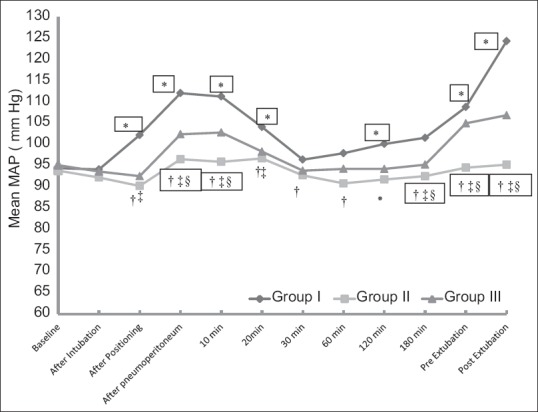
Results: All hemodynamic data: Heart rate (HR), systolic, diastolic, and mean arterial pressure were observed to be significantly higher (P < 0.001) from baseline in control group at the time of creation of pneumoperitoneum, till 20 min thereafter. The values were comparable to baseline in both esmolol and diltiazem group. On intergroup comparison, the patients in esmolol group had significantly lower HR and blood pressures than in diltiazem group at the creation of pneumoperitoneum and at extubation (P < 0.05). Mean dose of esmolol and diltiazem used were 7.25 ± 1.33 μg/kg/min and 1.14 ± 0.77 μg/kg/min, respectively.
Conclusion: Both esmolol and diltiazem infusion provide stable intraoperative hemodynamics and protection against stress response triggered by pneumoperitoneum in patients undergoing laparoscopic transperitoneal nephrectomy.
Keywords: Diltiazem; esmolol; laparoscopic nephrectomy.
Conflict of interest statement
There are no conflicts of interest.
Figures
References
-
- Öztürk T. Shamsa A, editor. Risks associated with laparoscopic surgery. Advanced Laparoscopy. InTech. 2011. [Last accessed on 2017 Nov 08]. Available from: http://www.intechopen.com/books/advancedlaparoscopy/risks-associatedwith... .
-
- Midgley S, Tolley DA. Anaesthesia for Laparoscopic Surgery in Urology. Eur Urol Suppl. 2006;4:241–5.
-
- Dar SA, Gupta DD, Deopujari RC, Gomes P. Effect of magnesium sulphate on attenuation of hemodynamic stress responses during laparoscopic abdominal surgeries. J Anesth Clin Res. 2015;6:12.
LinkOut - more resources
Full Text Sources
Other Literature Sources