Clinical performance of direct versus indirect composite restorations in posterior teeth: A systematic review
- PMID: 29628639
- PMCID: PMC5852929
- DOI: 10.4103/JCD.JCD_213_16
Clinical performance of direct versus indirect composite restorations in posterior teeth: A systematic review
Abstract
Background: Composite resin, serves as esthetic alternative to amalgam and cast restorations. Posterior teeth can be restored using direct or indirect composite restorations. The selection between direct and indirect technique is a clinically challenging decision-making process. Most important influencing factor is the amount of remaining tooth substance.
Aim: The aim of this systematic review was to compare the clinical performance of direct versus indirect composite restorations in posterior teeth.
Materials and methods: The databases searched included PubMed CENTRAL (until July 2015), Medline, and Cochrane Database of Systematic Reviews. The bibliographies of clinical studies and reviews identified in the electronic search were analyzed to identify studies which were published outside the electronically searched journals. The primary outcome measure was evaluation of the survival of direct and indirect composite restorations in posterior teeth.
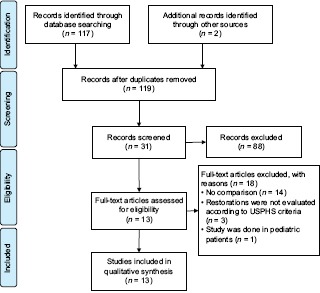
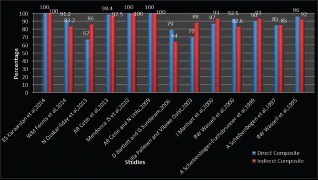
Results: This review included thirteen studies in which clinical performance of various types of direct and indirect composite restorations in posterior teeth were compared. Out of the thirteen studies which were included seven studies had a high risk of bias and five studies had a moderate risk of bias. One study having a low risk of bias, concluded that there was no significant difference between direct and indirect technique. However, the available evidence revealed inconclusive results.
Conclusion: Further research should focus on randomized controlled trials with long term follow-up to give concrete evidence on the clinical performce of direct and indirect composite restorations.
Keywords: Clinical evaluation; indirect technique; posterior teeth; single-visit direct composite restorations; survival rate.
Conflict of interest statement
There are no conflicts of interest.
Figures
References
-
- Manhart J, Scheibenbogen-Fuchsbrunner A, Chen HY, Hickel R. A 2-year clinical study of composite and ceramic inlays. Clin Oral Investig. 2000;4:192–8. - PubMed
-
- Burke EJ, Qualtrough AJ. Aesthetic inlays: Composite or ceramic? Br Dent J. 1994;176:53–60. - PubMed
-
- Lu H, Lee YK, Oguri M, Powers JM. Properties of a dental resin composite with a spherical inorganic filler. Oper Dent. 2006;31:734–40. - PubMed
-
- Mitra SB, Wu D, Holmes BN. An application of nanotechnology in advanced dental materials. J Am Dent Assoc. 2003;134:1382–90. - PubMed
-
- Ericson D. What is minimally invasive dentistry? Oral Health Prev Dent. 2004;2(Suppl 1):287–92. - PubMed
Publication types
LinkOut - more resources
Full Text Sources
Medical
Miscellaneous