Basic Findings Regarding Breast Cancer in Korea in 2015: Data from a Breast Cancer Registry
- PMID: 29628978
- PMCID: PMC5880959
- DOI: 10.4048/jbc.2018.21.1.1
Basic Findings Regarding Breast Cancer in Korea in 2015: Data from a Breast Cancer Registry
Erratum in
-
Erratum: Basic Findings Regarding Breast Cancer in Korea in 2015: Data from a Breast Cancer Registry.J Breast Cancer. 2019 Mar;22(1):153. doi: 10.4048/jbc.2019.22.e12. J Breast Cancer. 2019. PMID: 30941243 Free PMC article.
Abstract
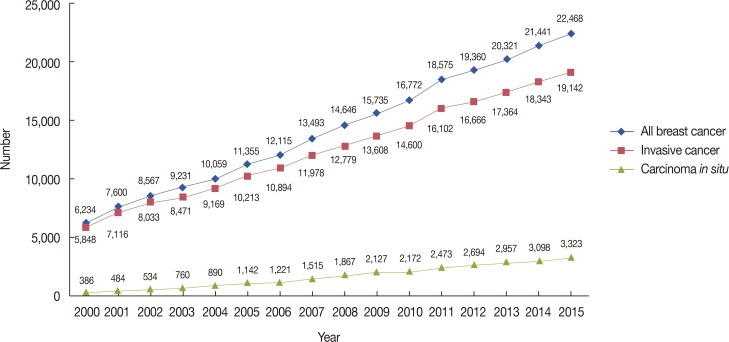
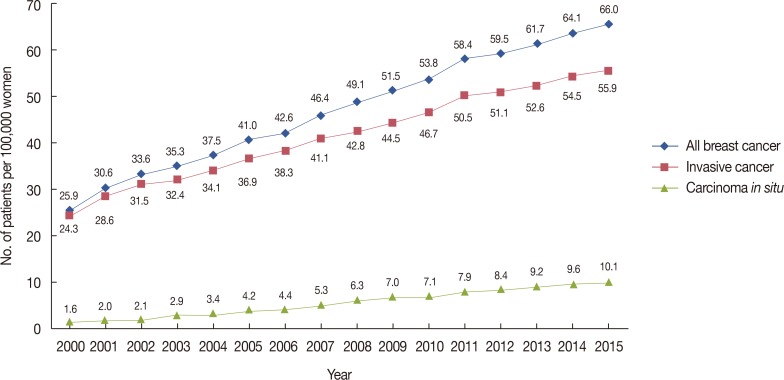
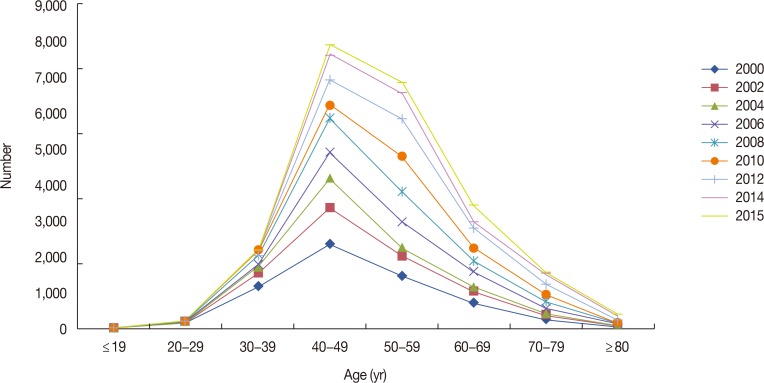
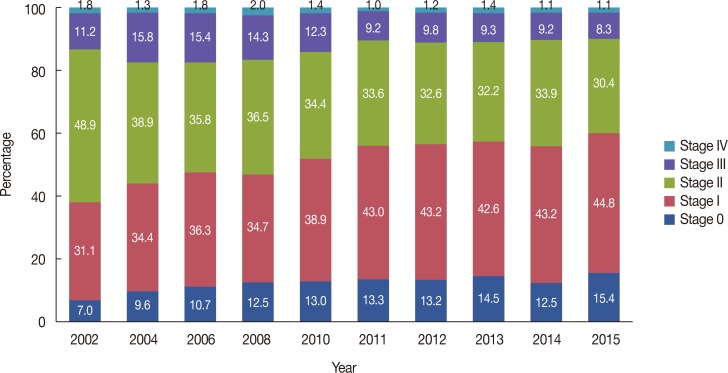
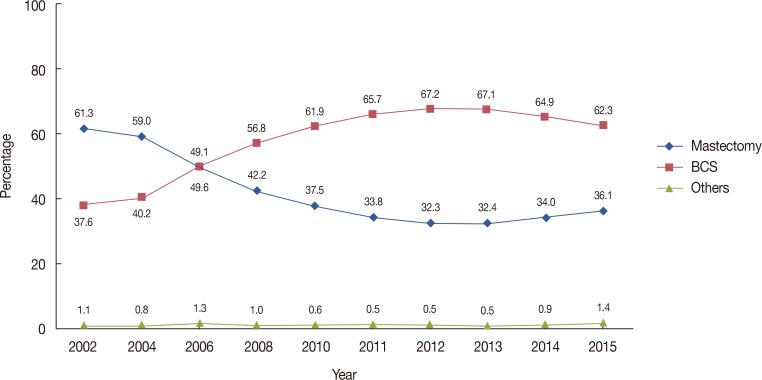
The Korean Breast Cancer Society (KBCS) has established a nationwide breast cancer database using an online registration program in 1996. The present study aimed to analyze the basic findings and trends of breast cancer in Korea in 2015 using the data provided by the Korea Central Cancer Registry and the KBCS. In 2015, a total of 22,550 patients were newly diagnosed with breast cancer, of which 3,331 were carcinoma in situ cases and 19,219 were invasive cancer cases. The incidence rate of breast cancer in Korea has steadily increased since the nationwide database was established, and the crude rate and age-standardized rate including that of carcinoma in situ, were 88.1 and 66.0 cases per 100,000 women, respectively. In terms of age, the incidence of breast cancer was the highest in the 40-49-year-old age group (7,889 patients, 35.0%). With regard to surgical procedure, breast-conserving surgery was frequently performed (62.3%). However, the rate of mastectomy has been gradually increasing since 2012, that is, from 32.3% in 2014 to 36.1% in 2015. The rate of early breast cancer has continued to increase, and that of stages III and IV breast cancer was only 9.1% at the time of diagnosis. However, the 5-year survival rate of patients with carcinoma in situ from 2011 to 2015 was 92.3%, which was 14.4% higher than that from 1993 to 1995 (77.9%). Analysis of data from the nationwide registry of breast cancer will not only help to understand the characteristics of breast cancer in individuals in Korea, but will also significantly contribute to the treatment and research of breast cancer. Therefore, a high quality database for breast cancer in Korea must be established by further initiating registration project and establishing an objective legal basis.
Keywords: Breast neoplasms; Epidemiology; Registries.
Conflict of interest statement
CONFLICT OF INTEREST: The authors declare that they have no competing interests.
Figures
References
-
- Ferlay J, Soerjomataram I, Ervik M, Dikshit R, Eser S, Mathers C, et al. GLOBOCAN 2012 v1.0, cancer incidence and mortality worldwide: IARC CancerBase No. 11. International Agency for Research on Cancer; [Accessed February 13th, 2018]. http://globocan.iarc.fr.
-
- National Cancer Information Center; Ministry of Health and Welfare. Cancer statistics. [Accessed February 13th, 2018]. https://www.cancer.go.kr/
-
- Fay MP, Tiwari RC, Feuer EJ, Zou Z. Estimating average annual percent change for disease rates without assuming constant change. Biometrics. 2006;62:847–854. - PubMed
Publication types
LinkOut - more resources
Full Text Sources
Other Literature Sources