Review
. 2017 Dec 4;9(1):15-21.
doi: 10.1039/c7sc04200k. eCollection 2018 Jan 7.

Mechanochemistry of the mechanical bond

Affiliations
Review

Mechanochemistry of the mechanical bond

Guillaume De Bo. Chem Sci. .

Abstract

Strong and stable under tension? In this review we present the recent efforts investigating the mechanochemical properties of interlocked structures by atomic force microscopy and polymer mechanochemistry.


Figures
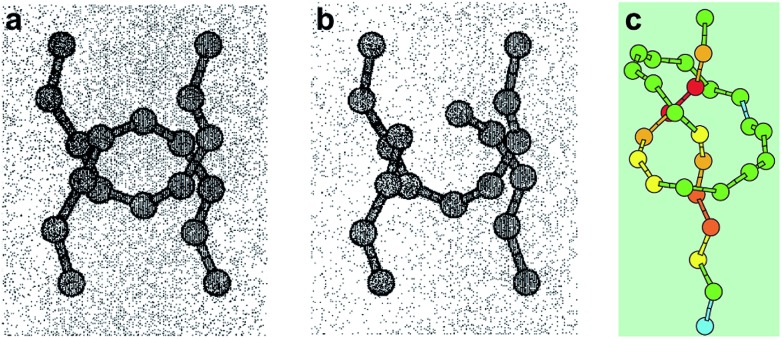
Fig. 1
Fig. 1. Snapshots from molecular dynamics simulation of the carbon backbones of two entangled alkanes (a) before and (b) after the break of a C–C bond and (c) a knotted polymer strand showing the strain energy distribution (from blue (low) to red (high)). Reproduced from ref. 5 and 6 respectively.
Fig. 2
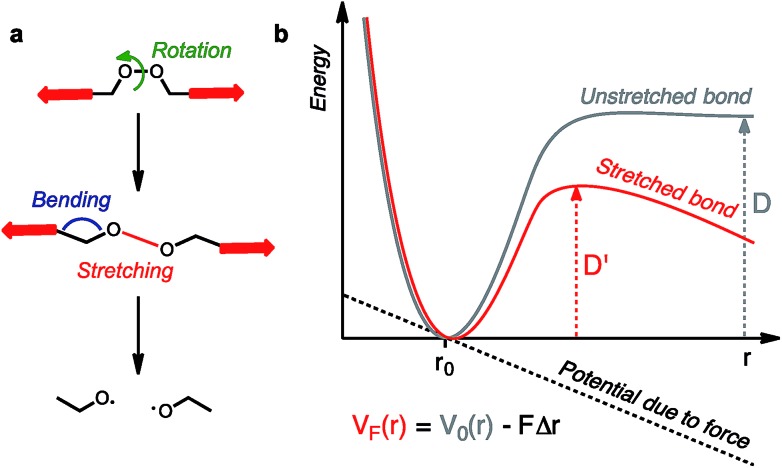
Fig. 2. Molecules under tension can undergo a series of deformations before the rupture of the weakest bond (a). The potential energy surface of a bond under tension can be described by a force-modified Morse potential (b).
Fig. 3
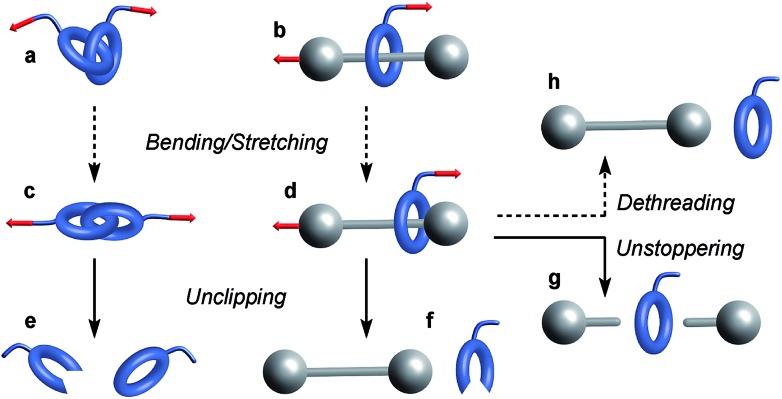
Fig. 3. Examples of mechanochemical behaviors observed in a catenane (a) and a rotaxane (b). Elongation of these mechanical bonds (c and d) can lead to their disassembly via the rupture of a covalent bond in the macrocycle (e and f) or the thread (g). Rotaxanes can also dissociate by dethreading (h). Plain and dashed arrows denote events involving the rupture or not of a covalent bond respectively.
Scheme 1
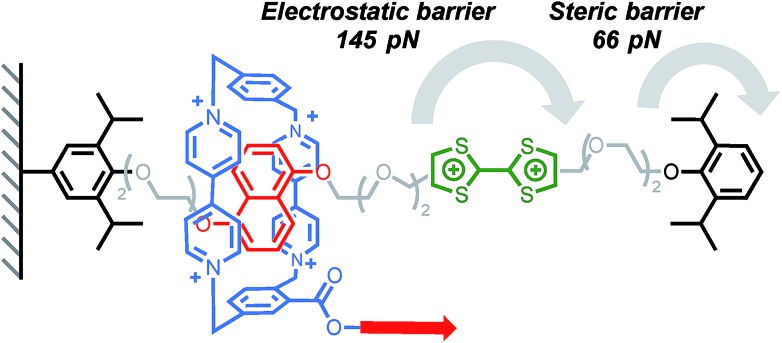
Scheme 1. AFM experiments probing the ability of a tetracationic macrocycle to cross electrostatic (green) and steric (black) barriers in Stoddart's bistable rotaxane (counterions are omitted for clarity). Red arrow indicates the direction of the force.
Scheme 2
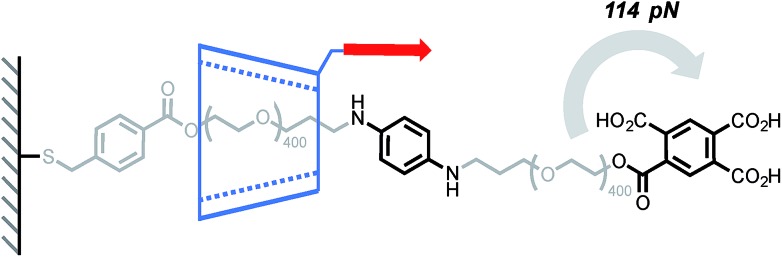
Scheme 2. AFM experiment probing the ability of α-cyclodextrin to slip over a tricarboxylic acid benzoyl stopper. Red arrow indicates the direction of the force.
Scheme 3
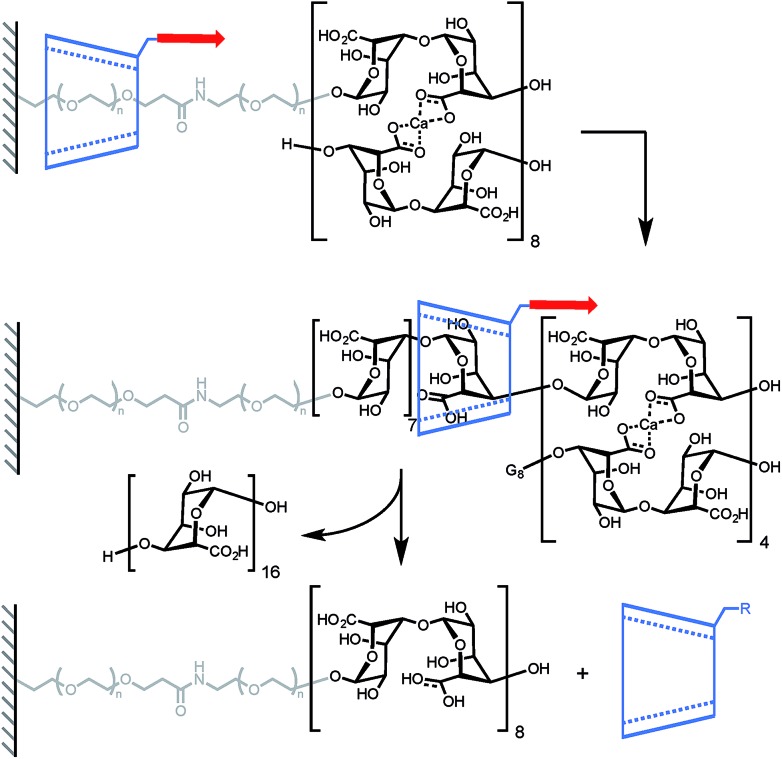
Scheme 3. AFM experiment probing the ability of α-cyclodextrin to dethread by unzipping a doubly-stranded oligoguluronic acid/Ca2+ complex. Red arrows indicate the direction of the force.
Scheme 4
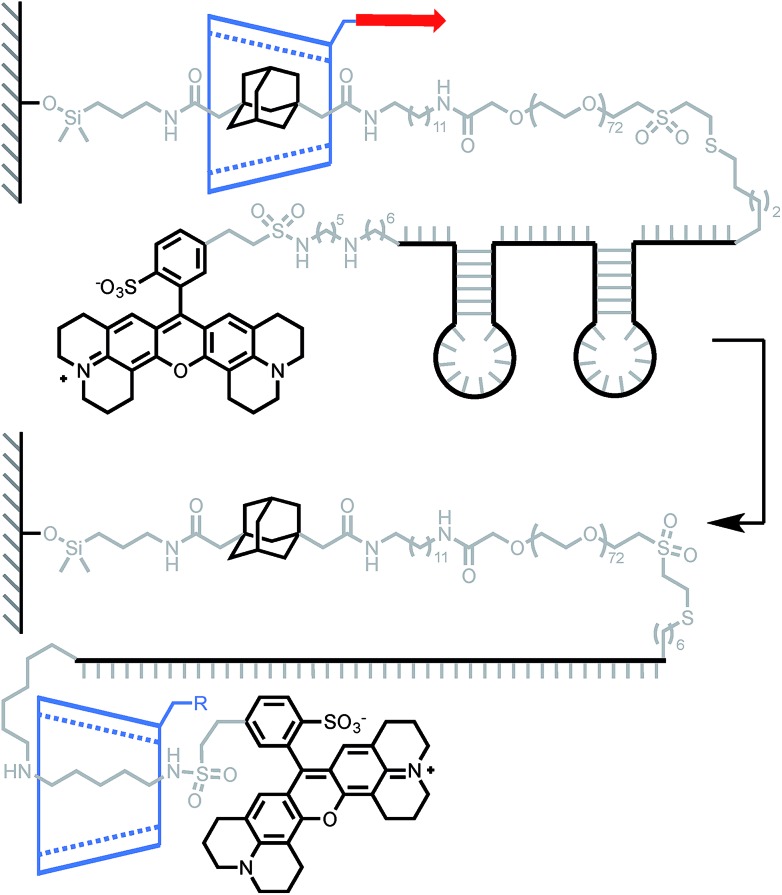
Scheme 4. AFM experiment probing the ability of β-cyclodextrin to dethread by unzipping a pair of hairpin DNA. Red arrow indicates the direction of the force.
Scheme 5
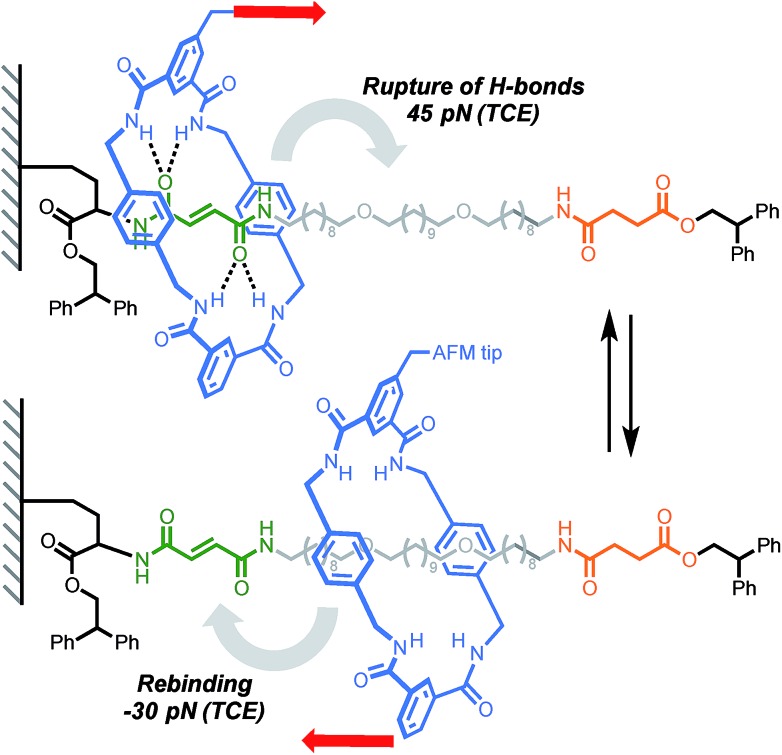
Scheme 5. AFM experiment probing the ability of a tetralactam macrocycle to escape a complementary station in Leigh's bistable rotaxane. Red arrows indicate the direction of the force.
Scheme 6
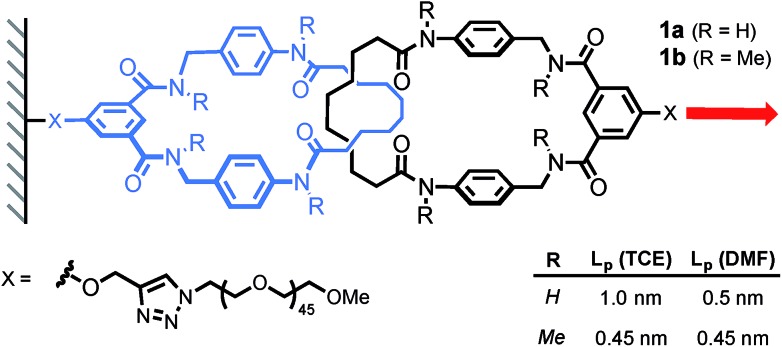
Scheme 6. AFM experiment probing the mobility of a [2]catenane under tension (1 nN s–1). Red arrow indicates the direction of the force.
Scheme 7
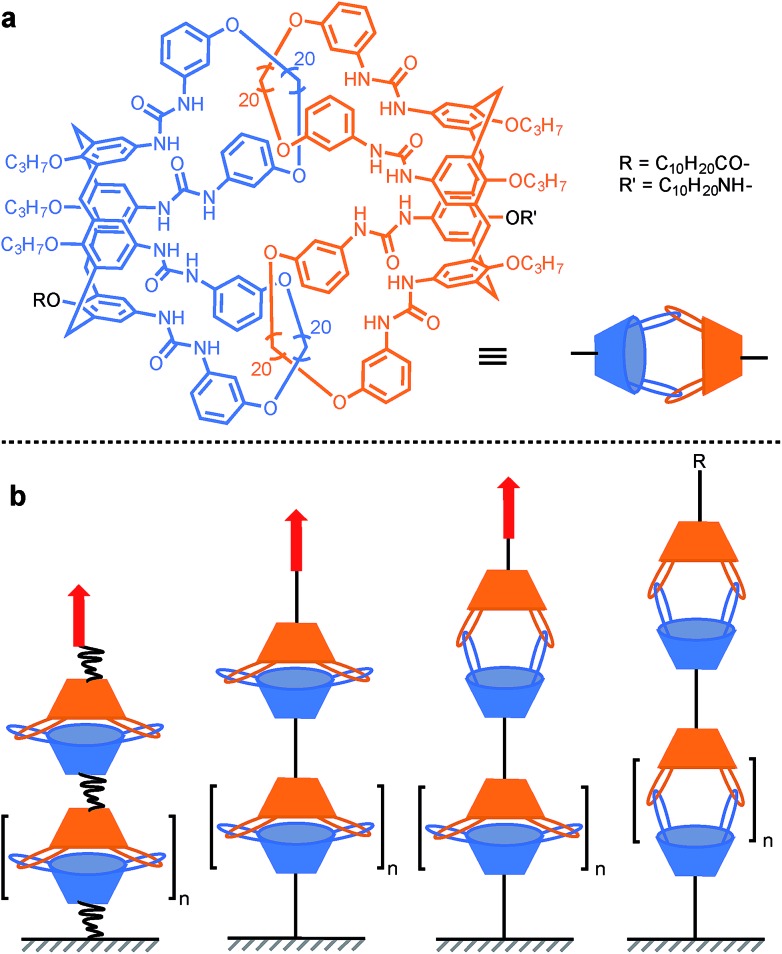
Scheme 7. AFM experiment probing the 16 hydrogen bonds uniting interlocked calix[4]arenes dimeric capsules. Red arrows indicate the direction of the force.
Scheme 8
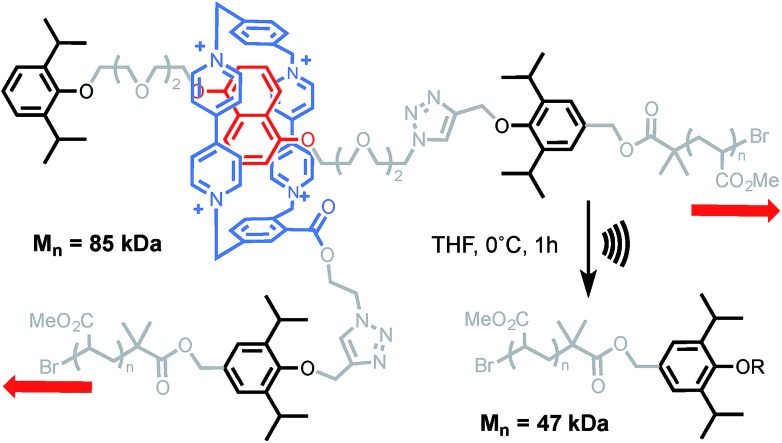
Scheme 8. Sonication of Stoddart's rotaxane incorporated into a PMA backbone. Counterions not shown for clarity. Red arrows indicate the direction of the force.
Scheme 9
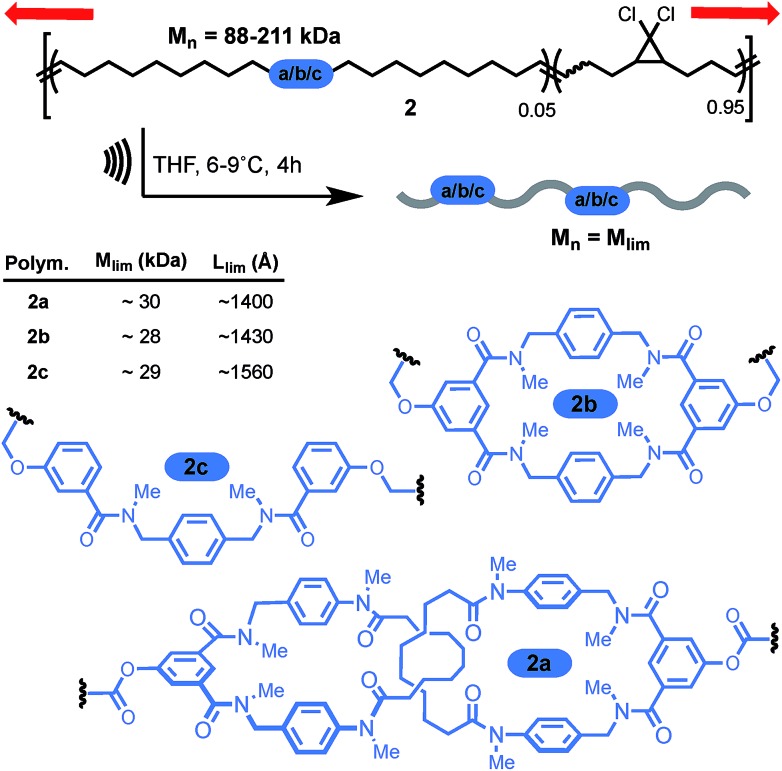
Scheme 9. Craig's sonomechanochemical approach to probe the mechanical strength of a catenane: limiting mass of a polymer containing Leigh's catenane 2a was compared to non-interlocked counterparts 2b–c. Red arrows indicate the direction of the force.
None
Guillaume De Bo

References

    1. Bruns C. J. and Stoddart J. F., in The Nature of the Mechanical Bond, John Wiley & Sons, Inc., Hoboken, NJ, USA, 2016, pp. 55–268.
    1. Wasserman E. J. Am. Chem. Soc. 1960;82:4433–4434.
    1. Erbas-Cakmak S., Leigh D. A., McTernan C. T., Nussbaumer A. L. Chem. Rev. 2015;115:10081–10206. - PMC - PubMed
    1. Ito K., Mayumi K. and Kato K., Polyrotaxane and Slide-Ring Materials, The Royal Society of Chemistry, Cambridge, 2016.
    1. Saitta A. M., Klein M. L. J. Phys. Chem. B. 2000;104:2197–2200.