


Nickel-catalyzed difunctionalization of allyl moieties using organoboronic acids and halides with divergent regioselectivities
- PMID: 29629124
- PMCID: PMC5869318
- DOI: 10.1039/c7sc03149a
Nickel-catalyzed difunctionalization of allyl moieties using organoboronic acids and halides with divergent regioselectivities
Abstract
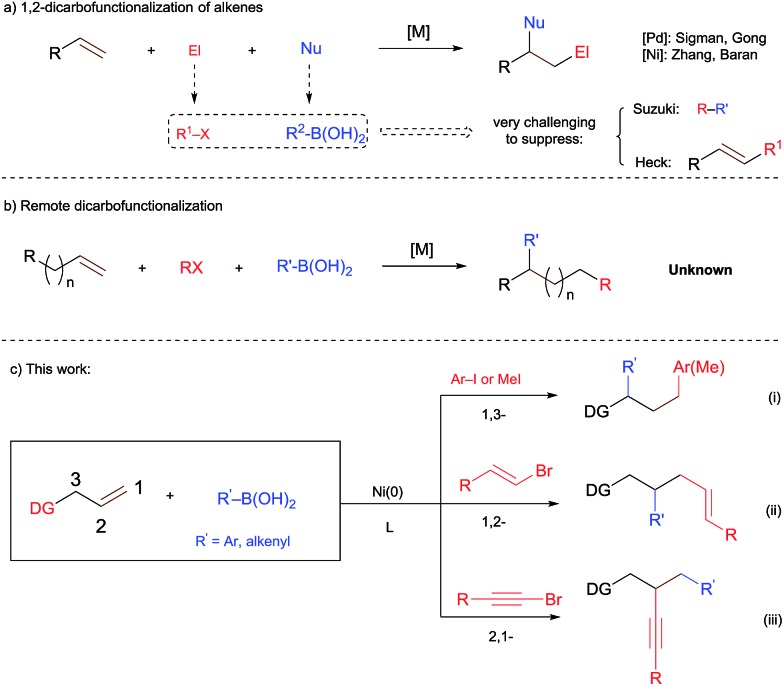
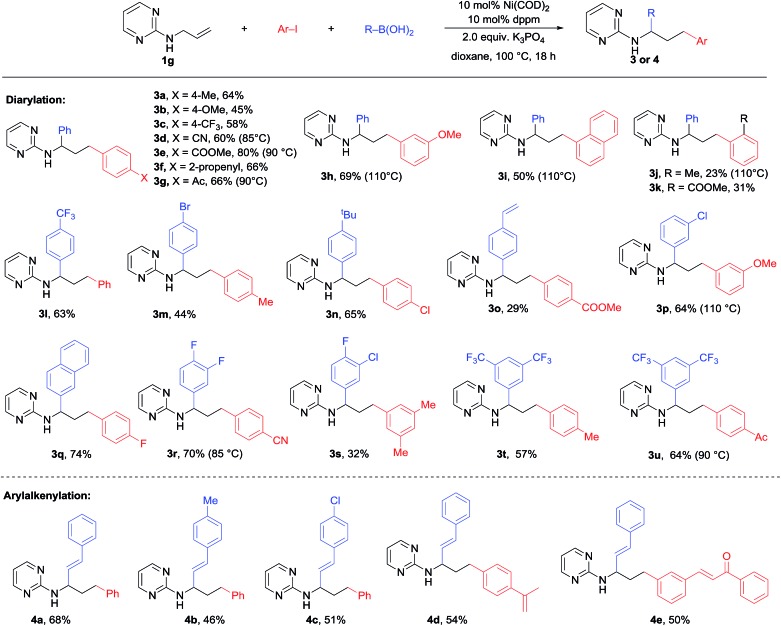
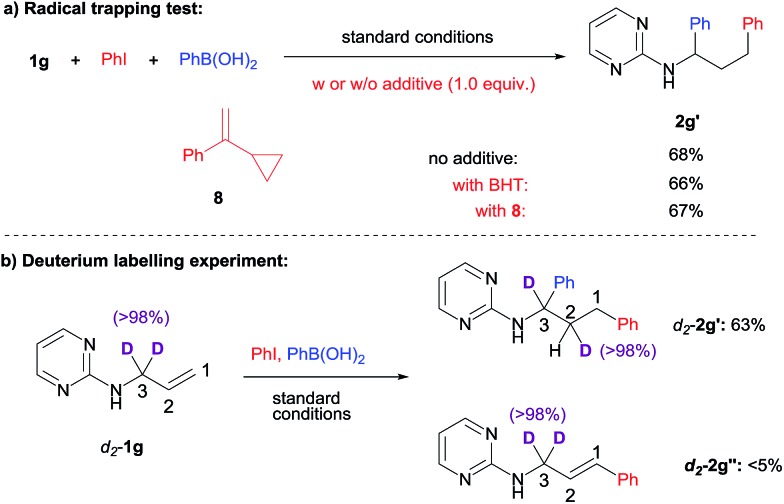
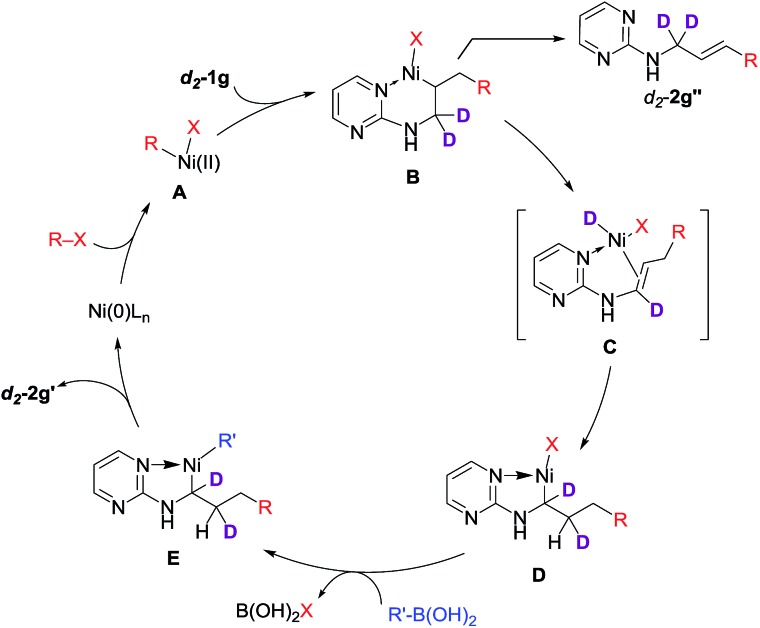
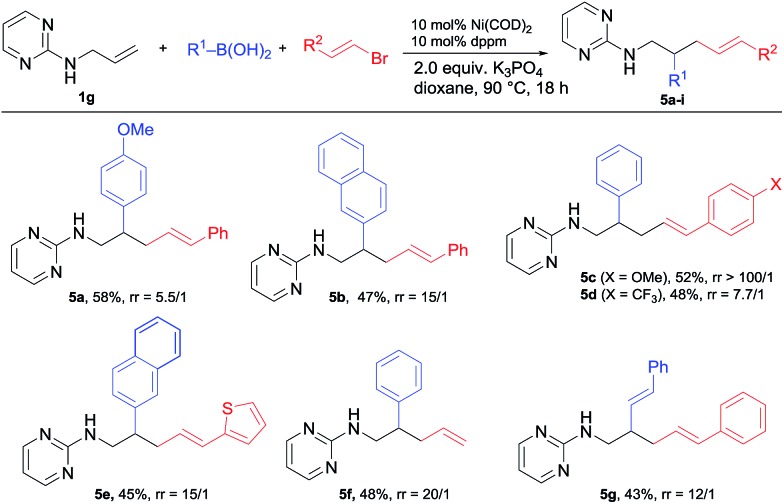
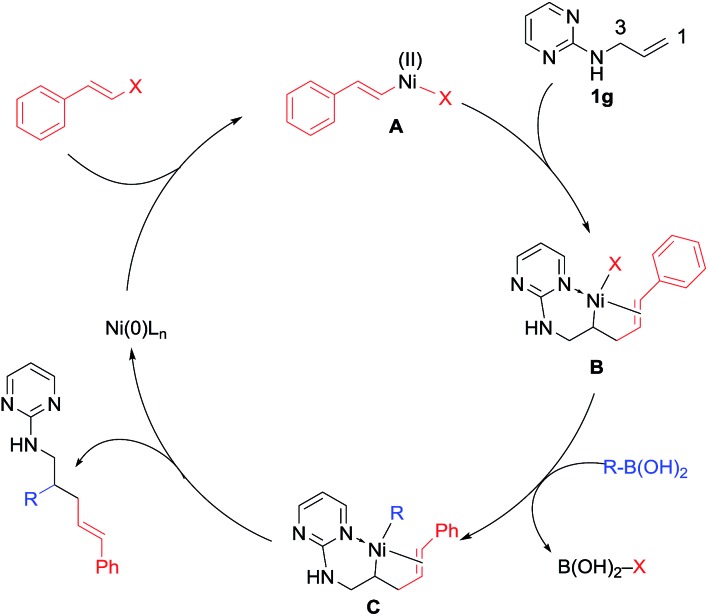
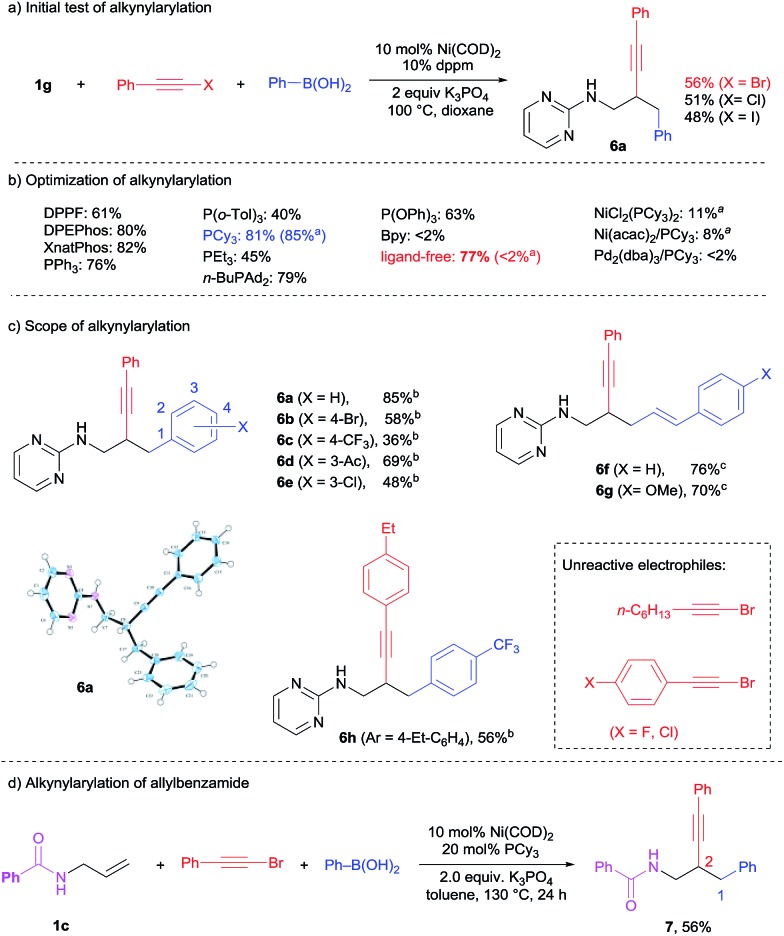
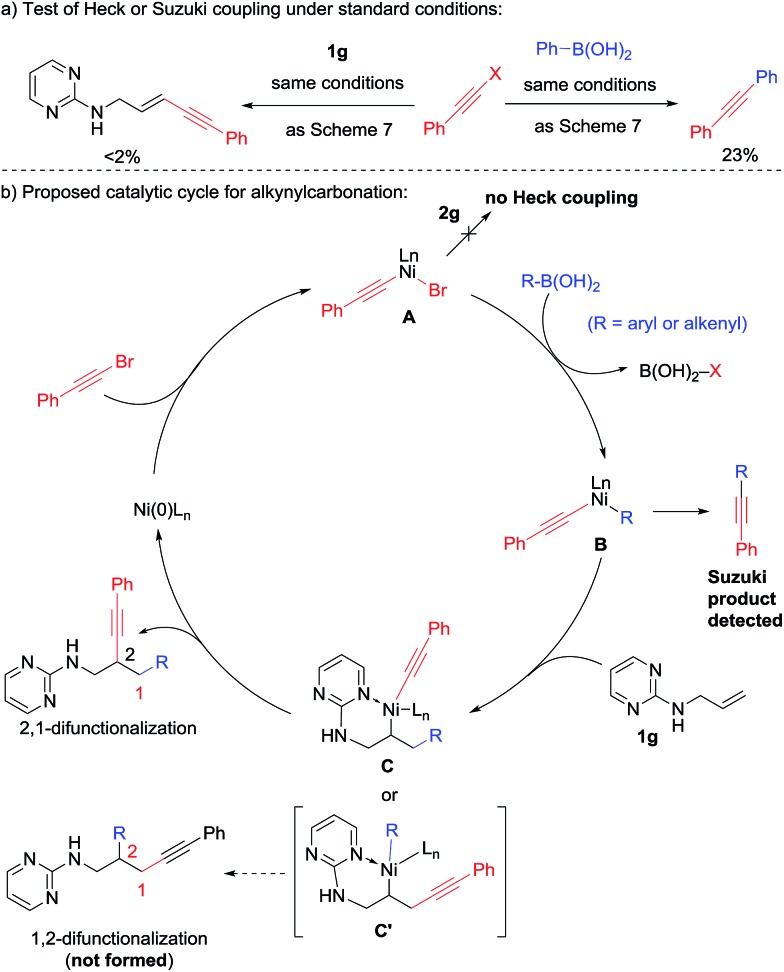
Efficient difunctionalization of alkenes allows the rapid construction of molecular complexity from simple building blocks in organic synthesis. We present herein a nickel-catalyzed dicarbofunctionalization of alkenes using readily available organoboronic acids and organic halides in a three-component fashion. In particular, an unprecedented regioselectivity of the 1,3-dicarbofunctionalization of N-allylpyrimidin-2-amine is achieved when aryl and methyl iodides are utilized. In contrast, the use of alkyl bromides with β-hydrogens results in 1,3-hydroarylation or oxidative 1,3-diarylation. Preliminary mechanistic studies suggest an isomerization involving nickel hydride in the 1,3-difunctionalization reactions. On the other hand, the use of alkenyl or alkynyl halides promotes alternative regioselectivities to deliver 1,2-alkenylcarbonation or intriguing 2,1-alkynylcarbonation products. Such 2,1-alkynylarylation is also applicable to N-allylbenzamide as a different class of substrates. Overall, this nickel-catalyzed process proves to be powerful in delivering versatile difunctionalized compounds using readily available reagents/catalysts and a simple procedure.
Figures
References
-
-
For selected Pd-catalyzed alkene dicarbofunctionalization, see:
- Catellani M., Chiusoli G. P., Concari S. Tetrahedron. 1989;45:5263–5268.
- Shaulis K. M., Hoskin B. L., Townsend J. R., Goodson F. E., Incarvito C. D., Rheingold A. L. J. Org. Chem. 2002;67:5860–5863. - PubMed
- Liao L., Jana R., Urkalan K. B., Sigman M. S. J. Am. Chem. Soc. 2011;133:5784–5787. - PMC - PubMed
- Stokes B. J., Liao L., de Andrade A. M., Wang Q., Sigman M. S. Org. Lett. 2014;16:4666–4669. - PMC - PubMed
- Wang D.-C., Niu H.-Y., Xie M.-S., Qu G.-R., Wang H.-X., Guo H.-M. Org. Lett. 2014;16:262–265. - PubMed
- Wu X., Lin H.-C., Li M.-L., Li L.-L., Han Z.-Y., Gong L.-Z. J. Am. Chem. Soc. 2015;137:13476–13479. - PubMed
- Liu Z., Zeng T., Yang K. S., Engle K. M. J. Am. Chem. Soc. 2016;138:15122–15125. - PubMed
- Yang K. S., Gurak J. A., Liu Z., Engle K. M. J. Am. Chem. Soc. 2016;138:14705–14712. - PubMed
- Yin G., Mu X., Liu G. Acc. Chem. Res. 2016;49:2413–2423. - PubMed
-
-
-
For selected recent Cu-catalyzed alkene dicarbofunctionalization, see:
- You W., Brown M. K. J. Am. Chem. Soc. 2014;136:14730–14733. - PubMed
- You W., Brown M. K. J. Am. Chem. Soc. 2015;137:14578–14581. - PubMed
- Thapa S., Basnet P., Giri R. J. Am. Chem. Soc. 2017;139:5700–5703. - PubMed
- Wu L., Wang F., Wan X., Wang D., Chen P., Liu G. J. Am. Chem. Soc. 2017;139:2904–2907. - PubMed
-
-
-
For selected recent Ni-catalyzed alkene dicarbofunctionalization, see:
- Qin T., Cornella J., Li C., Malins L. R., Edwards J. T., Kawamura S., Maxwell B. D., Eastgate M. D., Baran P. S. Science. 2016;352:801–805. - PMC - PubMed
- Xiao Y. L., Min Q. Q., Xu C., Wang R. W., Zhang X. G. Angew. Chem., Int. Ed. 2016;55:5837–5841. - PubMed
- Derosa J., Tran V., Boulous M. N., Chen J. S., Engle K. M. J. Am. Chem. Soc. 2017;139:10657–10660. - PubMed
- Shrestha B., Basnet P., Dhungana R. K., Kc S., Thapa S., Sears J. M., Giri R. J. Am. Chem. Soc. 2017;139:10653–10656. - PubMed
-
-
- Stüdemann T., Knochel P. Angew. Chem., Int. Ed. 1997;36:93–95.
- Nakao Y., Yukawa T., Hirata Y., Oda S., Satoh J., Hiyama T. J. Am. Chem. Soc. 2006;128:7116–7117. - PubMed
- Nakao Y., Yada A., Ebata S., Hiyama T. J. Am. Chem. Soc. 2007;129:2428–2429. - PubMed
- Terao J., Bando F., Kambe N. Chem. Commun. 2009;2009:7336–7338. - PubMed
- Hirata Y., Yada A., Morita E., Nakao Y., Hiyama T., Ohashi M., Ogoshi S. J. Am. Chem. Soc. 2010;132:10070–10077. - PubMed
- Minami Y., Yoshiyasu H., Nakao Y., Hiyama T. Angew. Chem., Int. Ed. 2013;52:883–887. - PubMed
- Hoshimoto Y., Ohata T., Sasaoka Y., Ohashi M., Ogoshi S. J. Am. Chem. Soc. 2014;136:15877–15880. - PubMed
- Nakai K., Yoshida Y., Kurahashi T., Matsubara S. J. Am. Chem. Soc. 2014;136:7797–7800. - PubMed
- Xue F., Zhao J., Hor T. S. A., Hayashi T. J. Am. Chem. Soc. 2015;137:3189–3192. - PubMed
- Wang X., Nakajima M., Serrano E., Martin R. J. Am. Chem. Soc. 2016;138:15531–15534. - PubMed
LinkOut - more resources
Full Text Sources
Other Literature Sources
