Review
. 2018 Mar 23:8:79.
doi: 10.3389/fonc.2018.00079. eCollection 2018.

Novel Therapeutic Targets in Cutaneous Squamous Cell Carcinoma

Affiliations
Review

Novel Therapeutic Targets in Cutaneous Squamous Cell Carcinoma

Teruki Yanagi et al. Front Oncol. .

Abstract

Cutaneous squamous cell carcinoma (SCC) is one of the common cancers in Caucasians, accounting for 20-30% of cutaneous malignancies. The risk of metastasis is low in most patients; however, aggressive SCC is associated with very high mortality and morbidity. Although cutaneous SCC can be treated with surgical removal, radiation and chemotherapy singly or in combination, the prognosis of patients with metastatic SCC is poor. Recently, the usage of immune checkpoint blockades has come under consideration. To develop effective therapies that are less toxic than existing ones, it is crucial to achieve a detailed characterization of the molecular mechanisms that are involved in cutaneous SCC pathogenesis and to identify new drug targets. Recent studies have identified novel molecules that are associated with SCC carcinogenesis and progression. This review focuses on recent advances in molecular studies involving SCC tumor development, as well as in new therapeutics that have become available to clinicians.

Keywords: Drp1; PD-1 antibody; cyclin-dependent kinase; epidermal growth factor receptor; mitochondria.


Figures
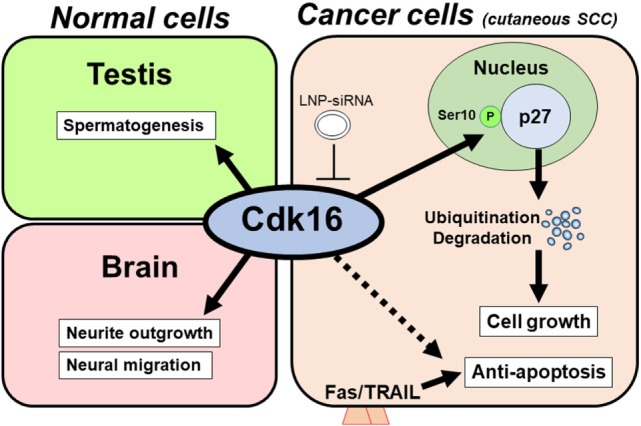
Figure 1
Figure 1
Model of the tumorigenic role of cyclin-dependent kinase 16 (Cdk16). In normal tissue (left), Cdk16 is required for spermatogenesis and neuron differentiation. In cancer cells, including cutaneous squamous cell carcinoma (SCC) cells (right), Cdk16 phosphorylates p27 at Ser10, thereby promoting p27 ubiquitination/degradation, which leads to cell cycle progression and decreased levels of apoptosis. An unknown mechanism may also exist in the Cdk16–apoptosis pathway. Lipid nanoparticle-mediated siRNA (LNP-siRNA) therapy against Cdk16 recently succeeded in a murine xenograft model.
Figure 2
Figure 2
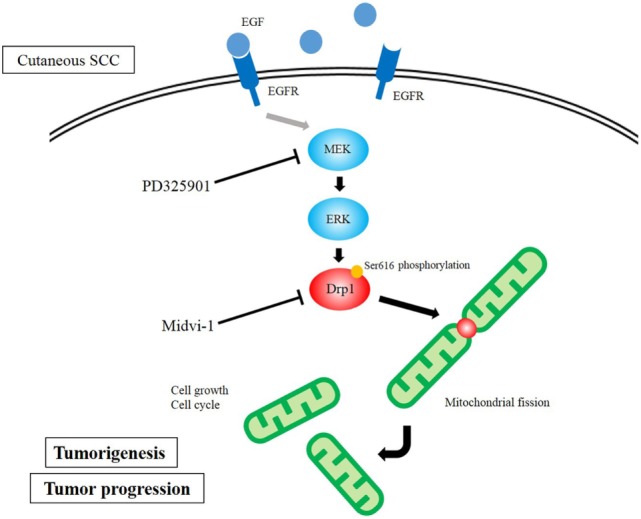
Diagram of dynamin-related protein 1 (Drp1) function in cutaneous squamous cell carcinoma (SCC) cells. MAPK signaling activates Drp1 via the phosphorylation of Drp1. The overexpression of Drp1 induces mitochondrial fission, which results in cell growth and assists cell cycle.

References

    1. Burton KA, Ashack KA, Khachemoune A. Cutaneous squamous cell carcinoma: a review of high-risk and metastatic disease. Am J Clin Dermatol (2016) 17:491–508. 10.1007/s40257-016-0207-3 - DOI - PubMed
    1. Madan V, Lear JT, Szeimies RM. Non-melanoma skin cancer. Lancet (2010) 375:673–85. 10.1016/S0140-6736(09)61196-X - DOI - PubMed
    1. Stratigos A, Garbe C, Lebbe C, Malvehy J, Marmol V, Pehamberger H, et al. Diagnosis and treatment of invasive squamous cell carcinoma of the skin: European consensus-based interdisciplinary guideline. Eur J Cancer (2015) 51:1989–2007. 10.1016/j.ejca.2015.06.110 - DOI - PubMed
    1. Kopecki Z, Yang GN, Jackson JE, Melville EL, Calley MP, Murrell DF, et al. Cytoskeletal protein flightless I inhibits apoptosis, enhances tumor cell invasion and promotes cutaneous squamous cell carcinoma progression. Oncotarget (2015) 6:36426–40. 10.18632/oncotarget.5536 - DOI - PMC - PubMed
    1. Weinberg AS, Ogle CA, Shim EK. Metastatic cutaneous squamous cell carcinoma: an update. Dermatol Surg (2007) 33:885–99. 10.1097/00042728-200708000-00001 - DOI - PubMed