


Review
doi: 10.1021/acschemneuro.8b00117.
Epub 2018 Apr 24.
DARK Classics in Chemical Neuroscience: Cocaine
Affiliations
- PMID: 29630337
- PMCID: PMC6197930
- DOI: 10.1021/acschemneuro.8b00117
Item in Clipboard
Review
DARK Classics in Chemical Neuroscience: Cocaine
ACS Chem Neurosci.
.
Abstract
In this Review, we consider the story of cocaine from its humble origins in South America to its status as one of the most abused substances in 21st century society. The synthesis and biosynthesis of cocaine are discussed, as well as its pharmacokinetics, metabolism, pharmacology, and importance in modern neuroscience and molecular imaging.
Keywords: Alkaloids; Cocaine; Crack cocaine; Molecular imaging; Pablo Escobar; Stimulant.
Conflict of interest statement
The authors declare no competing financial interest.
Figures
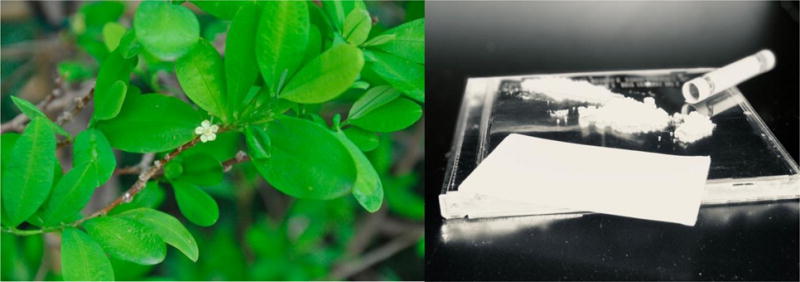
Erthroxylon coca (left, reprinted with permission from reference. Copyright 2015, Elsevier) and cocaine (right, personal photograph by the authors).
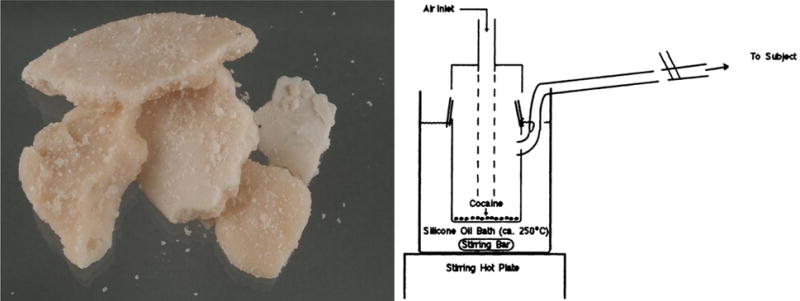
Crack cocaine (left, cropped from an image that is a work of a Drug Enforcement Administration employee, taken or made as part of that person’s official duties. As a work of the U.S. federal government, the image is in the public domain in the United States), and a laboratory crack pipe (right, reprinted with permission from reference. Copyright 1989, American Society of Pharmaceutics and Experimental Therapeutics).
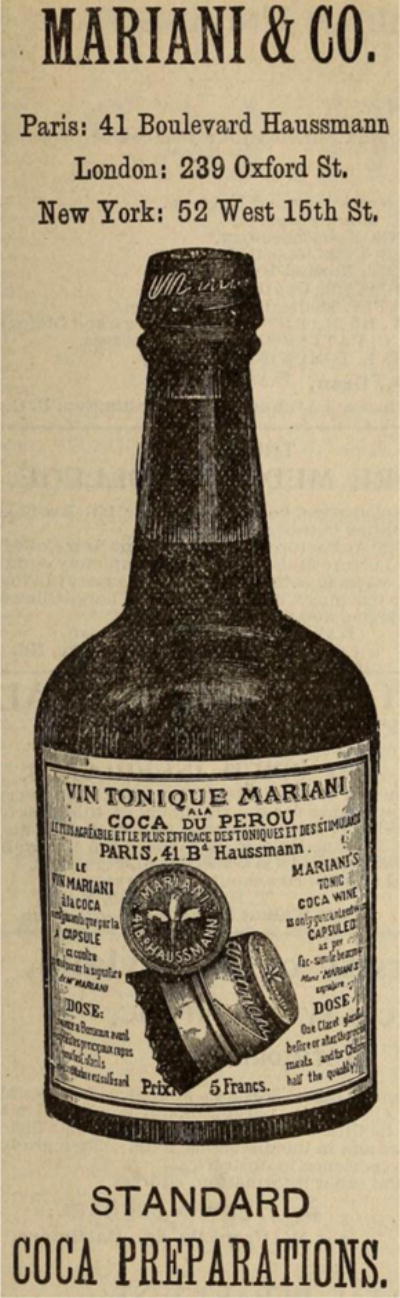
Mariani Wine (Image reprinted from reference and courtesy of the Smithsonian Libraries. No copyright in the United States).
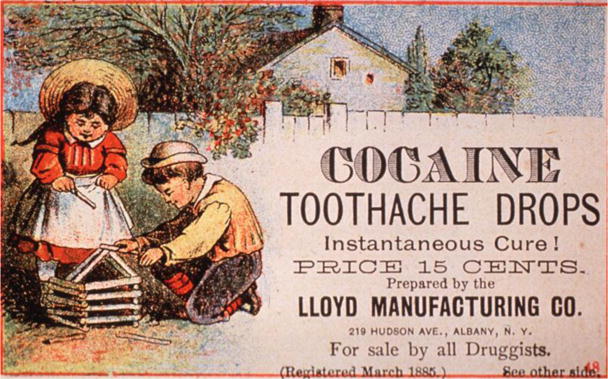
Cocaine Toothache Drops (Reprinted from the U.S. National Library of Medicine. Image is in the public domain).
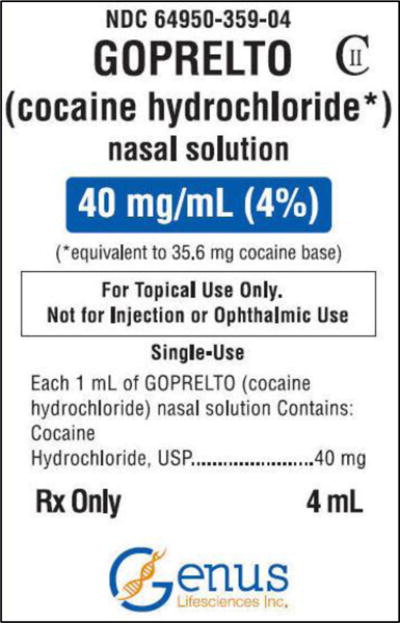
FDA-approved Cocaine hydrochloride marketed by Genus Lifesciences, Inc. (Reprinted from the U.S. National Library of Medicine. Image is in the public domain).
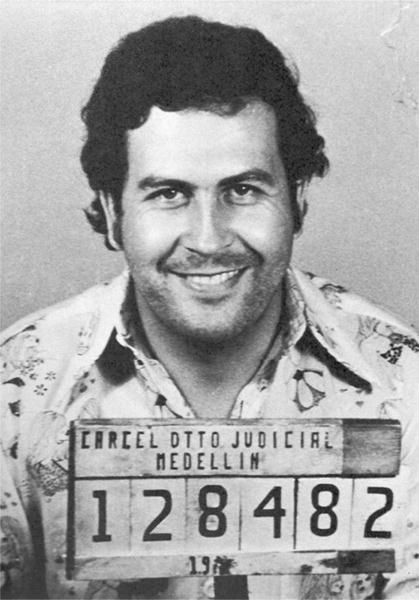
Juan Pablo Escobar (mugshot taken by the regional Colombia control agency in Medellin in 1977. Image is in the public domain).
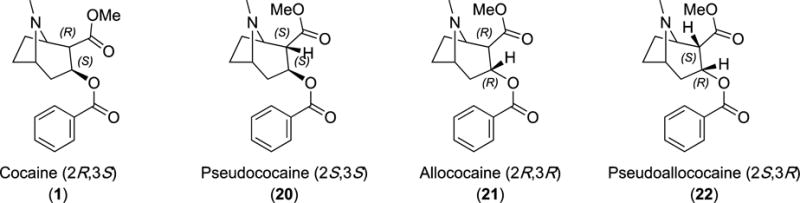
Stereoisomers of Cocaine
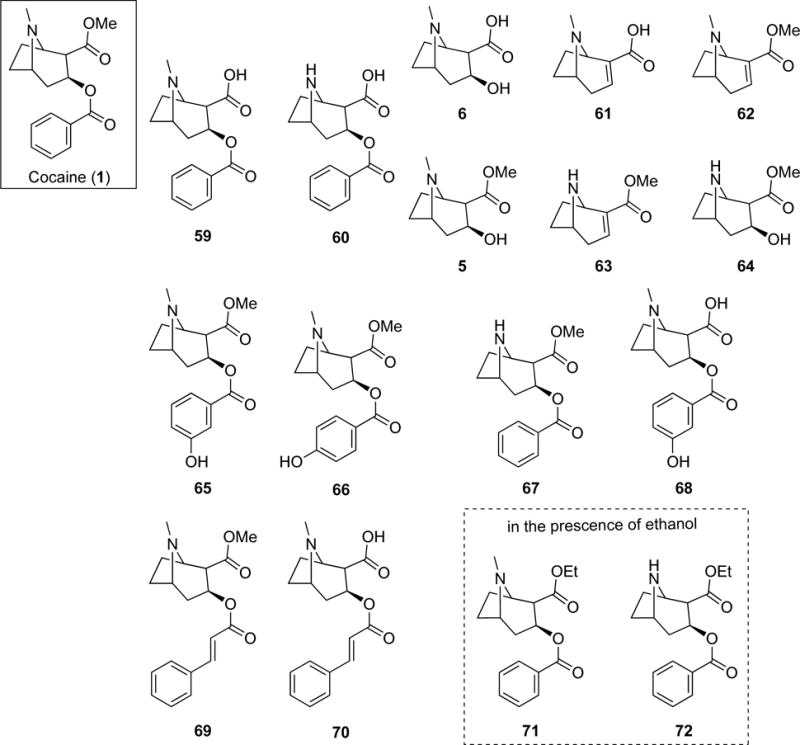
Metabolites of Cocaine: benzoylecgonine (59); benzoylnorecgonine (60); ecgonine (6); ecgonidine (61); ecgonidine methyl ester (62); ecgonine methyl ester (5); norecgonidine methyl ester (63); norecgonine methyl ester (64); m-hydroxycocaine (65); p-hydroxycocaine (66); norcocaine (67); m-hydroxybenzoylecgonine (68); cinnamoylcocaine (69); cinnamoylecgonine (70). Ethanol induced metabolites: cocaethylene (71); norcocaethylene (72).
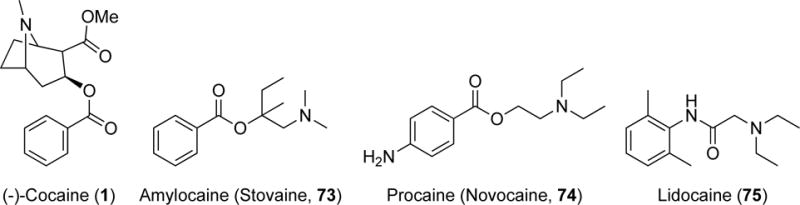
Cocaine and related local anesthetics
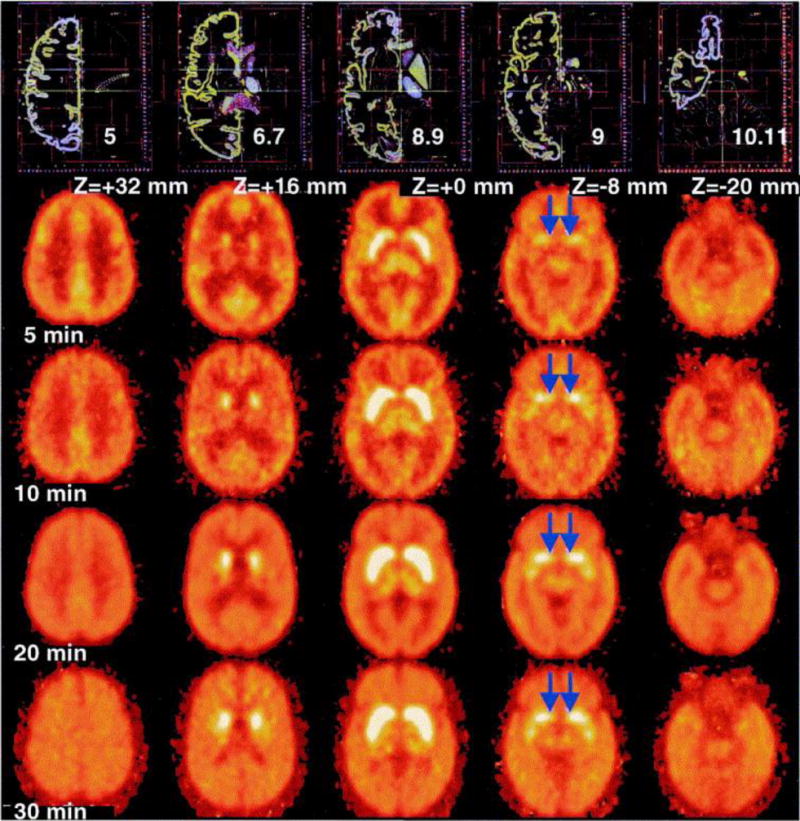
An average of 17 brain PET images with [11C]cocaine ([11C]1)at 4 different time frames after injection (5, 10, 20 and 30 minutes). Images have been normalized to the highest activity in a given time frame. The top row illustrated the Tailarach-Tournoux section. Arrows indicate the nucleus accumbens. (Reprinted with permission from reference. Copyright 2001, Elsevier).
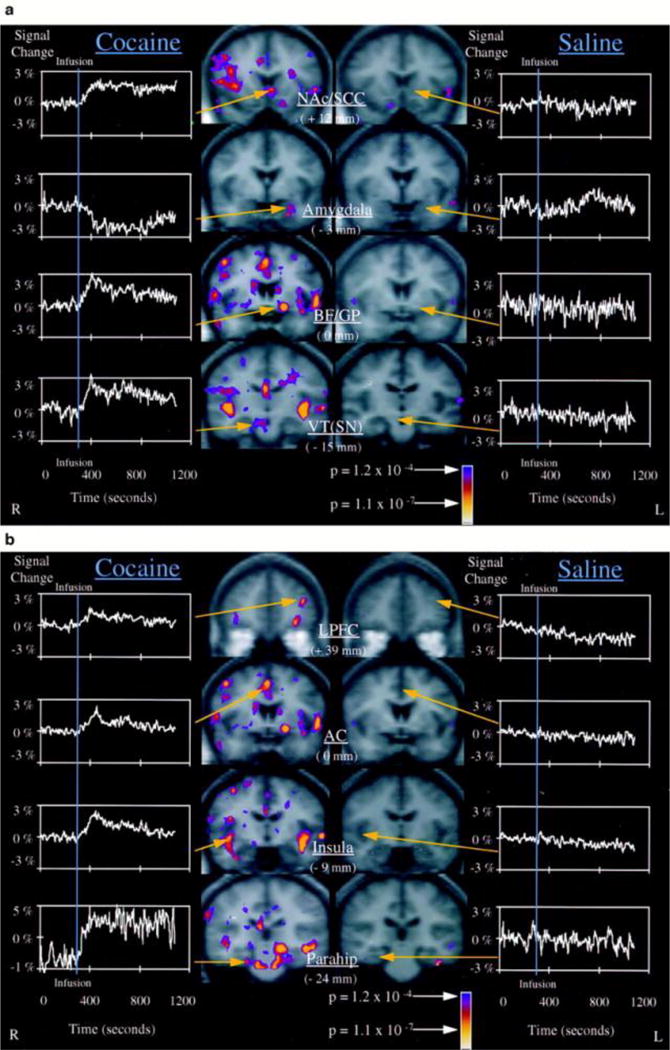
Regional brain activity as measured by fMRI following administration of cocaine (1) and saline control. (Reprinted with Permission from reference. Copyright 1997, Elsevier).

Wilstatter’s Total Synthesis of Cocaine. Conditions: (i) a. Na/EtOH, CO2; (ii) MeOH, H3O+; (iii) a. Na/Hg; (iv) Bz2O, D-tartaric acid chiral resolution.
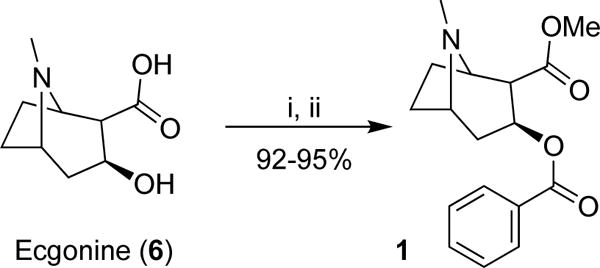
De Jong’s Conversion of Ecgonine (6) to Cocaine (1). Conditions: (i) MeOH, Benzene; (ii) BzCl, MeOH, Na2CO3.

Noyori’s General Synthesis of Tropane Alkaloids via the Polybromo Ketone-Iron Carbonyl Reaction. Conditions: i) a) Fe2(CO)9, benzene, 50°C, 72 h; ii) H2 10% Pd/C, ethanol; iii) DIBAH, THF, −78°C, 10 h.
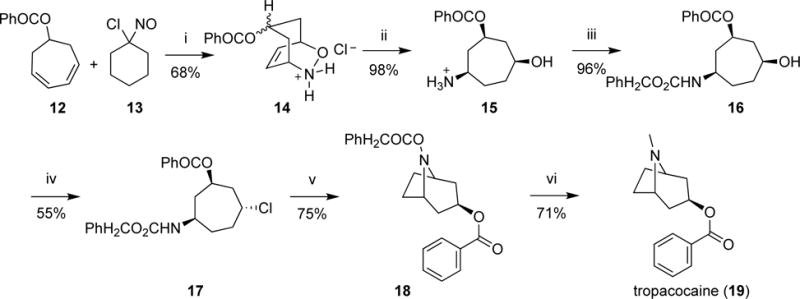
[4+2] Nitroso Cyloaddition route to Tropane Alkaloids. Conditions: (i) EtOH: CCl4, −20°C, 5 h, then −20°C, 14 d; (ii) H2 Pd/C, MeOH, 7h; (iii) Na2CO3, Benzyl chloroformate; (iv) Thionyl chloride, Pyridine, CDCl3, 0°C, 1h; (v) KtBuO; (vi) a) H2, Pd/C, MeOH, b) 90% aq. Formic acid, 37% aq. formaldehyde, reflux, 5 h; c) conc. HCl, recrystallized from ethanol:water.
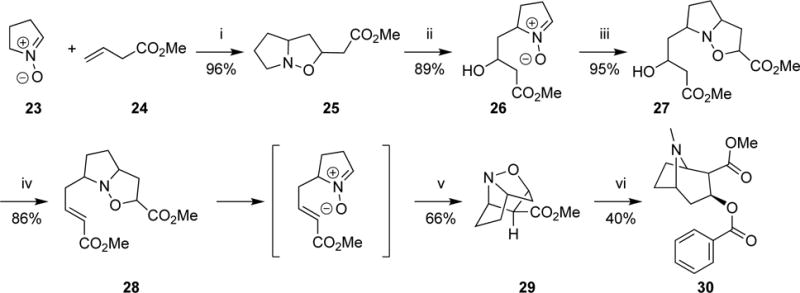
Tufariello’s Stereospecific Synthesis of (-)-Cocaine. Conditions: (i) toluene, reflux; (ii) mCPBA, CH2Cl2; (iii) methyl acrylate, benzene, reflux; (iv) a) MsCl, pyridine; b) 1,5 diaza-bicylco[4.3.0]non-5-ene, benzene; (v) xylene, reflux; (vi) a) MeI, CH2Cl2; b) Zn, AcOH; c) benzoyl chloride, MeOH, Na2CO3.
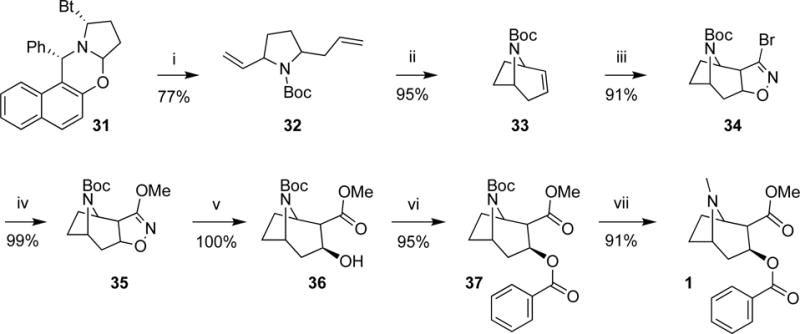
Cheng’s Total Synthesis of (-)-Cocaine. Conditions: (i) a) HC≡CMgCl added dropwise at −40 °C, THF, then 0 °C for 1 h; b) 5% Lindler catalyst, H2, THF, ~10 min; c) H2C=CHCH2MgBr, Et2O, −40 °C, 1 h; d) aq NaOH, MeOH, THF 60 °C, 1 h; e) Boc2O, K2CO3, CH2Cl2, rt,1 h; (ii) Grubbs II (0.025 eq) CH2Cl2, reflux, 12h; (iii) dibromoformaldoxime, Na2CO3, EtOAc, 10°C, 40 h; (iv) NaOMe, MeOH, reflux, 8 h; (v) Raney-Ni, H2, H3BO3, aq MeOH, rt, 3 h; (vi) BzCl, DMAP, Et3N, CH2Cl2, rt, 12 h; (vii) a) TFA, CH2Cl2, rt, 1 h b) 37% aq CH2O, NaBH3CN, rt, 1 h.
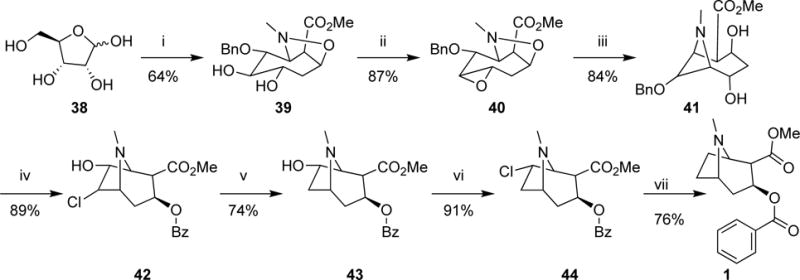
Shing & So Synthesis of (-)-Cocaine from D-(-)-Ribose. Conditions: (i) a) aq In, allyl bromide, H2O: EtOH; b) acetone, aq. AcOH, BzCl; c) methyl acrylate, Grubbs II, CH2Cl2, reflux; d) 80% AcOH reflux; e) NaIO4, silica gel, CH2Cl2, rt; f) MeNHOH, tol, reflux; (ii) Tf2O, 2,4,6-collidine, CH2Cl2, −78°C; b) K2CO3, MeOH, rt; (iii) H2, Raney Ni, AcOH, MeOH, rt to 60 °C; (iv) BzCl, Et3N, DMAP, CH2Cl2, 0 °C, then MsCl, rt; (v) H2, Raney Ni, MeOH, 50 °C; (vi) MsCl Et3N, CH2Cl2, rt to 70 °C, (vii) H2, Raney Ni, MeOH, rt, 14 h.
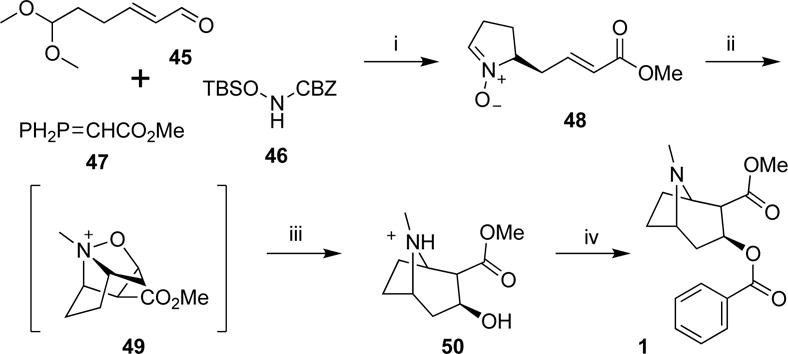
Concise Catalytic, Asymmetric Total Synthesis of Tropane Alkaloids. Conditions: (i) a) CHCl3, 4 °C, 17 h; b) cat PdCl2 (10 mol%), Et3N, Et3SiH, CH2Cl2, reflux 6 h; c) 3M HCl:THF, rt, 2h; (ii) a) Al(OtBu)3 (50 mol%) toluene, rt, 4 h, + 64 h at 150°C; b) MsOMe, CH2Cl2, reflux, 24 h. (iii) cat Pd/C, H2, MeOH, rt, 48 h; (iv) PhCOCl, Et3N, cat DMAP, CH2Cl2, rt, 17 h.
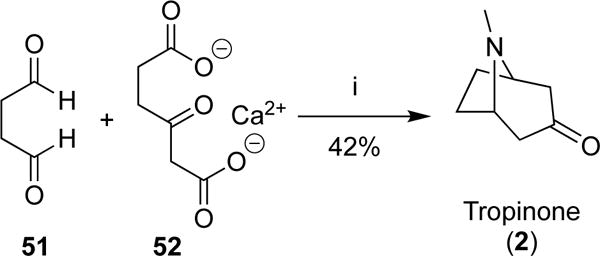
Robinson’s One-pot synthesis of Tropinone (2). Conditions: (i) H2NMe (53), H2O.
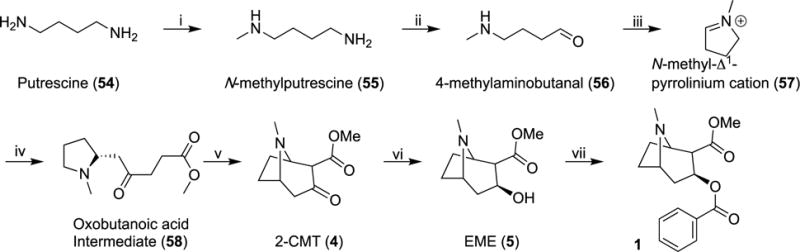
Biosynthesis of (-)-Cocaine. Conditions: (i) N-methyltransferase, (ii) oxidation, enzyme unknown, (iii) spontaneous cyclization, (iv) two acetyl groups are incorporated, enzyme unknown (v) Tropinone reductase, (vi) methylecgonone reductase, (vii) cocaine synthase, a BAHD acetyltransferase.
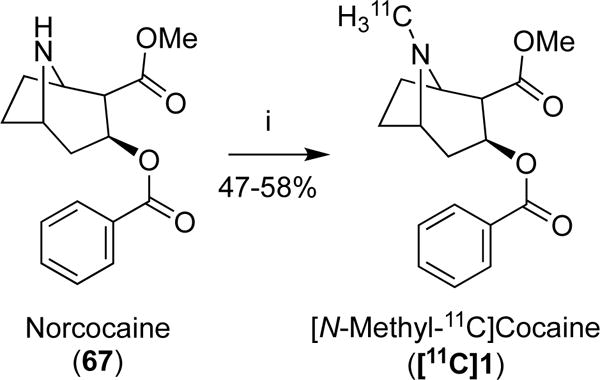
Radiosynthesis of [N-Methyl-C]Cocaine ([11C]1). Condition: (i) [11C]CH3I, 50 °C, 5 min.
References
-
- Crowley A. Cocaine. The International. 1917;11:291–294.
-
- Carroll FI, Lewin AH, Boja JW, K MJ. Cocaine receptor: biochemical characterization and structure-activity relationships of cocaine analogues at the dopamine transporter. J Med Chem. 1992;35:969–981. - PubMed
-
- Biondich AS, Joslin JD. Coca: High Altitude Remedy of the Ancient Incas. Wild Environ Med. 2015;26:567–571. - PubMed
-
- Mortimer W. Peru History of Coca “The Divine Plant” of the Incas. J. H. Vail & Company; New York: 1901.
-
- Carroll E. Coca: The plant and its use. Cocaine. 1977;77:35–45. - PubMed
Publication types
MeSH terms
Substances
Grants and funding
LinkOut - more resources
Full Text Sources
Other Literature Sources
