. 2018 Apr;50(4):510-514.
doi: 10.1038/s41588-018-0087-y. Epub 2018 Apr 9.

Highly parallel genome variant engineering with CRISPR-Cas9

Affiliations

Highly parallel genome variant engineering with CRISPR-Cas9

Meru J Sadhu et al. Nat Genet. 2018 Apr.

Abstract

Understanding the functional effects of DNA sequence variants is of critical importance for studies of basic biology, evolution, and medical genetics; however, measuring these effects in a high-throughput manner is a major challenge. One promising avenue is precise editing with the CRISPR-Cas9 system, which allows for generation of DNA double-strand breaks (DSBs) at genomic sites matching the targeting sequence of a guide RNA (gRNA). Recent studies have used CRISPR libraries to generate many frameshift mutations genome wide through faulty repair of CRISPR-directed breaks by nonhomologous end joining (NHEJ) 1 . Here, we developed a CRISPR-library-based approach for highly efficient and precise genome-wide variant engineering. We used our method to examine the functional consequences of premature-termination codons (PTCs) at different locations within all annotated essential genes in yeast. We found that most PTCs were highly deleterious unless they occurred close to the 3' end of the gene and did not affect an annotated protein domain. Unexpectedly, we discovered that some putatively essential genes are dispensable, whereas others have large dispensable regions. This approach can be used to profile the effects of large classes of variants in a high-throughput manner.


Conflict of interest statement

Competing Financial Interests Statement

The authors declare no competing financial interests.

Figures
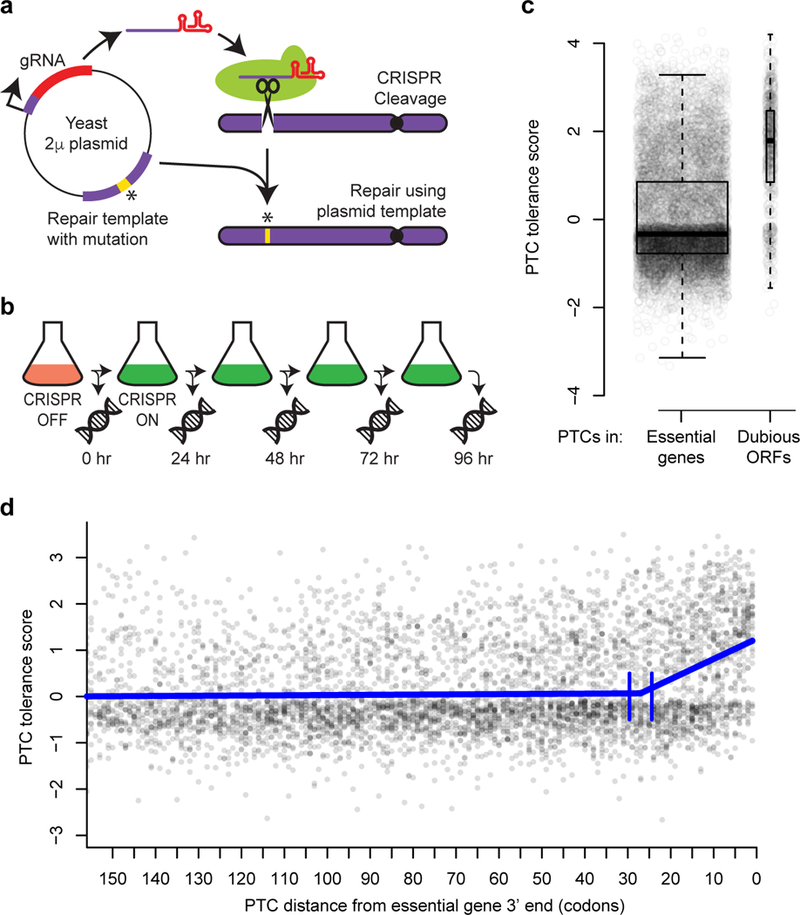
Figure 1:
Figure 1:
Measuring the effects of engineered PTCs in essential genes. a, Schematic of pairing of CRISPR gRNA and repair template on plasmids. b, Experimental design. Following Cas9 induction, DNA was extracted every 24 hours. At each time point, edit-directing plasmids were quantified by sequencing. c, Tolerance scores for n = 8,353 PTCs targeting essential genes and n = 694 PTCs targeting dubious ORFs are shown, with overlaid boxplots. The centerline of each box corresponds to the data’s median value; the top and bottom of the box span from the first quartile to the third quartile of the data; and the whiskers reach to either the data’s most extreme values or 1.5 times the interquartile range. P < 2 × 10⁻¹⁶, two-sided Wilcoxon rank sum test. d, Scatterplot of PTC tolerance scores versus distance in codons from the 3’ ends of essential genes. The thick blue line shows a segmented regression fit. Vertical blue lines indicate the 95% confidence interval for the boundary between the segments. The segmented regression was fit on PTC tolerance scores for n = 7,583 PTCs that were within 500 codons of the 3’ end of a gene.
Figure 2:
Figure 2:
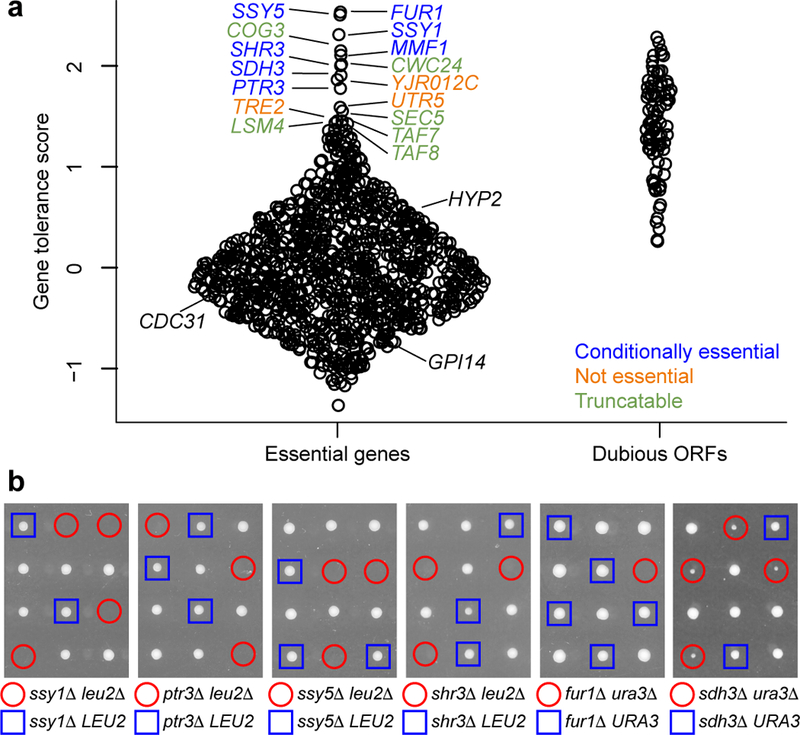
PTC tolerance of genes. a, Gene tolerance scores for essential genes and dubious ORFs, shown as a violin plot that displays the individual data points. b, Analysis of conditionally essential genes in yeast tetrads. Each vertical set of four colonies corresponds to the four haploid meiotic products from a diploid yeast strain. Each diploid was heterozygous for a deletion mutation of interest and for an interacting mutation. Haploid colonies carrying the deletion of interest are highlighted in red or blue based on their genotype at the interacting locus. Absence of a visible colony (first five panels) indicates a lethal interaction; small colonies (last panel) indicate an interaction causing poor growth. n = 10 tetrads were examined for the ssy1Δ, ptr3Δ, ssy5Δ, and fur1Δ interactions; n = 6 tetrads were examined for the shr3Δ interaction.
Figure 3:
Figure 3:
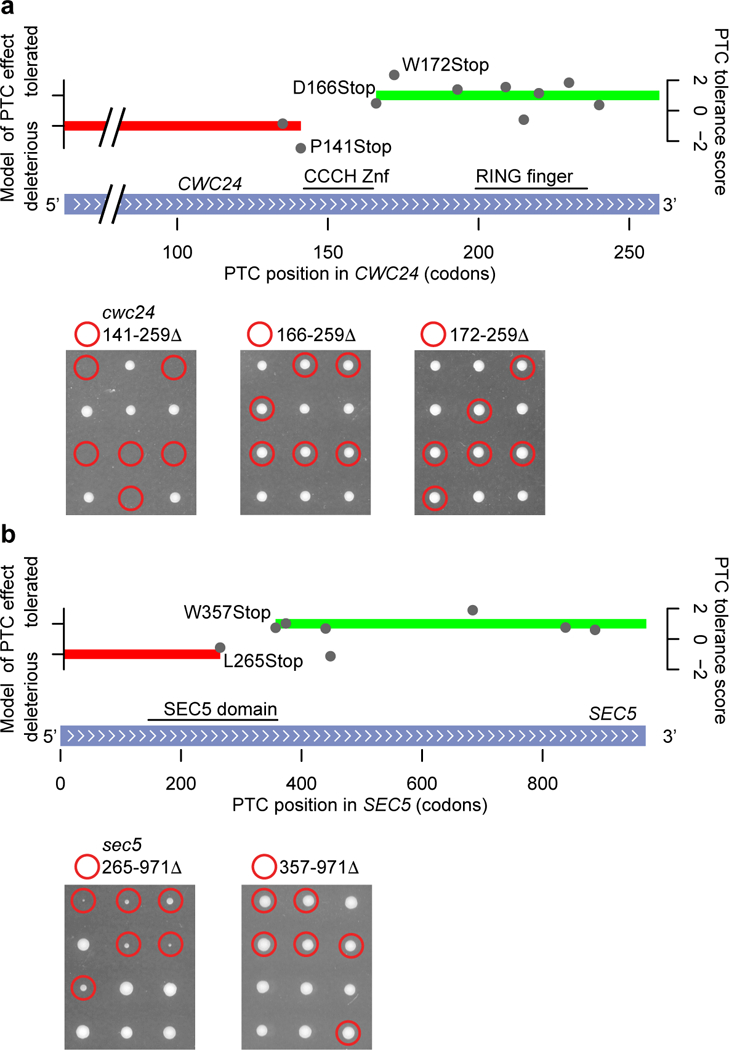
Selected truncatable essential genes. a, Tolerance scores for 10 PTCs in CWC24 are shown by gray circles; red and green bars indicate HMM calls of ‘deleterious’ and ‘tolerated’, respectively (top). The RING finger and CCCH Znf domains of Cwc24 are highlighted. Analysis of deleterious and tolerated truncations of CWC24 in yeast tetrads, displayed as in figure 2 (bottom). Deletions of the last 88 and 94 codons of CWC24 are tolerated (middle and right panels), while deletion of the last 119 codons is not (left panel). n = 10 tetrads were examined for each tested deletion. b, Tolerance scores for eight PTCs in SEC5 are shown by gray circles; red and green bars indicate HMM calls of ‘deleterious’ and ‘tolerated’, respectively (top). The Pfam-annotated “SEC5 domain” is highlighted. Analysis of deleterious and tolerated truncations of SEC5 in yeast tetrads (bottom). Deletion of the last 615 codons of SEC5 is tolerated (right panel), while deletion of the last 707 codons is not (left panel). n = 8 tetrads were examined for the deletion of 615 codons, and n = 12 tetrads were examined for the deletion of 707 codons.

References

    1. Shalem O, Sanjana NE & Zhang F High-throughput functional genomics using CRISPR–Cas9. Nat. Rev. Genet. 16, 299–311 (2015). - PMC - PubMed
    1. Dicarlo JE et al. Genome engineering in Saccharomyces cerevisiae using CRISPR-Cas systems. Nucleic Acids Res. 41, 4336–4343 (2013). - PMC - PubMed
    1. Landrum MJ et al. ClinVar: public archive of interpretations of clinically relevant variants. Nucleic Acids Res. 44, D862–D868 (2016). - PMC - PubMed
    1. Stenson PD et al. The Human Gene Mutation Database: building a comprehensive mutation repository for clinical and molecular genetics, diagnostic testing and personalized genomic medicine. Hum. Genet. 133, 1–9 (2014). - PMC - PubMed
    1. Teo S-H & Jackson SP Identification of Saccharomyces cerevisiae DNA ligase IV: involvement in DNA double-strand break repair. EMBO J. 16, 4788–4795 (1997). - PMC - PubMed

Methods-only References

    1. Bao Z et al. Homology-Integrated CRISPR-Cas (HI-CRISPR) System for One-Step Multigene Disruption in Saccharomyces cerevisiae. ACS Synth. Biol. (2014). doi: 10.1021/sb500255k - DOI - PubMed
    1. Gibson DG et al. Enzymatic assembly of DNA molecules up to several hundred kilobases. Nat. Methods 6, 343–5 (2009). - PubMed
    1. Becker DM & Lundblad V in Current protocols in molecular biology (ed. Ausubel FM) Unit13.7 (2001). doi: 10.1002/0471142727.mb1307s27 - DOI - PubMed
    1. Zhang J, Kobert K, Flouri T & Stamatakis A PEAR: a fast and accurate Illumina Paired-End reAd mergeR. Bioinformatics 30, 614–620 (2014). - PMC - PubMed
    1. Bolger AM, Lohse M & Usadel B Trimmomatic: A flexible trimmer for Illumina sequence data. Bioinformatics 30, 2114–2120 (2014). - PMC - PubMed

Publication types