Review
. 2018 Mar 26:9:286.
doi: 10.3389/fphys.2018.00286. eCollection 2018.

Continuous Change in Membrane and Membrane-Skeleton Organization During Development From Proerythroblast to Senescent Red Blood Cell

Affiliations
Review

Continuous Change in Membrane and Membrane-Skeleton Organization During Development From Proerythroblast to Senescent Red Blood Cell

Giampaolo Minetti et al. Front Physiol. .

Abstract

Within the context of erythropoiesis and the possibility of producing artificial red blood cells (RBCs) in vitro, a most critical step is the final differentiation of enucleated erythroblasts, or reticulocytes, to a fully mature biconcave discocyte, the RBC. Reviewed here is the current knowledge about this fundamental maturational process. By combining literature data with our own experimental evidence we propose that the early phase in the maturation of reticulocytes to RBCs is driven by a membrane raft-based mechanism for the sorting of disposable membrane proteins, mostly the no longer needed transferrin receptor (TfR), to the multivesicular endosome (MVE) as cargo of intraluminal vesicles that are subsequently exocytosed as exosomes, consistently with the seminal and original observation of Johnstone and collaborators of more than 30 years ago (Pan BT, Johnstone RM. Cell. 1983;33:967-978). According to a strikingly selective sorting process, the TfR becomes cargo destined to exocytosis while other molecules, including the most abundant RBC transmembrane protein, band 3, are completely retained in the cell membrane. It is also proposed that while this process could be operating in the early maturational steps in the bone marrow, additional mechanism(s) must be at play for the final removal of the excess reticulocyte membrane that is observed to occur in the circulation. This processing will most likely require the intervention of the spleen, whose function is also necessary for the continuous remodeling of the RBC membrane all along this cell's circulatory life.

Keywords: artificial red blood cells; autophagy; fluid phase endocytosis; membrane rafts; multivesicular endosome; red blood cell ageing; reticulocyte maturation; spleen.


Figures
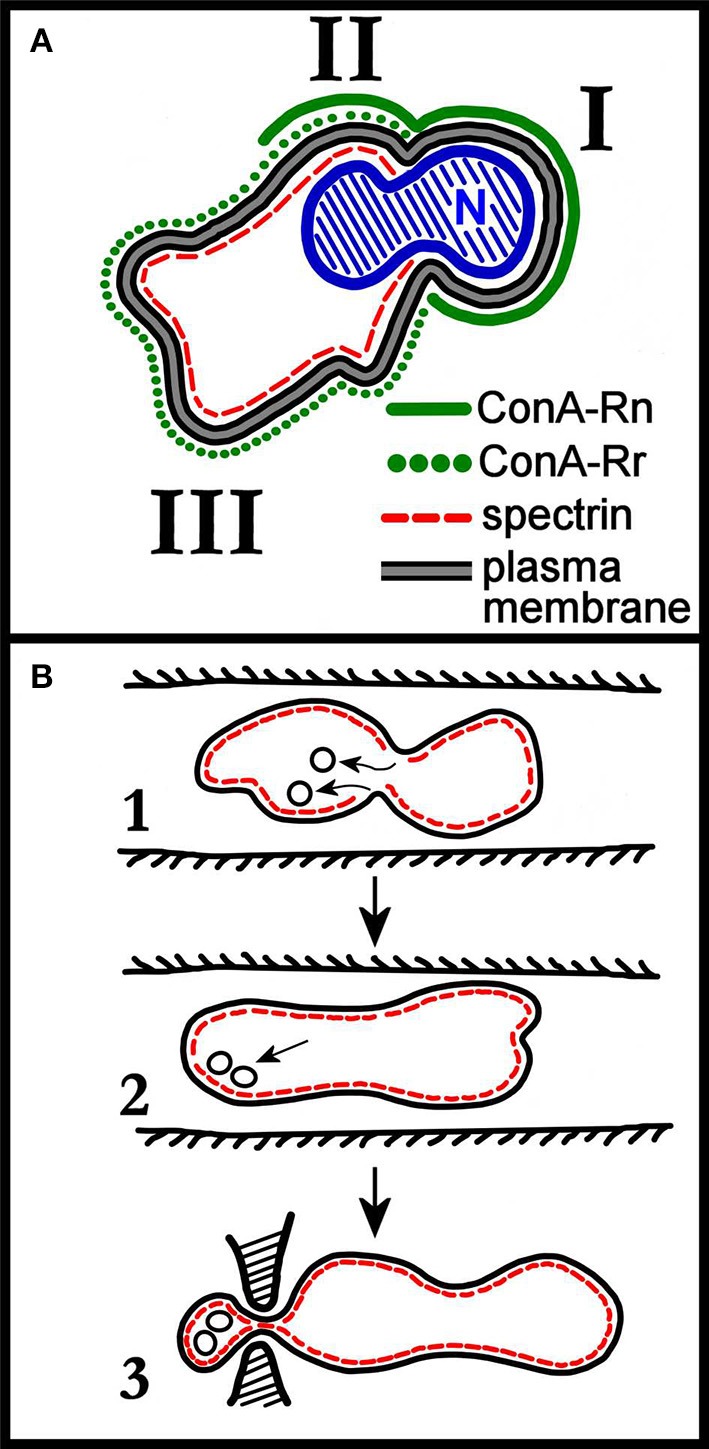
Figure 1
Figure 1
(A) Schematic distribution of membrane proteins in the enucleating mouse erythroblast. Roman numerals I, II, and III correspond to the domains identified by the authors of the work (Geiduschek and Singer, 1979). Domain III corresponds to the incipient reticulocyte. The nucleus (N), not completely extruded, shows the characteristic constriction which separates domain I from domain II. As discussed in the text of the cited work, two classes of ConA receptors (ConA is a lectin that binds to band3, so ConA receptors are band 3 molecules) are assumed to be present in the erythroblast membrane, with ConA-Rn (but not ConA-Rr) present in domain I; both ConA-Rn and ConA-Rr in the membrane of domain II; and ConA-Rr (but not ConA-Rn) in domain III. Most strikingly, spectrin is confined to domains II and III. Re-drawn from Geiduschek and Singer (1979). (B) Rudimentary early depiction of a model for the remodeling of the cell membrane during retic maturation to RBC in vivo. Panel 1 depicts the invaginations of spectrin-free domains of the retic membrane occurring in the circulation, and their subsequent endocytosis. In panel 2, the endocytosed vesicles are pictured as associating with the membrane either to fuse with it or to be exocytosed. In panel 3, the exocytosis of vesicles in a larger, spectrin-containing body is pictured as occurring by mediation of the spleen. Re-drawn from Zweig et al. (1981).
Figure 2
Figure 2
(A) A model extended from that proposed by Johnstone et al. (Johnstone, 2005). Reticulocytes mature through the release of TfR-containing exosomes from MVEs. Clathrin coated vesicles and lipid rafts have been added to the original scenario, to show that TfR is recruited at clathrin-coated pits and endocytosed in clathrin-coated vesicles (1) that do not contain membrane rafts nor band 3, GPC, or GPA. Parallel routes of endocytosis must exist that deliver membrane raft components to the MVB while, again, excluding band 3, GPC and GPA (2). After shedding of the clathrin coat (3) from clathrin-coated vesicles, all vesicles converge and fuse (4) in a single early endosome, which is soon converted into a MVB with the endovesiculation of ILVs that contain both membrane raft components and TfR (5). The membrane of the MVB becomes thus depleted of TfR and membrane raft constituents, including cholesterol and sphingolipids, The MVB eventually fuses with the plasma membrane and releases the ILVs that are now defined as exosomes. The bulky structure of the spectrin skeleton is depicted as separated from the scenario where this vesicular trafficking occurs. In (B) a different pathway is proposed whereby band 3, GPC, and GPA can reach the MVB membrane coming from, for instance, clathrin-coated vesicles, but then are not packaged into ILVs and exosomes because of their inability to partition to the raft phase. Band 3, GPC, and GPA are therefore returned to the plasma membrane with the fusion of the MVB with it. See text for additional details.

References

    1. Achilli C., Ciana A., Balduini C., Risso A., Minetti G. (2011). Application of gelatin zymography for evaluating low levels of contaminating neutrophils in red blood cell samples. Anal. Biochem. 409, 296–297. 10.1016/j.ab.2010.10.019 - DOI - PubMed
    1. Ahn J., Johnstone R. M. (1991). Synthesis of the transferrin receptor in peripheral sheep reticulocytes: evidence for incomplete oligosaccharide processing. Adv. Exp. Med. Biol. 307, 3–13. 10.1007/978-1-4684-5985-2_1 - DOI - PubMed
    1. An X., Mohandas N. (2011). Erythroblastic islands, terminal erythroid differentiation and reticulocyte maturation. Int. J. Hematol. 93, 139–143. 10.1007/s12185-011-0779-x - DOI - PubMed
    1. An X., Schulz V. P., Li J., Wu K., Liu J., Xue F., et al. (2014). Global transcriptome analyses of human and murine terminal erythroid differentiation. Blood 123, 3466–3477. 10.1182/blood-2014-01-548305 - DOI - PMC - PubMed
    1. Anstee D. J., Gampel A., Toye A. M. (2012). Ex-vivo generation of human red cells for transfusion. Curr. Opin. Hematol. 19, 163–169. 10.1097/MOH.0b013e328352240a - DOI - PubMed

LinkOut - more resources
