


Tissue-Resident Memory CD8+ T Cells: From Phenotype to Function
- PMID: 29632527
- PMCID: PMC5879098
- DOI: 10.3389/fimmu.2018.00515
Tissue-Resident Memory CD8+ T Cells: From Phenotype to Function
Abstract
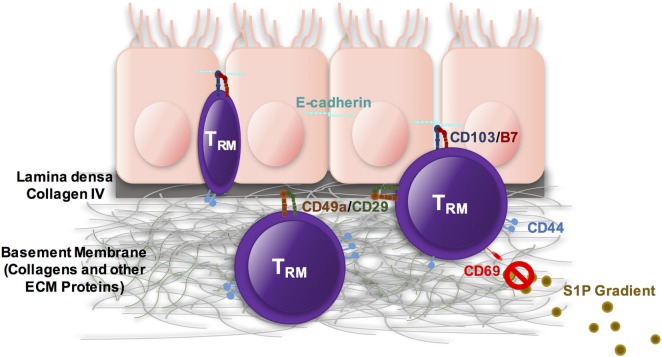
Tissue-resident memory CD8+ T cells are an important first line of defense from infection in peripheral non-lymphoid tissues, such as the mucosal tissues of the respiratory, digestive, and urogenital tracts. This memory T cell subset is established late during resolution of primary infection of those tissues, has a distinct genetic signature, and is often defined by the cell surface expression of CD69, CD103, CD49a, and CD44 in both mouse and human studies. The stimuli that program or imprint the unique gene expression and cell surface phenotypes on TRM are beginning to be defined, but much work remains to be done. It is not clear, for example, when and where the TRM precursors receive these signals, and there is evidence that supports imprinting in both the lymph node and the peripheral tissue sites. In most studies, expression of CD49a, CD103, and CD69 on T cells in the tissues appears relatively late in the response, suggesting there are precise environmental cues that are not present at the height of the acute response. CD49a and CD103 are not merely biomarkers of TRM, they confer substrate specificities for cell adhesion to collagen and E-cadherin, respectively. Yet, little attention has been paid to how expression affects the positioning of TRM in the peripheral tissues. CD103 and CD49a are not mutually exclusive, and not always co-expressed, although whether they can compensate for one another is unknown. In fact, they may define different subsets of TRM in certain tissues. For instance, while CD49a+CD8+ memory T cells can be found in almost all peripheral tissues, CD103 appears to be more restricted. In this review, we discuss the evidence for how these hallmarks of TRM affect positioning of T cells in peripheral sites, how CD49a and CD103 differ in expression and function, and why they are important for immune protection conferred by TRM in mucosal tissues such as the respiratory tract.
Keywords: T cells; cellular; immunity; infection; integrins; memory; tissue distribution.
Figures
References
Publication types
MeSH terms
Substances
Grants and funding
LinkOut - more resources
Full Text Sources
Other Literature Sources
Research Materials
Miscellaneous
