


A Phase 3, Double-Blind, Randomized, Placebo-Controlled Study of Vilazodone in Adolescents with Major Depressive Disorder
- PMID: 29633166
- PMCID: PMC6028869
- DOI: 10.1007/s40272-018-0290-4
A Phase 3, Double-Blind, Randomized, Placebo-Controlled Study of Vilazodone in Adolescents with Major Depressive Disorder
Abstract
Background: Major depressive disorder (MDD) is a serious illness in children and adolescents. Vilazodone is a selective serotonin reuptake inhibitor approved for MDD in adults. This study evaluated the efficacy, safety, and tolerability of vilazodone in adolescent patients, ages 12-17 years, with MDD (NCT01878292).
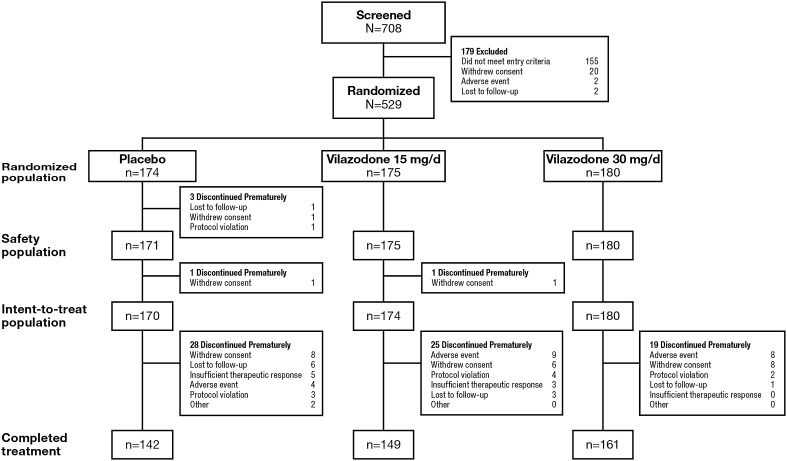
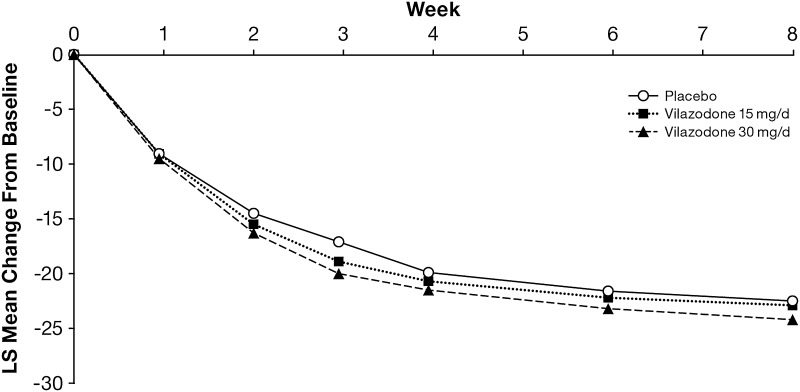
Methods: This double-blind, randomized, placebo-controlled, parallel-group, fixed-dose study was conducted at 56 study centers in the United States and was 10 weeks in duration (a 1-week screening period, an 8-week double-blind treatment period, and a 1-week double-blind down-taper period). Outpatients with an MDD diagnosis based on Diagnostic and Statistical Manual of Mental Disorders, Fourth Edition, Text Revision criteria were included in the study. Clinical inclusion criteria required a Children's Depression Rating Scale-Revised (CDRS-R) total score of ≥ 40 and Clinical Global Impressions-Severity (CGI-S) score of ≥ 4. Patients were randomized 1:1:1 to 8 weeks of double-blind treatment with placebo (n = 174), vilazodone 15 mg/day (n = 175), or vilazodone 30 mg/day (n = 180). The primary and secondary efficacy parameters were change from baseline to week 8 in CDRS-R total score and CGI-S score, respectively. Safety parameters included adverse events (AEs); clinical laboratory, vital sign, and electrocardiogram parameters; and the Columbia-Suicide Severity Rating Scale.
Results: Approximately 86% of patients completed double-blind treatment. There was no statistically significant difference between vilazodone 15 mg/day or 30 mg/day and placebo in change from baseline in CDRS-R score. Change in CGI-S score was not significant after adjustment for multiple comparisons. The most common treatment-emergent AEs were nausea, upper abdominal pain, vomiting, diarrhea, nasopharyngitis, headache, and dizziness. Reports of suicidal ideation (placebo, 33.3%; vilazodone 15 mg/day, 36.0%; vilazodone 30 mg/day, 31.1%) and suicidal behavior (placebo, 1.8%; vilazodone 15 mg/day, 1.1%; vilazodone 30 mg/day, 1.1%) were similar between treatment groups. There were no deaths in the study.
Conclusions: The efficacy of vilazodone for the treatment of MDD in adolescent patients could not be confirmed in this study. Vilazodone was generally safe and well tolerated, with treatment-emergent AEs similar to those in adult patients.
Clinical trial registration: NCT01878292.
Conflict of interest statement
Funding
The analyses and studies presented in this report were sponsored by Forest Research Institute, an Allergan affiliate. The sponsor was involved in conducting the analyses, interpreting the results, and the decision to submit this manuscript for publication.
Conflict of interest
R. Findling receives or has received research support, has acted as a consultant and/or served on a speaker’s bureau for Aevi, Akili, Alcobra, Amerex, American Academy of Child & Adolescent Psychiatry, American Psychiatric Press, Bracket, Epharma Solutions, Forest, Genentech, Guilford Press, Ironshore, Johns Hopkins University Press, KemPharm, Lundbeck, Merck, NIH, Neurim, Nuvelution, Otsuka, PCORI, Pfizer, Physicians Postgraduate Press, Purdue, Roche, Sage, Shire, Sunovion, Supernus Pharmaceuticals, Syneurx, Teva, Tris, TouchPoint, Validus, and WebMD. S. Durgam, C. Chen, R. Migliore, C. Prakash, and J. Edwards are full-time employees of Allergan.
Ethical approval
The study was approved by an institutional review board at each study center involved in the study (
Informed consent
Informed consent was obtained from all individual participants included in the study. Written permission was obtained from parents or legal guardians in accordance with appropriate local laws, where applicable.
Figures
References
Publication types
MeSH terms
Substances
Associated data
LinkOut - more resources
Full Text Sources
Other Literature Sources
Medical
