


Improved survival for extremity soft tissue sarcoma treated in high-volume facilities
- PMID: 29633281
- PMCID: PMC6322682
- DOI: 10.1002/jso.25052
Improved survival for extremity soft tissue sarcoma treated in high-volume facilities
Abstract
Background and objectives: The purpose of this investigation was to determine the effect of hospital volume on treatment decisions, treatment results, and overall patient survival in extremity soft tissue sarcoma.
Methods: The National Cancer Database was used to identify patients ≥18 years of age with non-metastatic soft tissue sarcoma of the extremity treated with surgery. Patients in high- and low-volume centers were matched by propensity score and placed into two equal comparative groups of 2437 patients each.
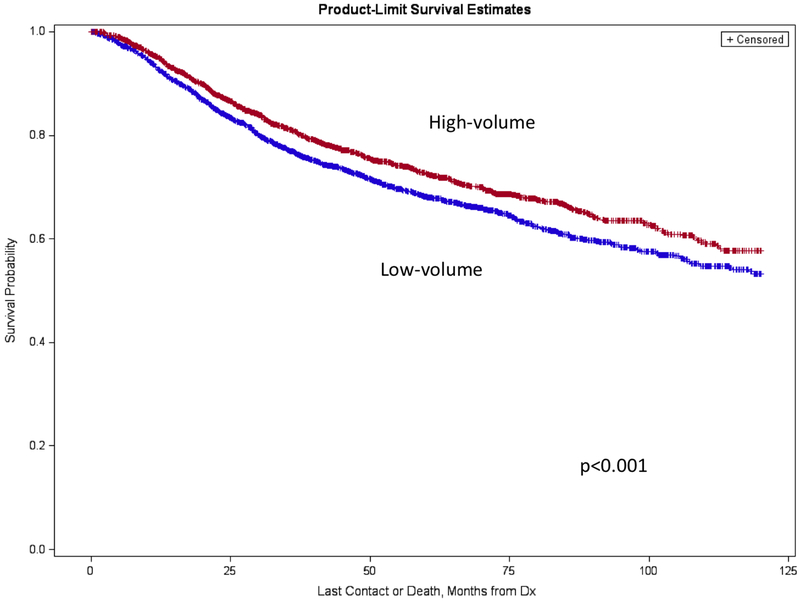
Results: Chemotherapy was used at a higher rate in high-volume centers (22% vs 17%, P < 0.001) and external beam radiation usage was similar (55% vs 52%, P = 0.108). There was a lower incidence of positive margins in high-volume centers (12% vs 17%, P < 0.001). There was no significant difference in the rates of limb salvage surgery or readmissions at high-volume hospitals compared to low-volume. In a multivariate Cox proportional hazards model, low-volume facilities demonstrated diminished overall survival at all time points (hazard ratio at 5 years = 1.24, 95%CI 1.10-1.39).
Conclusions: Treatment at high-volume hospitals was associated with fewer positive margins and increased overall survival at 2, 5, and 10 years. Continued efforts should focus on optimizing the balance between patient access to specialty care and experience of the treating center.
Keywords: National Cancer Database; hospital volume; sarcoma; survival; treatment.
© 2018 Wiley Periodicals, Inc.
Figures
References
-
- Hui JY: Epidemiology and Etiology of Sarcomas. Surg Clin North Am 2016;96:901–914. - PubMed
-
- Cancer Facts and Figures 2017. In “American Cancer Society.” 2017.
-
- Cheung MC, Koniaris LG, Perez EA, et al. : Impact of hospital volume on surgical outcome for head and neck cancer. Ann Surg Oncol 2009;16:1001–1009. - PubMed
-
- Begg CB, Cramer LD, Hoskins WJ, Brennan MF: Impact of hospital volume on operative mortality for major cancer surgery. JAMA 1998;280:1747–1751. - PubMed
-
- Bach PB, Cramer LD, Schrag D, et al. : The influence of hospital volume on survival after resection for lung cancer. N Engl J Med 2001;345:181–188. - PubMed
MeSH terms
Grants and funding
LinkOut - more resources
Full Text Sources
Other Literature Sources
Medical
