


How far are we from viral hepatitis elimination service coverage targets?
- PMID: 29633520
- PMCID: PMC5978704
- DOI: 10.1002/jia2.25050
How far are we from viral hepatitis elimination service coverage targets?
Abstract
Introduction: In 2016, the Global Health Sector Strategy (GHSS) on viral hepatitis called for elimination of viral hepatitis as a major public health threat by 2030 (i.e. 90% reduction in incidence and 65% in mortality). In 2017, WHO's first-ever Global Hepatitis Report presented the baseline values for each of the core indicators of the strategy. We review the challenges and opportunities that lie ahead in order to reach the 2030 service coverage targets.
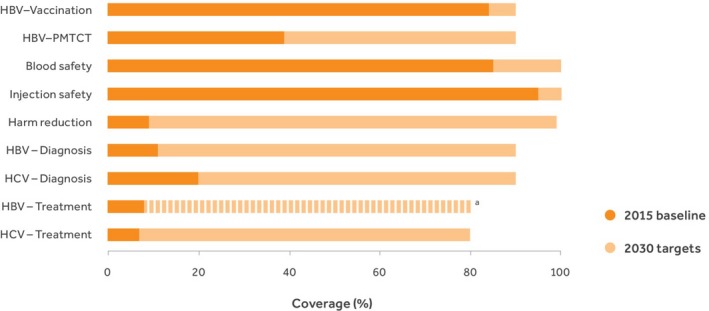
Discussion: Three-dose coverage of hepatitis B vaccine in infancy reached 84% in 2015 (2030 target: 90%); however, only 39% received the timely birth dose (2030 target: 90%). Blood safety (97% of blood units screened with quality assurance, 2030 target: 100%) and injection safety (5% unsafe injections, 2030 target: 0%) had made substantial progress while harm reduction fell short (27 syringe and needle sets distributed per person who injects drugs per year, 2030 target: 300). Worldwide, 9% and 20% of the HBV- and HCV-infected population respectively, were aware of their status (2030 targets: 90%). In the short term, to reach the 2020 target of diagnosing 50% of those infected, 107 million HBV infected persons and 15 million HCV infected persons should be urgently diagnosed. Overall, in 2015, less than 10% of known infected persons were on HBV treatment or had started HCV treatment (2030 targets: 80%).
Conclusions: The prevention component of elimination is on track with respect to hepatitis B vaccination, blood safety, and injection safety. However, coverage of the hepatitis B vaccine timely birth dose requires a substantial increase, particularly in sub-Saharan Africa, and harm reduction needs to be taken to scale as injecting drug use accounts for a third of mortality from HCV infection. A promising but limited start in hepatitis testing and treatment needs to be followed by immediate and sustained action so that we reach the service coverage targets required to achieve elimination by 2030. Treating persons coinfected with HIV and hepatitis viruses is particularly urgent and needs to be promoted in the context of the HIV response.
Keywords: elimination; evaluation; hepatitis B; hepatitis C; indicators; monitoring; public health; strategy; treatment access; viral hepatitis.
© 2018 World Health Organization; licensed by IAS.
Figures
References
-
- WHO . Global hepatitis report, 2017. [cited 2017 Jun 19]. Available from: http://www.who.int/hepatitis/publications/global-hepatitis-report2017/en/
-
- Resolution WHA58.13 . Blood safety: proposal to establish World Blood Donor Day. In: Fifty‐eighth World Health Assembly, Geneva, 16–25 May 2005. Resolutions and decisions, annexes. Geneva: World Health Organization; 2005 [cited 2017 Mar 10]. Available from: http://www.who.int/bloodsafety/WHA58_13-en.pdf?ua=1
-
- Global state of harm reduction. London: Harm Reduction International; 2016.
-
- WHO . Global Health Sector Strategy on Viral hepatitis, 2016–2021. Geneva: World Health Organization; 2016 [WHO/HIV/2016.06] [cited 2017 Mar 10]. Available from: http://apps.who.int/iris/bitstream/10665/246177/1/WHO-HIV-2016.06-eng.pd...
Publication types
MeSH terms
Substances
Grants and funding
LinkOut - more resources
Full Text Sources
Other Literature Sources
