. 2018 Apr;4(4):e000168.
doi: 10.1099/mgen.0.000168. Epub 2018 Apr 10.

Correlation between bacterial G+C content, genome size and the G+C content of associated plasmids and bacteriophages

Affiliations

Correlation between bacterial G+C content, genome size and the G+C content of associated plasmids and bacteriophages

Apostolos Almpanis et al. Microb Genom. 2018 Apr.

Abstract

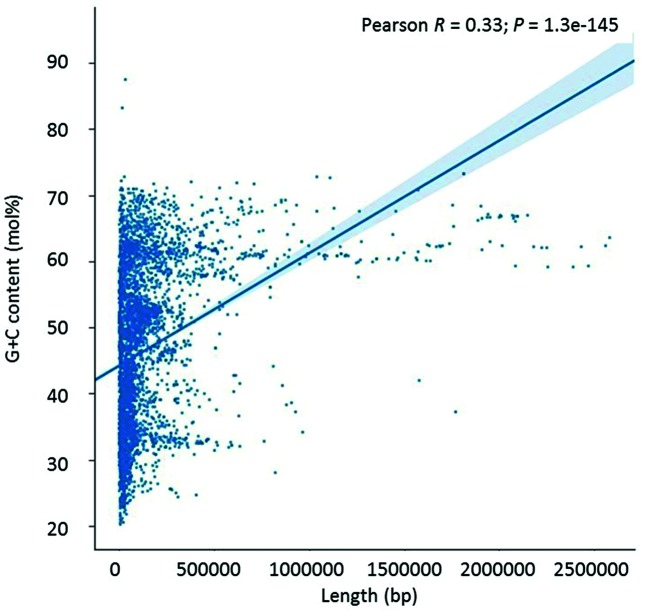
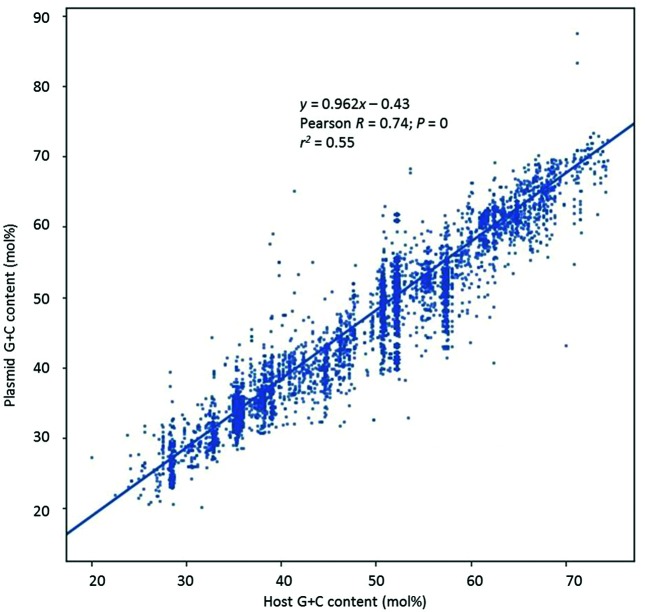
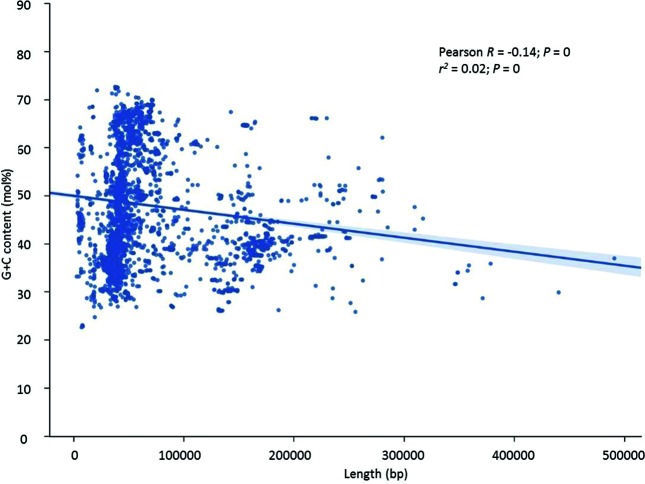
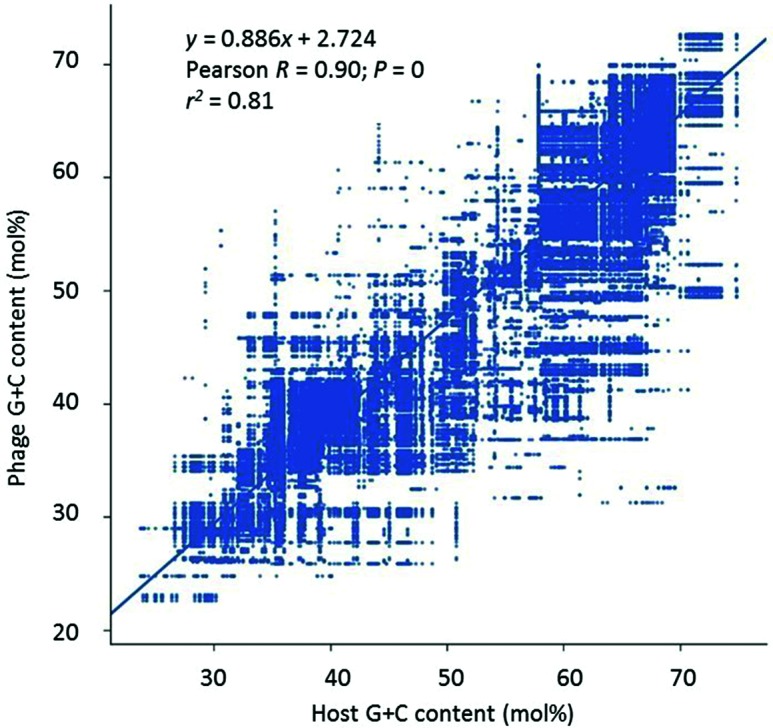
Based on complete bacterial genome sequence data, we demonstrate a correlation between bacterial chromosome length and the G+C content of the genome, with longer genomes having higher G+C contents. The correlation value decreases at shorter genome sizes, where there is a wider spread of G+C values. However, although significant (P<0.001), the correlation value (Pearson R=0.58) suggests that other factors also have a significant influence. A similar pattern was seen for plasmids; longer plasmids had higher G+C values, although the large number of shorter plasmids had a wide spread of G+C values. There was also a significant (P<0.0001) correlation between the G+C content of plasmids and the G+C content of their bacterial host. Conversely, the G+C content of bacteriophages tended to reduce with larger genome sizes, and although there was a correlation between host genome G+C content and that of the bacteriophage, it was not as strong as that seen between plasmids and their hosts.

Keywords: bacteria; genome G+C content; genome length; plasmids.


Conflict of interest statement

The authors declare that there are no conflicts of interest.

Figures
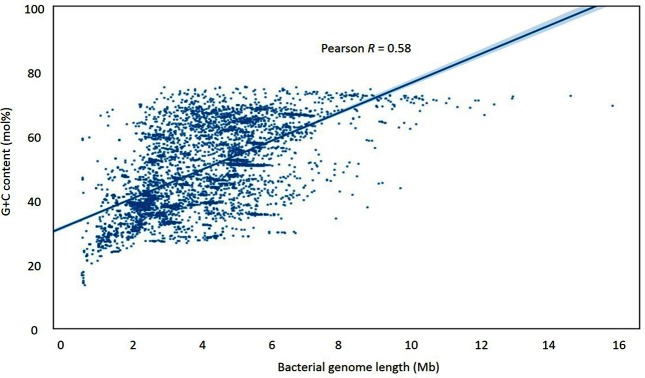
Fig. 1.
Fig. 1.
Scatterplot of G+C content versus sequence length for bacterial chromosomal sequences, showing an approximately triangular shape associated with their relation. Pearson’s R indicates that about 58 mol% of the G+C content variation can be explained by genome length, although there is also apparent heteroskedasticity. G+C content is plotted using values to the nearest percentage point.
Fig. 2.
Fig. 2.
Scatterplot of plasmid G+C content versus plasmid sequence length, showing an approximately rotated L-shape. G+C content is shown to the nearest mol% value.
Fig. 3.
Fig. 3.
Comparison of the G+C content of plasmids versus that of their host. G+C content is shown to the nearest mol% value.
Fig. 4.
Fig. 4.
Scatterplot of phage G+C content versus phage sequence length, showing that longer phages tend to have a lower G+C content. G+C content is shown to the nearest mol% value.
Fig. 5.
Fig. 5.
Comparison of the G+C content of phages versus that of their host. G+C content is shown to the nearest mol% value.

References

    1. Brocchieri L. The GC content of bacterial genomes. J Phylogen Evolution Biol. 2014;2:e108. doi: 10.4172/2329-9002.1000e108. - DOI
    1. Freese E. On the evolution of the base composition of DNA. J Theor Biol. 1962;3:82–101. doi: 10.1016/S0022-5193(62)80005-8. - DOI
    1. Sueoka N. On the genetic basis of variation and heterogeneity of DNA base composition. Proc Natl Acad Sci USA. 1962;48:582–592. doi: 10.1073/pnas.48.4.582. - DOI - PMC - PubMed
    1. Mitchell A, Graur D. Inferring the pattern of spontaneous mutation from the pattern of substitution in unitary pseudogenes of Mycobacterium leprae and a comparison of mutation patterns among distantly related organisms. J Mol Evol. 2005;61:795–803. doi: 10.1007/s00239-004-0235-0. - DOI - PubMed
    1. Sargentini NJ, Smith KC. DNA sequence analysis of γ-radiation (anoxic)-induced and spontaneous lacId mutations in Escherichia coli K-12. Mutat Res. 1994;309:147–163. doi: 10.1016/0027-5107(94)90088-4. - DOI - PubMed

LinkOut - more resources