Review
. 2019 Mar 10;30(8):1124-1143.
doi: 10.1089/ars.2018.7527. Epub 2018 May 2.

Molecular Mechanisms of Nitric Oxide in Cancer Progression, Signal Transduction, and Metabolism

Affiliations
Review

Molecular Mechanisms of Nitric Oxide in Cancer Progression, Signal Transduction, and Metabolism

Veena Somasundaram et al. Antioxid Redox Signal. .

Abstract

Significance: Cancer is a complex disease, which not only involves the tumor but its microenvironment comprising different immune cells as well. Nitric oxide (NO) plays specific roles within tumor cells and the microenvironment and determines the rate of cancer progression, therapy efficacy, and patient prognosis. Recent Advances: Key understanding of the processes leading to dysregulated NO flux within the tumor microenvironment over the past decade has provided better understanding of the dichotomous role of NO in cancer and its importance in shaping the immune landscape. It is becoming increasingly evident that nitric oxide synthase 2 (NOS2)-mediated NO/reactive nitrogen oxide species (RNS) are heavily involved in cancer progression and metastasis in different types of tumor. More recent studies have found that NO from NOS2+ macrophages is required for cancer immunotherapy to be effective.

Critical issues: NO/RNS, unlike other molecules, are unique in their ability to target a plethora of oncogenic pathways during cancer progression. In this review, we subcategorize the different levels of NO produced by cells and shed light on the context-dependent temporal effects on cancer signaling and metabolic shift in the tumor microenvironment.

Future directions: Understanding the source of NO and its spaciotemporal profile within the tumor microenvironment could help improve efficacy of cancer immunotherapies by improving tumor infiltration of immune cells for better tumor clearance.

Keywords: cancer; carcinogenesis; metabolism; nitric oxide; nitric oxide synthase; prognosis.


Figures
<b>FIG. 1.</b>
FIG. 1.
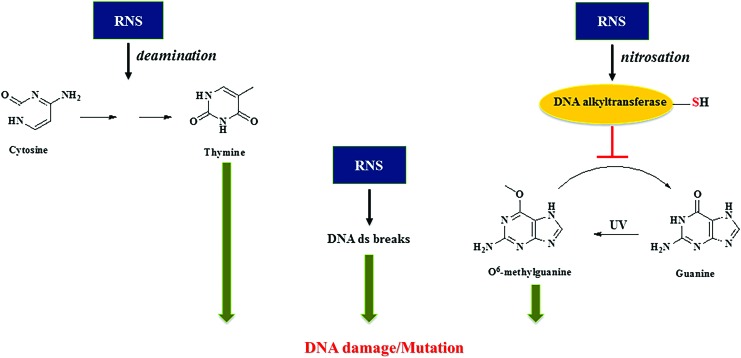
Genotoxicity of NO. High NO flux leads to formation of RNS that causes DNA damage and/or mutations that could eventually lead to carcinogenesis. Low NO flux modulates normal physiology and improves chemotherapeutic efficacy. NO, nitric oxide; RNS, reactive nitrogen species. Color images are available online.
<b>FIG. 2.</b>
FIG. 2.
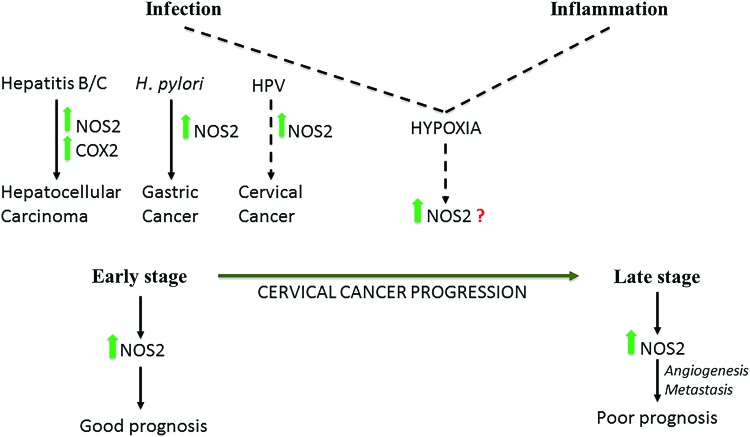
Carcinogenic induction downstream of infections is modulated by high NOS2 expression in hepatitis B/C and possibly HPV, and high NOS2 as well as high COX2 induction in hepatocellular carcinoma. NOS2 expression in early and late-stage cervical cancer has different prognostic effects. COX2, cyclooxygenase 2; H. pylori, Helicobacter pylori; HPV, human papillomavirus; NOS2, nitric oxide synthase 2. Color images are available online.
<b>FIG. 3.</b>
FIG. 3.
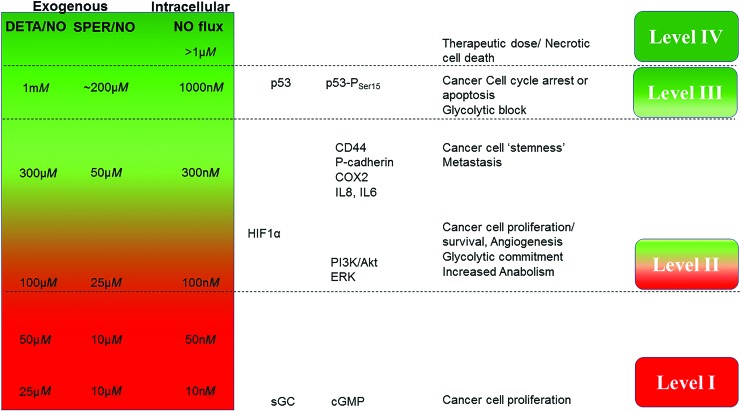
The effects of NO fluxes on cancer cell signaling. The different levels induce cancer cell proliferation, “stemness”/metastasis, and cell death in a concentration-dependent manner. DETA/NO and SPER/NO are spontaneous NO donors. The figure shows the approximate intracellular NO flux and approximate NO release from SPER/NO when compared with the indicated concentrations of DETA/NO. cGMP, cyclic guanosine monophosphate; ERK, extracellular signal-regulated kinase; HIF, hypoxia-inducible factor; IL, interleukin; PI3K/Akt, phosphoinositide 3-kinase/protein kinase B; sGC, soluble guanylyl cyclase. Color images are available online.
<b>FIG. 4.</b>
FIG. 4.
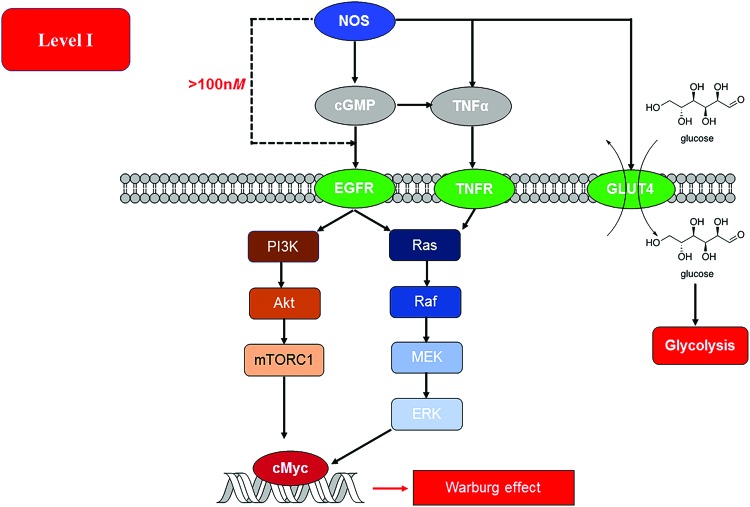
NO (<100 nM) from NOS triggers cGMP-dependent signaling events that culminate in an induction of the Warburg effect/aerobic glycolysis. At >100 nM NO flux, this signaling can bypass cGMP and independently induce similar signaling events through EGFR. EGFR, epidermal growth factor receptor; GLUT4, glucose transporter 4; TNF, tumor necrosis factor. Color images are available online.
<b>FIG. 5.</b>
FIG. 5.
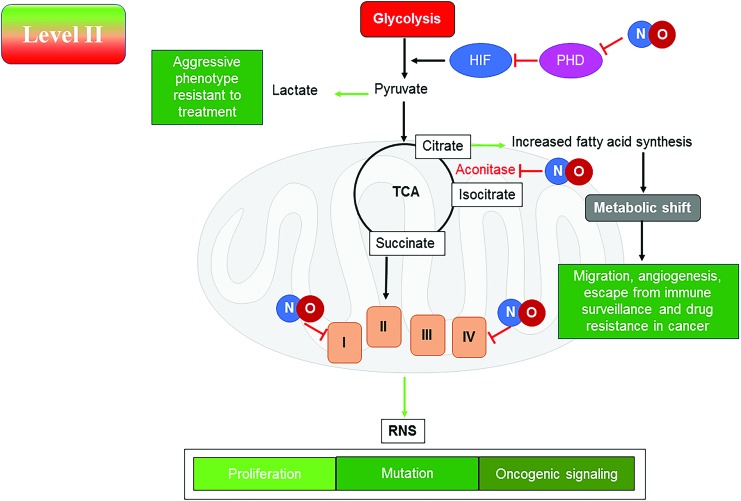
Level II NO flux induces metabolic changes that, in turn, activate cellular mechanisms that can lead to oncogenic signaling, proliferation, and increased incidence of mutations. PHD, prolyl hydroxylase; TCA, tricarboxylic acid. Color images are available online.
<b>FIG. 6.</b>
FIG. 6.
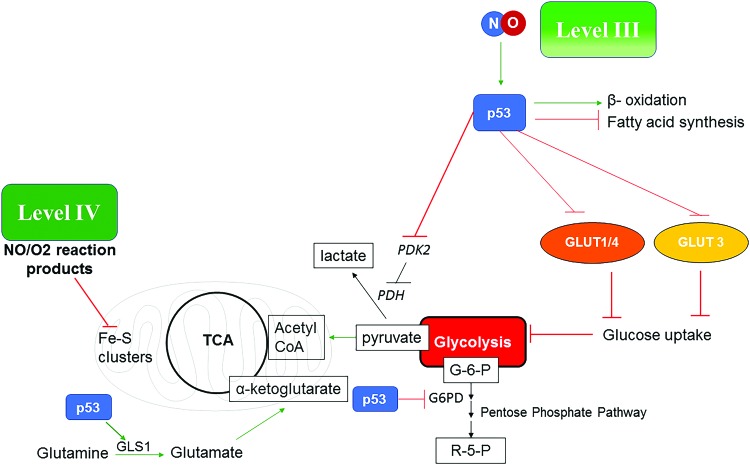
Level III NO fluxes induce more indirect effects on metabolism mostly through p53. represents proteins or pathways downregulated by p53 and represents proteins or pathways upregulated by p53. NO at level IV flux can lead to formation of NO/O2 reaction products that can directly bind the Fe–S clusters in the mitochondrial inner membrane proteins and cause prolonged mitochondrial depolarization. G-6-P, glucose-6- phosphate; GLS1, glutaminase1; PDH, pyruvate dehydrogenase; PDK2, pyruvate dehydrogenase kinase 2; R-5-P, ribose-5-phosphate. Color images are available online.

References

    1. This reference has been deleted.
    1. Abbas K, Breton J, Planson AG, Bouton C, Bignon J, Seguin C, Riquier S, Toledano MB, and Drapier JC. Nitric oxide activates an Nrf2/sulfiredoxin antioxidant pathway in macrophages. Free Radic Biol Med 51: 107–114, 2011 - PubMed
    1. Adachi T, Pimentel DR, Heibeck T, Hou X, Lee YJ, Jiang B, Ido Y, and Cohen RA. S-glutathiolation of Ras mediates redox-sensitive signaling by angiotensin II in vascular smooth muscle cells. J Biol Chem 279: 29857–29862, 2004 - PubMed
    1. Aldridge C, Razzak A, Babcock TA, Helton WS, and Espat NJ. Lipopolysaccharide-stimulated RAW 264.7 macrophage inducible nitric oxide synthase and nitric oxide production is decreased by an omega-3 fatty acid lipid emulsion. J Surg Res 149: 296–302, 2008 - PMC - PubMed
    1. Ambs S, Merriam WG, Bennett WP, Felley-Bosco E, Ogunfusika MO, Oser SM, Klein S, Shields PG, Billiar TR, and Harris CC. Frequent nitric oxide synthase-2 expression in human colon adenomas: implication for tumor angiogenesis and colon cancer progression. Cancer Res 58: 334–341, 1998 - PubMed

Publication types

LinkOut - more resources