


The National Network of State Perinatal Quality Collaboratives: A Growing Movement to Improve Maternal and Infant Health
- PMID: 29634446
- PMCID: PMC11009782
- DOI: 10.1089/jwh.2018.6941
The National Network of State Perinatal Quality Collaboratives: A Growing Movement to Improve Maternal and Infant Health
Abstract
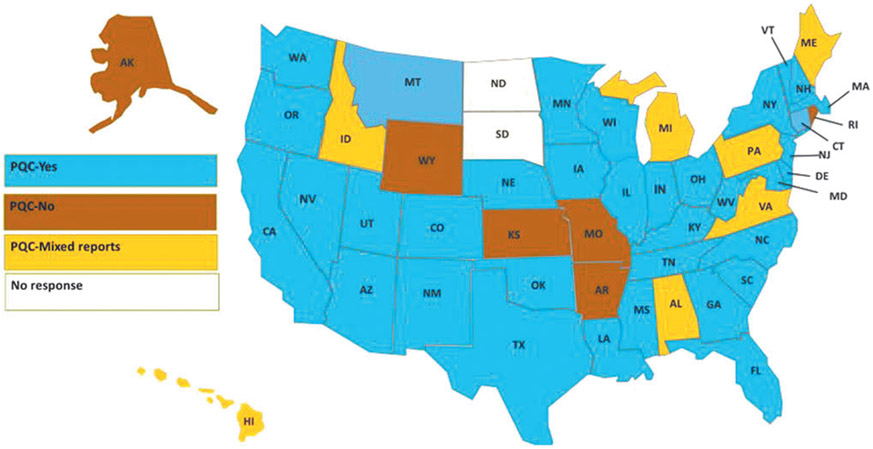
State Perinatal Quality Collaboratives (PQCs) are networks of multidisciplinary teams working to improve maternal and infant health outcomes. To address the shared needs across state PQCs and enable collaboration, Centers for Disease Control and Prevention (CDC), in partnership with March of Dimes and perinatal quality improvement experts from across the country, supported the development and launch of the National Network of Perinatal Quality Collaboratives (NNPQC). This process included assessing the status of PQCs in this country and identifying the needs and resources that would be most useful to support PQC development. National representatives from 48 states gathered for the first meeting of the NNPQC to share best practices for making measurable improvements in maternal and infant health. The number of state PQCs has grown considerably over the past decade, with an active PQC or a PQC in development in almost every state. However, PQCs have some common challenges that need to be addressed. After its successful launch, the NNPQC is positioned to ensure that every state PQC has access to key tools and resources that build capacity to actively improve maternal and infant health outcomes and healthcare quality.
Keywords: Perinatal Quality Collaboratives; obstetrics; quality improvement.
Conflict of interest statement
Author Disclosure Statement
The authors have no conflicts of interest to report. The findings and conclusions in this report are those of the authors and do not necessarily represent the official position of the CDC.
Figures
References
-
- Institute for Healthcare Improvement. The break-through series: IHI’s collaborative model for achieving break-through improvement. IHI Innovation Series white paper. 2003; Available at: www.ihi.org/knowledge/Pages/IHIWhitePapers/TheBreakthroughSeriesIHIsColl... Accessed September 29, 2017.
-
- Donovan EF, Lannon C, Bailit J, et al. A statewide initiative to reduce inappropriate scheduled births at 36(0/7)-38(6/7) weeks’ gestation. Am J Obstet Gynecol 2010;202: 243.e1–243.e8. - PubMed
-
- Kacica MA, Glantz JC, Xiong K, Shields EP, Cherouny PH. A statewide quality improvement initiative to reduce non-medically indicated scheduled deliveries. Matern Child Health J 2017;21:932–941. - PubMed
Publication types
MeSH terms
Grants and funding
LinkOut - more resources
Full Text Sources
Other Literature Sources
Miscellaneous
