. 2018 May 4;96(5):1778-1794.
doi: 10.1093/jas/sky109.

Microbiome profiling of commercial pigs from farrow to finish

Affiliations

Microbiome profiling of commercial pigs from farrow to finish

Brenda De Rodas et al. J Anim Sci. .

Abstract

Balanced bacterial communities within the gastrointestinal (GI) tract of animals are a key component of gut health, resulting in optimal performance and the prevention of disease. The purpose of this study was to characterize the commercial pig's baseline bacterial microbiome over time and across anatomical site. Several anatomical sites (duodenum/jejunum, ileum, cecum, and colon) were examined across multiple ages (days 0, 10, 21, 33, 62, 84, and market) for bacterial microbiome structure using 16S rRNA V4 region sequencing with Illumina MiSeq. General trends in the succession of the bacterial microbiome were observed over age, such as increasing populations of Clostridia and decreasing populations of Gammaproteobacteria (P < 0.05). However, apparent disruptions in the microbiome were also observed that did not follow these trends, specifically at sampling 24 h post-weaning where Lactobacillaceae were drastically reduced in relative abundance (P < 0.05). The introduction of solid feed between days 21 and 33 had the greatest overall impact on bacterial community structure as compared with the effects of age, changes in solid feed type, and pig movement. A core bacterial microbiome was identified across all anatomical sites consisting of the dominant operational taxonomic units (OTUs); samples were only differentiated based upon anatomical site when considering less abundant OTUs and differences in relative abundance. When considering mucosal vs. digesta samples from the cecum and ileum, several taxa were of significantly higher relative abundance in the mucosa (P < 0.05), including Anaerovibrio, Bacteroides, Desulfovibrio, Helicobacter, Oscillospira, Phascolarctobacterium, and Prevotella. Correlations between several genus-level taxa and pig weight were observed. Overall, this study provides an expanded view of the dynamic pig GI microbiome from farrow to finish.


Figures
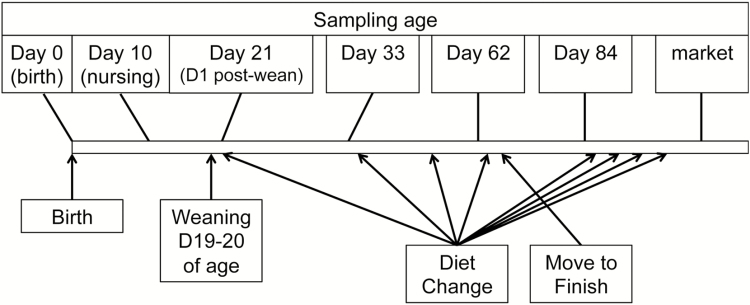
Figure 1.
Figure 1.
Sampling strategy for this study relative to events potentially shaping the pig microbiome.
Figure 2.
Figure 2.
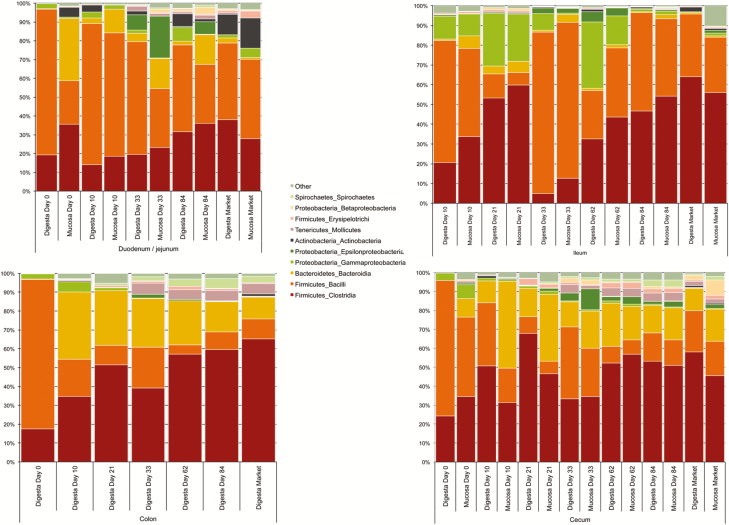
Taxonomic classification at the bacterial class level of samples averaged by age and tissue.
Figure 3.
Figure 3.
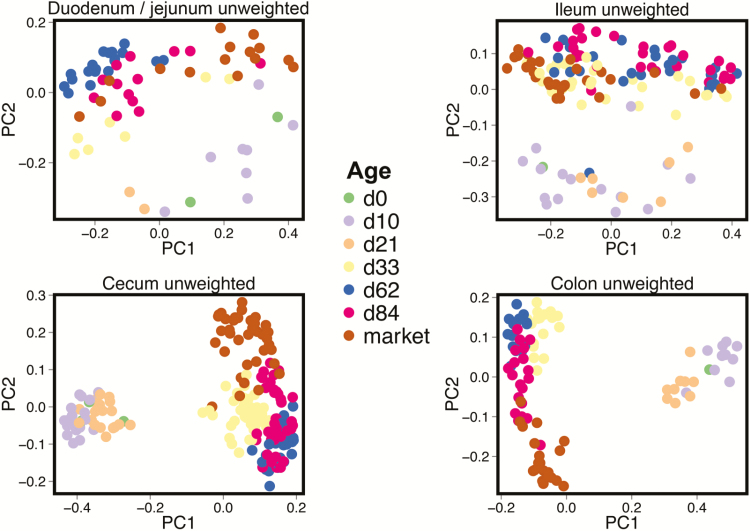
Principal coordinate analysis (PCoA) plots of samples grouped by tissue and colored by animal age using Unifrac unweighted distance matrices. The transition from sow’s milk to solid feed occurred between days 21 and 33 of age.
Figure 4.
Figure 4.
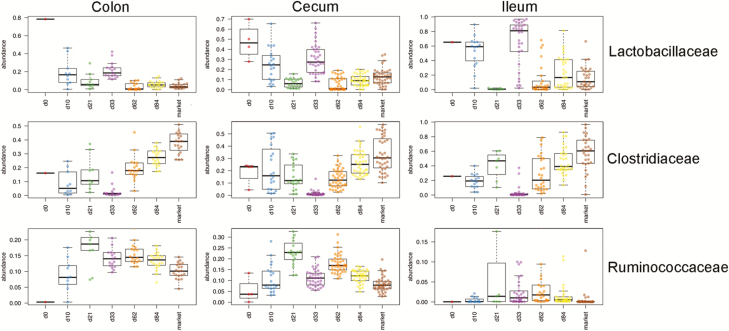
Changes in Lactobacillaceae (top), Clostridiaceae (middle), and Ruminococcaceae (bottom) across pig age in the colon (left), cecum (middle), and ileum (right).
Figure 5.
Figure 5.
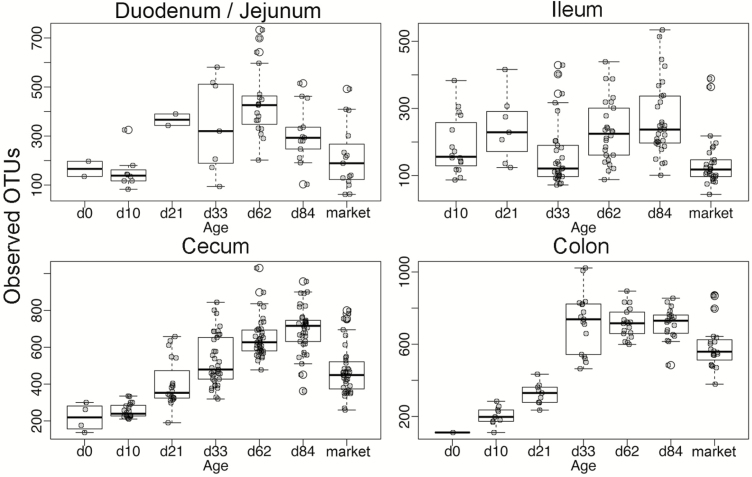
Alpha diversity assessments of samples grouped by tissue and divided by age using number of observed OTUs.
Figure 6.
Figure 6.
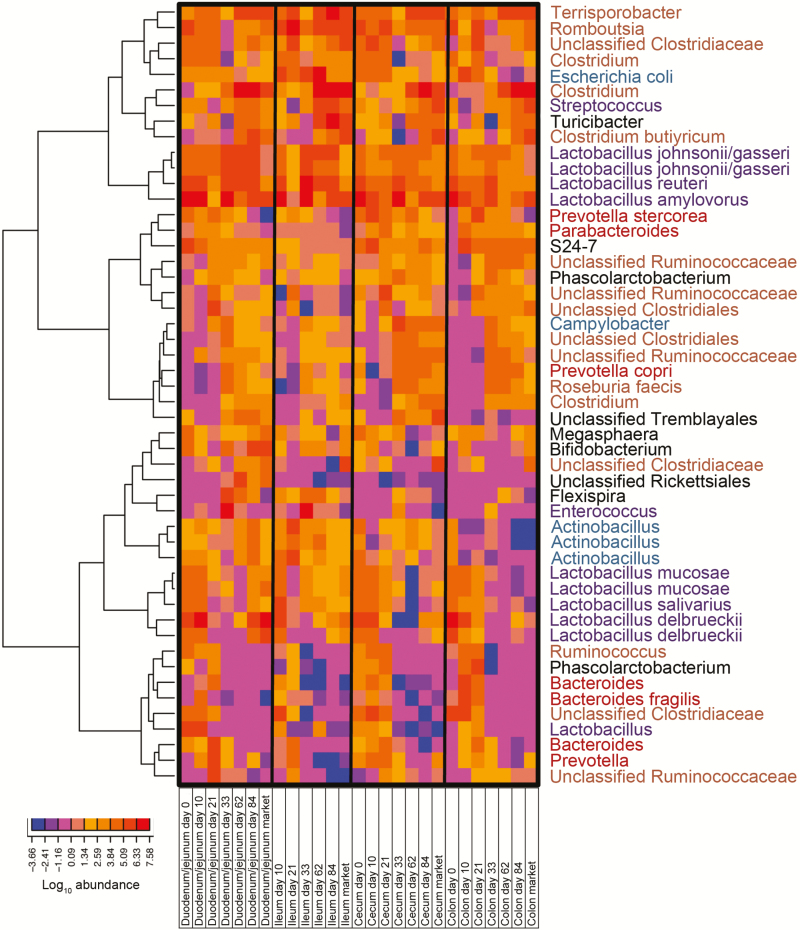
Heatmap depicting top 50 most abundant OTUs across all samples in this study. OTUs were classified using the Greengenes database, followed by nucleotide BLAST against reference genomes where appropriate. Samples are averaged by anatomical site (duodenum/jejunum, ileum, cecum, colon) and age (day 0, 10, 21, 33, 62, 84, and market). Values on the x-axis are given in log10 format and colored accordingly in the heatmap. Unsupervised hierarchical clustering was performed using the Ward method.
Figure 7.
Figure 7.
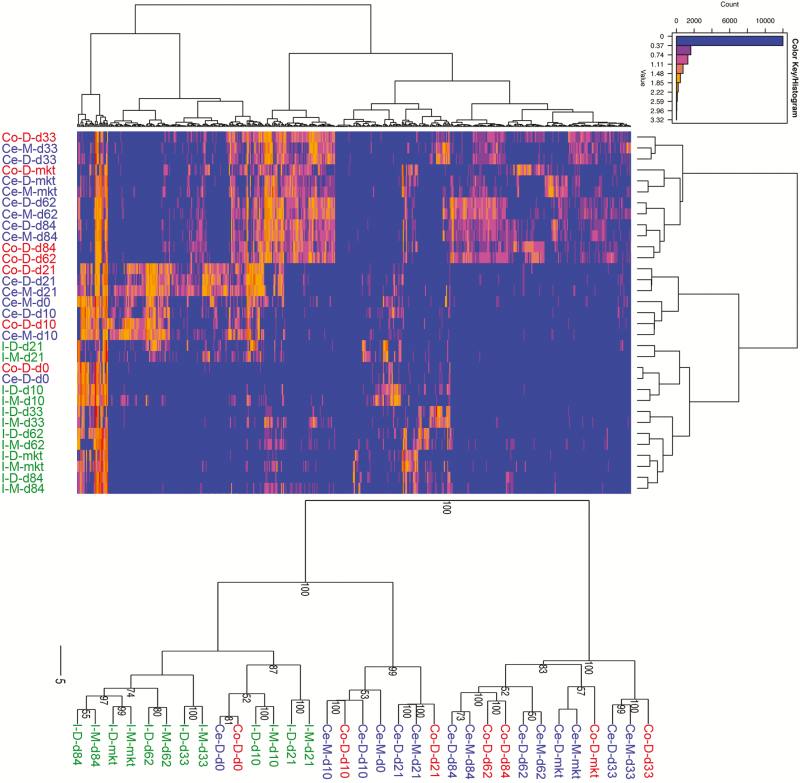
Top: Heatmap depicting top 500 most abundant OTUs across all samples in this study. Samples are averaged by anatomical site (I = ileum, Ce = cecum, Co = colon) and age (day 0, 10, 21, 33, 62, 84, and market). Values on the x-axis are given in log10 format and colored accordingly in the heatmap. Unsupervised hierarchical clustering was performed using the Ward method. Bottom: Unsupervised hierarchical clustering using the Ward method on the same data, with 100 bootstrap replicates.
Figure 8.
Figure 8.
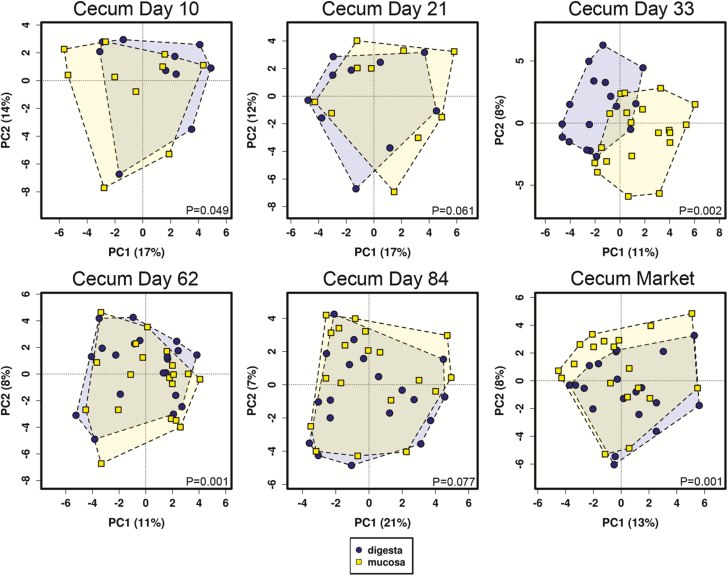
Principal component analysis of digesta versus mucosal samples in the pig cecum across age. P values using ANOSIM are depicted in lower right of each plot.
Figure 9.
Figure 9.
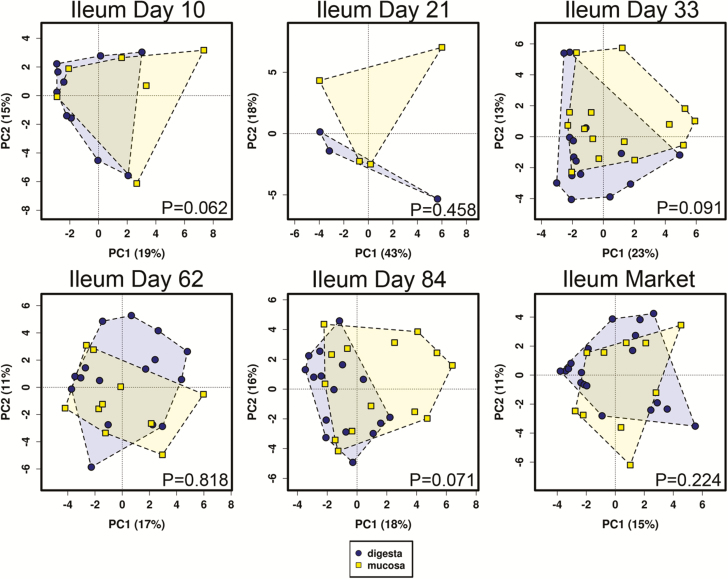
Principal component analysis of digesta versus mucosal samples in the pig ileum across age. P values using ANOSIM are depicted in lower right of each plot.

References

    1. Alain B Pajarillo E., Chae J. P., Balolong M. P., Bum Kim H., and Kang D. K.. 2014. Assessment of fecal bacterial diversity among healthy piglets during the weaning transition. J. Gen. Appl. Microbiol. 60:140–146. 10.2323/jgam.60.140 - DOI - PubMed
    1. Alter T., Gaull F., Kasimir S., Gürtler M., Mielke H., Linnebur M., and Fehlhaber K.. 2005. Prevalences and transmission routes of Campylobacter spp. Strains within multiple pig farms. Vet. Microbiol. 108:251–261. doi:10.1016/j.vetmic.2005.03.004 - PubMed
    1. Bian G., Ma S., Zhu Z., Su Y., Zoetendal E. G., Mackie R., Liu J., Mu C., Huang R., Smidt H., et al. 2016. Age, introduction of solid feed and weaning are more important determinants of gut bacterial succession in piglets than breed and nursing mother as revealed by a reciprocal cross-fostering model. Environ. Microbiol. 18:1566–1577. doi:10.1111/1462-2920.13272 - PubMed
    1. Caporaso J. G., Kuczynski J., Stombaugh J., Bittinger K., Bushman F. D., Costello E. K., Fierer N., Peña A. G., Goodrich J. K., Gordon J. I., et al. 2010. QIIME allows analysis of high-throughput community sequencing data. Nat. Methods 7:335–336. doi:10.1038/nmeth.f.303 - PMC - PubMed
    1. Caporaso J. G., Lauber C. L., Walters W. A., Berg-Lyons D., Huntley J., Fierer N., Owens S. M., Betley J., Fraser L., Bauer M., et al. 2012. Ultra-high-throughput microbial community analysis on the illumina hiseq and miseq platforms. Isme. J. 6:1621–1624. doi:10.1038/ismej.2012.8 - PMC - PubMed

Substances