Review
. 2018 May 1;27(R1):R72-R78.
doi: 10.1093/hmg/ddy116.

Pharmacogenomics and big genomic data: from lab to clinic and back again

Affiliations
Review

Pharmacogenomics and big genomic data: from lab to clinic and back again

Adam Lavertu et al. Hum Mol Genet. .

Abstract

The field of pharmacogenomics is an area of great potential for near-term human health impacts from the big genomic data revolution. Pharmacogenomics research momentum is building with numerous hypotheses currently being investigated through the integration of molecular profiles of different cell lines and large genomic data sets containing information on cellular and human responses to therapies. Additionally, the results of previous pharmacogenetic research efforts have been formulated into clinical guidelines that are beginning to impact how healthcare is conducted on the level of the individual patient. This trend will only continue with the recent release of new datasets containing linked genotype and electronic medical record data. This review discusses key resources available for pharmacogenomics and pharmacogenetics research and highlights recent work within the field.


Figures
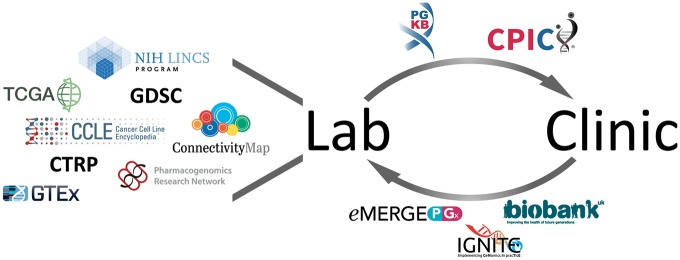
Figure 1.
Figure 1.
General overview of the various resources that contain or utilize genomic data within pharmacogenomics (PGx), with arrows representing information flow. Much initial PGx discovery is carried out in the laboratory setting, through cell-line resources such as ConnectivityMap (4), LINCS (5), Genomics of Drug Sensitivity in Cancer (GDSC) (6), the Cancer Cell Line Encyclopedia (CCLE) (7) and Cancer Therapeutics Response Portal (CTRP) (8). The Cancer Genome Atlas (TCGA) (9) and the Genotype-Tissue Expression (GTEx) project (10) were not created for PGx research but have been used by PGx investigators. Additionally, the PGRN has sought to bring U.S. PGx research efforts together and has conducted numerous PGx studies. Published PGx findings are reviewed and aggregated by PharmGKB (11) in the form of variant and clinical annotations. The Clinical Pharmacogenetics Implementation Consortium (CPIC) brings together clinical and basic research scientists to evaluate the evidence and develop consensus for dosing guidelines in the clinical setting. Recent efforts, such as eMERGE-PGx (12), Implementing Genomics in Practice (IGNITE) (13) and the UKB (14), have sought to generate genomic data for individuals within clinical electronic health record systems and make that data available to PGx researchers for further discovery.
Figure 2.
Figure 2.
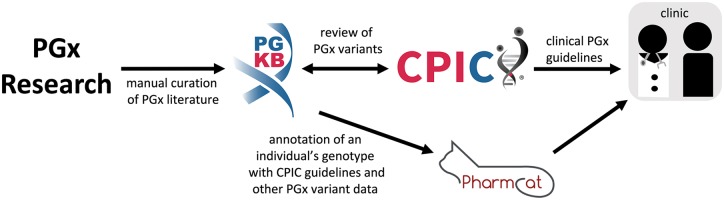
Relationships between different pharmacogenomics (PGx) variant resources. PharmGKB manually curates PGx literature and acts as a repository of information about PGx variants. CPIC uses PharmGKB literature and drug label annotations to help rank gene–drug pairs for genotype-based drug prescribing guideline development, and incorporates PhamGKB annotations with independent literature reviews to create the guideline recommendations, that can then be used to support clinical decision making. PharmCAT facilitates genome annotation with actionable PGx information, starting with CPIC guideline recommendations.

References

    1. Center for Disease Control National Center for Health Statistics: ‘Therapeutic drug use’. https://www.cdc.gov/nchs/fastats/drug-use-therapeutic.htm; January 18, 2018, date last accessed.
    1. Kantor E.D., Rehm C.D., Haas J.S., Chan A.T., Giovannucci E.L. (2015) Trends in prescription drug use among adults in the United States from 1999–2012. JAMA, 314, 1818–1831. - PMC - PubMed
    1. Meyer U.A. (2004) Pharmacogenetics – five decades of therapeutic lessons from genetic diversity. Nat. Rev. Genet., 5, 669. - PubMed
    1. Lamb J., Crawford E.D., Peck D., Modell J.W., Blat I.C., Wrobel M.J., Lerner J., Brunet J.-P., Subramanian A., Ross K.N. (2006) The Connectivity Map: using gene-expression signatures to connect small molecules, genes, and disease. Science, 313, 1929–1935. - PubMed
    1. Subramanian A., Narayan R., Corsello S.M., Peck D.D., Natoli T.E., Lu X., Gould J., Davis J.F., Tubelli A.A., Asiedu J.K. (2017) A next generation Connectivity Map: L1000 platform and the first 1,000,000 profiles. Cell, 171, 1437–1452.e17. - PMC - PubMed

Publication types