


Are there multiple ways to direct attention in working memory?
- PMID: 29635690
- PMCID: PMC6849770
- DOI: 10.1111/nyas.13634
Are there multiple ways to direct attention in working memory?
Abstract
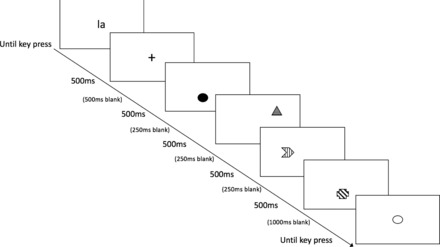
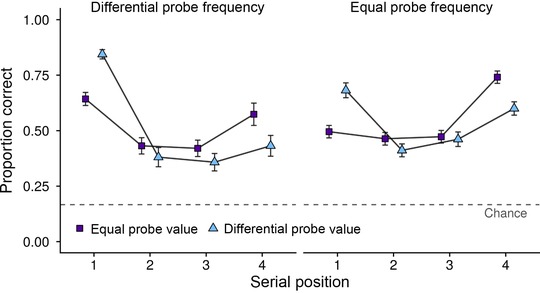
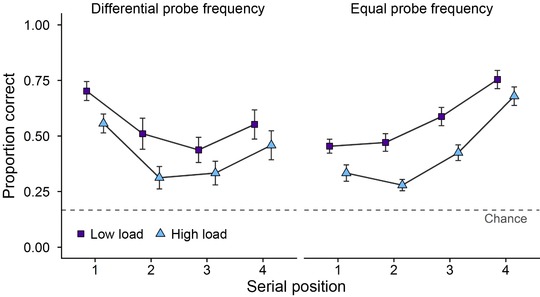
In visual working memory tasks, memory for an item is enhanced if participants are told that the item is relatively more valuable than others presented within the same trial. Experiment 1 explored whether these probe value boosts (termed prioritization effects in previous literature) are affected by probe frequency (i.e., how often the more valuable item is tested). Participants were presented with four colored shapes sequentially and asked to recall the color of one probed item following a delay. They were informed that the first item was more valuable (differential probe value) or as valuable as the other items (equal probe value), and that this item would be tested more frequently (differential probe frequency) or as frequently (equal probe frequency) as the other items. Probe value and probe frequency boosts were observed at the first position, though both were accompanied by costs to other items. Probe value and probe frequency boosts were additive, suggesting the manipulations yield independent effects. Further supporting this, experiment 2 revealed that probe frequency boosts are not reliant on executive resources, directly contrasting with previous findings regarding probe value. Taken together, these outcomes suggest there may be several ways in which attention can be directed in working memory.
Keywords: attention; focus of attention; prioritization; probe frequency; probe value; visual working memory.
© 2018 The Authors. Annals of the New York Academy of Sciences published by Wiley Periodicals, Inc. on behalf of New York Academy of Sciences.
Figures
References
-
- Cowan, N. 1988. Evolving conceptions of memory storage, selective attention, and their mutual constraints within the human information‐processing system. Psychol. Bull. 104: 163–191. - PubMed
-
- Gathercole, S.E. & Pickering S.J.. 2000. Working memory deficits in children with low achievements in the national curriculum at 7 years of age. Br. J. Educ. Psychol. 70: 177–194. - PubMed
-
- Woltz, D.J. 1988. An investigation of the role of working memory in procedural skill acquisition. J. Exp. Psychol. Gen. 117: 319–331.
-
- Oberauer, K. & Hein L.. 2012. Attention to information in working memory. Curr. Dir. Psychol. Sci. 21: 164–169.
-
- Souza, A.S. & Oberauer K.. 2016. In search of the focus of attention in working memory: 13 years of the retro‐cue effect. Atten. Percept. Psychophys. 78: 1839–1860. - PubMed
Publication types
MeSH terms
LinkOut - more resources
Full Text Sources
Other Literature Sources
