


Procalcitonin measurement to screen medullary thyroid carcinoma: A prospective evaluation in a series of 2705 patients with thyroid nodules
- PMID: 29635700
- PMCID: PMC6001787
- DOI: 10.1111/eci.12934
Procalcitonin measurement to screen medullary thyroid carcinoma: A prospective evaluation in a series of 2705 patients with thyroid nodules
Abstract
Background: To prospectively evaluate the role of procalcitonin (PCT) in screening of patients with thyroid nodules for medullary thyroid carcinoma (MTC).
Materials and methods: We measured PCT in 2705 patients with thyroid nodules referred to our centre between January 2011 and December 2017. Those with a positive PCT were operated after positive confirmatory tests such as fine-needle aspiration, measurement of calcitonin (CT) in serum and fine-needle aspiration washouts or CT stimulation testing. Patients with a negative PCT were operated based on the results of further diagnostics. The diagnostic performance of PCT was evaluated, and the best cut-off level was selected by ROC curve analysis.
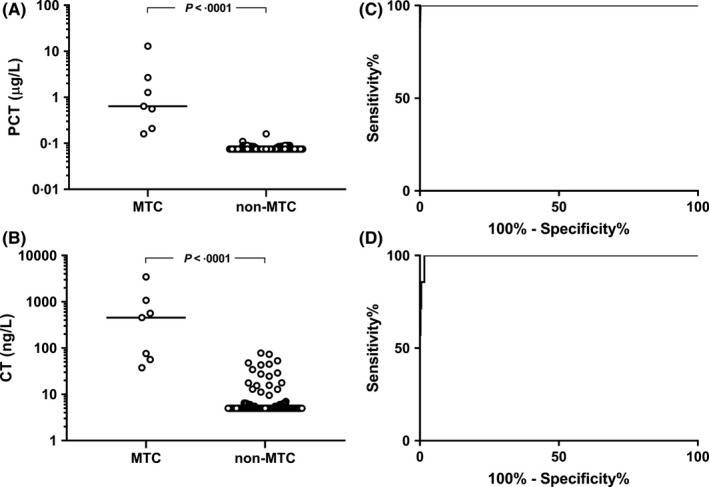
Results: Among 2705 patients, 9 with positive serum PCT (ie, above 0.1 μg/L) and 370 with negative PCT underwent thyroid surgery. MTC was histologically confirmed in all patients with positive PCT but not found in patients with negative PCT. Serum PCT levels were significantly higher in patients with MTC (median 0.64 μg/L, range 0.16-12.9 μg/L) than in those without (median 0.075 μg/L, range 0.075-0.16 μg/L; P < .0001). ROC curves were plotted to calculate the optimal PCT value separating patients with MTC from those without. The best cut-off was 0.155 μg/L with sensitivity, specificity, positive and negative predictive values as well as accuracy of 100%, 99.7%, 91.7%, 100% and 99.7%, respectively. Positive and negative likelihood ratios were 329 and zero, respectively.
Conclusions: Measurement of PCT is a sensitive and accurate method for detecting MTC in patients with thyroid nodules and can thus be a reliable alternative to CT measurement.
Keywords: calcitonin; medullary thyroid carcinoma; procalcitonin; thyroid nodules.
© 2018 The Authors. European Journal of Clinical Investigation published by John Wiley & Sons Ltd on behalf of Stichting European Society for Clinical Investigation Journal Foundation.
Figures
References
-
- Kebebew E, Ituarte PH, Siperstein AE, Duh QY, Clark OH. Medullary thyroid carcinoma: clinical characteristics, treatment, prognostic factors, and a comparison of staging systems. Cancer. 2000;88:1139‐1148. - PubMed
-
- Roman S, Lin R, Sosa JA. Prognosis of medullary thyroid carcinoma: demographic, clinical, and pathologic predictors of survival in 1252 cases. Cancer. 2006;107:2134‐2142. - PubMed
-
- Bae YJ, Schaab M, Kratzsch J. Calcitonin as biomarker for the medullary thyroid carcinoma. Recent Results Cancer Res. 2015;204:117‐137. - PubMed
-
- Trimboli P, Treglia G, Guidobaldi L, et al. Detection rate of FNA cytology in medullary thyroid carcinoma: a meta‐analysis. Clin Endocrinol. 2015;82:280‐285. - PubMed
MeSH terms
Substances
Supplementary concepts
LinkOut - more resources
Full Text Sources
Other Literature Sources
Medical
